Use the same chapter number in this manual and the website. Read here, open the matching lesson to watch its available video, and use the course activities to check your understanding.
Chapters 1–19 and 22–25 follow the retained video scripts, with greetings and production commentary adapted for reading. Chapters 20–21 use corrected reading editions that preserve valid source topics; they are not video transcripts. Chapters 26–32 combine the matching course concepts with additional instruction. Exact video-to-text alignment for those chapters is still being developed. Video availability is shown in each course lesson.
The chapter sequence is SmartiExamPrep’s teaching structure. For the official exam scope, consult FINRA’s SIE content outline.
SmartiExamPrep is an independent preparation resource and is not affiliated with or endorsed by FINRA. Passing the SIE alone does not authorize securities business; see FINRA’s SIE overview. Edition 2026-09-09.
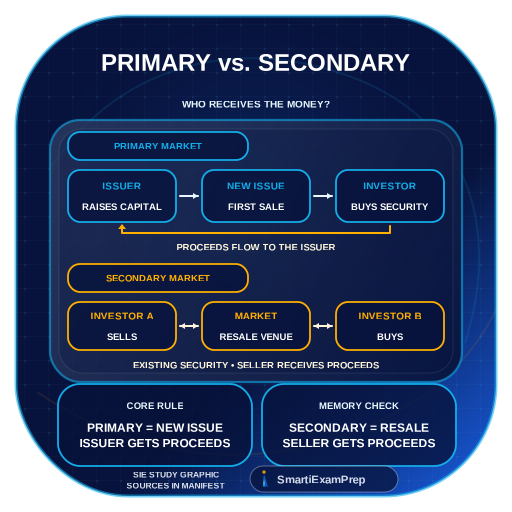
A security begins with an issuer and can later change hands among investors. The same company's shares can appear in both markets; the transaction determines the label.
Primary market
The issuer sells newly issued securities to raise capital. Money goes to the issuer, like buying a new product from its manufacturer.
Secondary market
An investor resells an existing security. Money goes to the selling investor, like buying a used car from its current owner.
The decision framework
Track whether the security is new or already issued, who receives the proceeds, and—when distinguishing third and fourth markets—the venue and intermediary.
A company can issue stock or bonds to finance operations, build a factory or expand. The first buyers may be individuals or institutions. The market label does not depend on whether the security is debt or equity.
IPO
A company's sale of newly created shares in its first public offering raises capital for the company.
Follow-on offering
An already-public company can sell additional new shares. That new issuance is still primary-market activity.
New bond issue
A corporation or government sells new debt and receives the proceeds. That is primary-market financing too.
Remember Read who is selling and receiving the proceeds; an offering's name alone is not enough.
After issuance, an investor can sell a security to another investor. The original issuer normally takes no part in that resale and receives no additional sale proceeds.
Liquidity
A resale market gives investors a way to turn a holding into cash. Liquidity does not guarantee a quick sale or a particular price.
Price discovery
Buyers and sellers establish trading prices. Their willingness to trade helps reveal what an existing security is worth in the market.
Many venues
Exchanges such as the NYSE and Nasdaq, electronic markets and OTC dealer markets can support secondary trading. Expected resale opportunities can also make new issues more attractive.
Remember A familiar exchange or ticker symbol does not make a transaction primary.
Public offerings generally require registration and disclosure unless an exemption applies. The two Acts below provide a useful starting point for distinguishing offering activity from ongoing trading.
Securities Act of 1933
Focus on offering disclosure, registration and new securities distributions. Registration does not mean the SEC endorses an investment.
Securities Exchange Act of 1934
This Act created the SEC and addresses ongoing markets, exchanges, broker-dealers and reporting.
Apply the distinction
A company selling new shares to fund a factory describes an offering. An investor buying another investor's shares describes secondary trading.
Remember These are broad associations, not a claim that either Act applies exclusively to one market.
The issuer is the entity whose stock or debt is being issued. It receives capital in a new issuance and has the obligations associated with that security.
Corporations
A corporation may issue common stock, preferred stock or debt.
Government issuers
The U.S. Treasury, states, cities, counties, public authorities and foreign governments can issue debt.
Other structures
Special-purpose entities and nonprofit organizations may issue securities when their legal structure permits. Identify whose equity it is or who has the bond obligation, even if another firm markets it.
Remember Distributing another entity's securities does not make the distributor the issuer.
An underwriter is typically a broker-dealer doing investment-banking work: helping with timing, structure, pricing and distribution. An underwriting agreement sets out the issuer's and underwriter's responsibilities.
Firm commitment
The underwriter buys the securities from the issuer for resale. It takes the risk that some of its commitment will remain unsold.
Best efforts
The dealer acts as selling agent and undertakes to try to sell the issue. It does not commit to buy the entire offering or guarantee that all securities will sell.
Remember Separate a commitment to buy from a commitment to try to sell.
Selling responsibility and underwriting risk differ
Several underwriters may form a syndicate to distribute a large offering and share its underwriting commitment. Additional dealers can help sell without joining that commitment.
Managing underwriter
The lead manager coordinates the offering, keeps the books and allocates securities among participants.
Syndicate members
Members share the underwriting commitment and its financial risk according to their agreement.
Selling-group members
These dealers broaden distribution and earn selling compensation. They do not assume the syndicate's responsibility for unsold securities merely by joining the selling group.
Remember Helping sell an issue is different from accepting underwriting inventory risk.
States, cities, counties, school districts and public authorities issue municipal bonds for public needs such as roads, schools and water systems.
Competitive sale
Underwriters submit bids for the issue.
Negotiated sale
The issuer selects an underwriter and negotiates the offering terms.
Advisor versus underwriter
A municipal advisor advises the municipal client in a fiduciary capacity. An underwriter has an arm's-length distribution role. Both may discuss financing, but their duties differ.
Remember Identify whether the firm is advising the municipality or distributing its bonds.
ABC Corporation sells newly created shares in an IPO and uses the proceeds to expand. Later, the first buyer sells those shares to another investor on an exchange.
First sale: primary
ABC issues new shares and receives the money.
Later resale: secondary
The shares already exist and the selling investor receives the money. ABC receives no new capital from this resale.
Remember The company name stays the same. The security's stage and recipient of the proceeds change.
Advice, distribution and ownership are different jobs
Investment adviser
A person or firm in the business of providing securities advice for compensation, subject to applicable definitions and exclusions. An asset-based advisory fee is a common example.
Investor
The buyer supplies capital and bears the investment's potential gain or loss.
Municipal advisor
A firm retained to advise a municipality about financing structure, timing or terms serves an advisory role. A dealer buying the bonds for resale serves an underwriting role.
Issuer
A corporation selling its own new shares remains the issuer, even if an underwriter temporarily holds shares for distribution.
Remember Classify the job being performed in the transaction, rather than relying only on the firm's name.
A federal government agency that administers federal securities laws, oversees securities markets and SROs, and reviews issuer disclosures. Its mission includes investor protection, fair and orderly markets, and capital formation.
Self-regulatory organization
A nongovernmental organization with rules for its members or market participants, under SEC oversight. Its authority has a defined scope.
Membership matters
Violations of applicable SRO rules can result in discipline, fines, suspension or expulsion. SRO status does not turn the organization into a federal agency.
Remember Identify the function and jurisdiction before choosing the regulator.
The Municipal Securities Rulemaking Board writes rules for municipal securities dealers and municipal advisors. It does not itself conduct their enforcement proceedings.
Examining authorities
FINRA and the SEC enforce municipal rules for securities firms; federal bank regulators oversee bank dealers. The SEC has primary enforcement authority over municipal advisors.
Exchange SROs
National securities exchanges, including Cboe exchanges, regulate members and activity within their markets under SEC oversight.
Remember MSRB writes municipal rules; other regulators examine and enforce.
Discipline and dispute resolution serve different purposes
Conduct rules
Address customer treatment, supervision, ethical conduct and communications.
Uniform practice
Standardizes operational matters such as confirmations, settlement and delivery between firms.
Procedure versus arbitration
The disciplinary process enforces rules. Arbitration resolves eligible private disputes when required or agreed to; mediation is a separate dispute-resolution process.
Remember A customer dispute and a regulatory disciplinary case are different proceedings.
Can govern securities, broker-dealers, agents, investment advisers and investment-adviser representatives within the state’s jurisdiction. The Uniform Securities Act is model legislation, not one law automatically enacted everywhere.
State administrator
Investigates potential violations, handles registrations and complaints, and can use the orders and sanctions authorized by that state’s law. Subpoenas, registration denial or revocation, and cease-and-desist orders are examples.
Limits and referrals
Powers and procedures vary by state. Administrators may refer matters for civil or criminal action; a federal exemption does not eliminate every state obligation.
Remember The state administrator enforces that jurisdiction’s law.
The North American Securities Administrators Association connects state, provincial and territorial securities regulators across the United States, Canada and Mexico.
Coordination
Its work includes model rules, information sharing, policy development and investor education.
Examinations
NASAA develops the Series 63, 65 and 66 exams; FINRA administers them. NASAA is not the agency bringing an individual state enforcement action.
Remember NASAA coordinates; the state administrator enforces.
Classify the security before choosing a filing method
Covered or exempt
Federal covered status generally preempts state registration. Exempt securities and exempt transactions avoid registration under the applicable exemption, but antifraud rules still apply.
Coordination
When required and available, state registration by coordination connects the state filing with a federal Securities Act registration.
Qualification
Registration by qualification is a state review method used when coordination is unavailable.
Remember Federal covered status is not itself a method of state registration.
In the traditional exam model, Fed security purchases add reserve balances and liquidity, supporting easier credit and downward pressure on short-term rates.
Sale
Fed security sales remove reserve balances and are associated with tighter credit and upward rate pressure.
Modern implementation
The FOMC sets policy direction. An ample-reserves framework and administered rates make actual implementation more detailed than the simplified exam model.
A Federal Reserve Bank charges eligible institutions for discount-window borrowing.
Federal funds rate
The market rate on overnight unsecured loans of reserve balances between depository institutions. The FOMC sets a target range.
Usual effect
A lower policy-rate posture is generally expansionary; a higher posture is generally restrictive. Neither rate is a bond’s coupon or a customer’s broker loan rate.
Remember Identify who lends to whom before naming the rate.
Distinguish reserve authority from current operating tools
Traditional relationship
A higher required reserve ratio restricts the portion of deposits available to support lending; a lower ratio relaxes that constraint in the simplified model.
Current qualification
Reserve-requirement ratios have been zero since March 26, 2020. The legal authority remains; reserve-ratio changes are not today’s routine operating tool.
Regulation T
The Federal Reserve Board regulates credit extended by brokers and dealers for securities transactions, including initial margin requirements.
Remember The Fed’s margin authority does not make it a broker-dealer SRO.
Keep liquidity support separate from asset protection
Lender of last resort
The Fed can provide liquidity to eligible institutions during financial stress to support credit and payment systems.
Different jobs
SEC/FINRA: securities conduct. Fed: monetary and banking conditions. FDIC: insured bank deposits. SIPC: missing customer property at a failed member brokerage.
Remember Match the problem—conduct, liquidity, deposits or custody—to the organization.
A SIPC-member brokerage fails financially and customer cash or securities are missing. SIPC can support liquidation or direct payment to restore customer property.
Limit
Up to $500,000 per customer capacity, including up to $250,000 for a cash claim. SIPC is a nonprofit membership corporation created under the 1970 Act, not a federal agency.
Not investment insurance
SIPC does not guarantee returns, restore ordinary market losses or protect a security simply because its price fell.
Remember Missing assets at a failed member brokerage—not a falling investment price.
Two individual accounts belonging to the same person at one brokerage are combined for the protection limit.
Separate capacity
An individual account, a joint account and qualifying retirement accounts can receive separate protection when the applicable capacity requirements are met.
Liquidation
A trustee collects and distributes customer property based on net-equity claims. SIPC advances cover shortfalls up to the limits; recoveries can include customer property beyond the advance limit. Remaining claims follow the applicable estate process.
Remember Multiple accounts do not automatically multiply SIPC protection.
A bank deposit that may qualify for FDIC insurance.
Money-market mutual fund
A security. SIPC may help restore it if it is missing at a failed member brokerage; its market value is not guaranteed.
Sweep and bank-sold products
A qualifying bank sweep can receive pass-through FDIC insurance. A bond or fund sold through a bank remains a security. Neither system covers ordinary security market losses.
Remember First identify the product, then the institution and the type of loss.
The Act addresses exchanges, broker-dealers, clearing agencies, SROs, public-company reporting and market conduct.
Worked example
An organization administers federal securities laws, reviews public-company filings and oversees securities SROs: those are SEC functions. FINRA, MSRB and exchange SROs have narrower roles.
Remember 1933: offering disclosure. 1934: ongoing markets and the SEC.
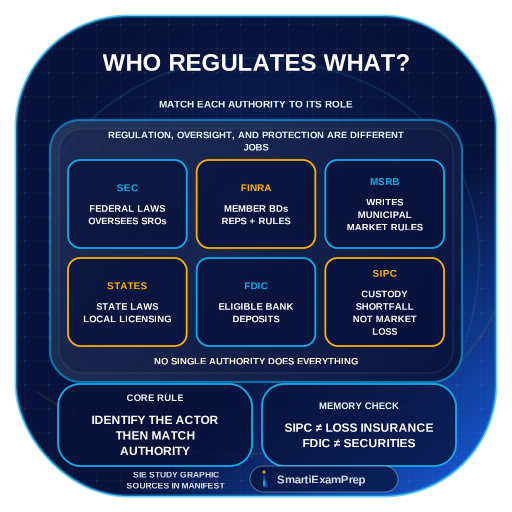
SEC: federal oversight. FINRA: member broker-dealer conduct. MSRB: municipal rule writing. Exchange SRO: its market. State administrator: state law. NASAA: coordination.
Money and protection
Fed: money, credit and Regulation T. FDIC: eligible bank deposits. SIPC: missing brokerage customer assets.
Apply the map
Use Explain to recall the roles, then Practice and Timed to apply them. Lesson 3 continues with market participants and trade infrastructure.
Remember Name the job, jurisdiction, product and type of loss before choosing the organization.
Investors and the firms receiving their orders form the relationship layer. Brokers, dealers, market makers and trading venues handle execution.
Custody and records
Custodians safeguard assets, trustees administer legal arrangements, and transfer agents maintain issuer ownership records.
Post-trade infrastructure
Clearing agencies, clearing corporations and depositories help determine obligations and complete settlement. One organization may perform several roles.
Remember Customer contact, trade execution, asset custody and settlement are different functions.
The introducing firm manages the customer relationship
Customer-facing work
May solicit business, gather account information, perform required customer reviews, accept orders and provide permitted recommendations or service.
Written allocation
The carrying agreement divides responsibilities. Outsourcing custody and settlement does not erase the introducing firm’s supervision or compliance duties.
Worked distinction
A smaller firm serves the customer while another firm carries the account and safeguards assets: introducing firm versus carrying firm.
Remember Read the agreement and the described duty; do not assume the customer-facing firm holds the assets.
Fully disclosed and omnibus describe account visibility
Fully disclosed
The carrying firm receives identifying information and carries each underlying customer’s account. Responsibilities include safeguarding funds and securities and providing account statements, subject to permitted arrangements.
Omnibus
The carrier sees an aggregate account in the introducing firm’s name; the introducing firm maintains the underlying customer identities and position detail.
Memory cue
Fully disclosed: individual customers visible to the carrier. Omnibus: customer detail behind one master account.
Remember Operational details depend on the agreement; the distinction is who sees each underlying customer.
One prime broker can consolidate many executing brokers
Execution choice
An institutional client, such as a hedge fund, can execute through several broker-dealers.
Centralized service
Trades may be given up to the prime broker for clearance, settlement, custody, reporting, financing and securities lending under the applicable agreements.
Recognize the role
Many executing brokers plus one central institutional account and service provider points to prime brokerage.
Remember Execution can be distributed while institutional account services are centralized.
Generally an individual investing for a personal account.
Institutional
An organization investing pooled assets, such as a bank, insurer, investment company, pension fund, endowment or investment fund.
Scope matters
Larger trade size or professional management does not eliminate every legal protection. Definitions and obligations depend on the applicable rule and facts.
Remember Investor identity is a starting point, not a blanket exemption from customer obligations.
Accredited investor is a private-offering eligibility category
Net worth route
Over $1 million individually or with a spouse or spousal equivalent, excluding the primary residence under the applicable calculation rules.
Income route
Over $200,000 individually or $300,000 with a spouse or spousal equivalent in each of the two prior years, with a reasonable expectation of the same level in the current year.
Other routes
Certain professional credentials, issuer-related roles and qualifying entities can also meet the definition. Accreditation does not guarantee an investment is safe or profitable.
Remember An individual can qualify; financial thresholds are not the only permitted route.
Provides a safe harbor for resales of eligible restricted securities to qualified institutional buyers.
Common institutional threshold
Many eligible entities must own and invest at least $100 million on a discretionary basis in securities of unaffiliated issuers.
Category-specific rules
Certain registered dealers use a $10 million threshold. Additional entity, calculation and bank requirements apply; the $100 million amount is not a universal definition for every institution.
Remember Accredited investor and QIB are different legal categories; QIB status is institutional.
Dealer capacity means trading for the firm’s account
Principal
The firm is the customer’s counterparty: it sells from its inventory or buys the customer’s securities into inventory.
Markup or markdown
Compensation may be reflected in a markup when selling to a customer or a markdown when buying from a customer, subject to fair-pricing and disclosure requirements.
Inventory risk
The firm bears price risk while it owns the security. The same broker-dealer can act as agent in one trade and principal in another.
Remember PDM: principal, dealer, markup or markdown.
Safeguarding assets differs from administering a trust
Custodian
Safeguards financial assets, keeps custody records and processes authorized movements and servicing.
Trustee
Administers property under a trust or indenture, with duties to beneficiaries or bondholders defined by that arrangement.
Bond indenture
An indenture trustee may represent bondholders, monitor specified covenants and perform assigned payment or enforcement functions. A bank can act in either role.
Remember Choose by the legal duty described, not by the institution’s name.
Clearing and depository systems complete post-trade work
Clearing corporation
Compares trades, calculates or nets obligations and manages the process toward settlement. A central counterparty becomes buyer to sellers and seller to buyers under its rules.
Depository
Holds or immobilizes securities and enables book-entry transfers rather than physically moving certificates for each transaction.
Examples
NSCC provides central counterparty clearing for many broker-to-broker equity trades; DTC provides depository and book-entry settlement services; OCC clears listed options.
Remember NSCC, DTC and OCC perform different infrastructure functions.
Lower pre-trade visibility does not remove regulation
Alternative trading systems
Some ATSs are called dark pools because their order books are not publicly displayed before execution. An ATS generally operates as a registered broker-dealer under Regulation ATS.
Potential benefit and tradeoff
Discreet execution may reduce information leakage or market impact for large orders; less displayed liquidity can make public price discovery harder.
Continuing obligations
Applicable best-execution, reporting, recordkeeping and antifraud rules continue. Completed off-exchange listed-stock trades are reported; no one share-count threshold defines every block trade.
Remember “Dark” concerns pre-trade transparency; it does not mean unregulated or permanently invisible.
Distinguish market-wide halts from individual-stock pauses
Levels 1 and 2
On a regular trading day, S&P 500 declines of 7% or 13% from the prior close trigger a 15-minute market-wide halt when reached before 3:25 p.m. Eastern. At or after 3:25 p.m., those levels do not trigger a halt.
Level 3
A 20% decline stops trading for the remainder of the day regardless of when it occurs.
Individual securities
Limit Up–Limit Down uses price bands and pauses for individual listed securities. A pause allows orderly processing and reopening; it does not guarantee recovery.
Remember 7%, 13%, 20%: distinguish the trigger, time and scope.
Keep capacity, custody and infrastructure separate
Customer and account
Introducing versus carrying; fully disclosed versus omnibus; multiple executing brokers versus one prime broker.
Investor and trade
Retail/institutional describe investor type. Accredited/QIB are separate legal categories. Broker/agent/commission and dealer/principal/markup identify transaction capacity.
Assets and completion
Market makers supply liquidity; custodians safeguard; trustees administer; transfer agents maintain issuer records; clearing and depository systems support settlement. Use Explain, then Practice and Timed. Lesson 4 connects these markets to the economy.
Remember Identify whose account, whose assets and which step in the process.
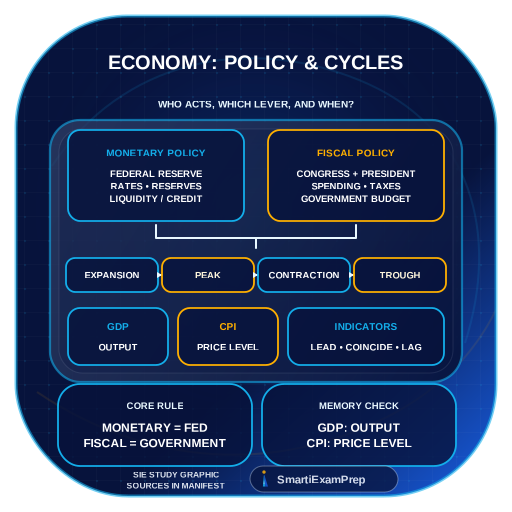
Production, employment, income and spending generally rise during expansion. The peak is the upper turning point.
Contraction and trough
Activity generally falls during contraction. The trough is the lower turning point before renewed expansion. A recession involves a significant, widespread decline evaluated across several indicators.
Use several signals
Real cycles vary in length and indicators can disagree near a turn. The goal is to classify conditions and likely policy responses, not predict tomorrow’s market.
Remember Expansion → peak → contraction → trough; use the direction of broad activity.
A balance sheet is a date; income and cash flow cover a period
Balance sheet
Assets = liabilities + owners’ equity. A snapshot used to assess financial position, liquidity and leverage.
Income statement
Revenue, expenses and profit or loss over a period; used to assess operating performance.
Cash-flow statement
Cash from operating, investing and financing activities over a period. Company statements describe the business; analysts can aggregate business activity to study the economy.
Remember Distinguish a stock of assets at a date from activity during a period.
Examples include building permits, manufacturers’ new orders, consumer expectations and financial-market measures. They can point toward a future turn without guaranteeing it.
Coincident: now
Payroll employment, industrial production, personal income less transfers, and manufacturing/trade sales help describe current activity.
Lagging: afterward
Examples include average unemployment duration, inventories relative to sales, certain interest-rate measures and consumer installment credit relative to income. They help confirm an established trend.
Remember Learn the timing relationship; a statistic’s classification depends on its definition and index.
Adjust nominal return for the change in purchasing power
Nominal return
Return measured in dollars before adjusting for inflation.
Quick estimate
Before taxes, approximate real return = nominal return − inflation. A 5% return with 5% inflation produces roughly 0% real return.
Exact calculation
Before taxes, real return = (1 + nominal return) ÷ (1 + inflation) − 1, using decimal rates. Inflation erodes fixed payments; borrowers may benefit when fixed debt is repaid with less valuable dollars.
Remember A positive nominal return can still mean no gain—or a loss—in purchasing power.
GDP follows location; GNP follows residents’ production
Gross domestic product
The value of final goods and services produced within the country during a period. Expenditure components are consumption + investment + government purchases + net exports.
Gross national product
Production by labor and property supplied by the nation’s residents, wherever located. Residency and supplied resources are more precise than a company’s brand or place of sale.
Nominal versus real GDP
Nominal GDP uses current prices. Real GDP adjusts for price changes to compare the volume of output over time.
Remember Domestic: where production occurs. National: whose labor and property supply it.
The Federal Reserve influences short-term rates, reserve balances and financial conditions. Its system includes the Board of Governors and 12 Reserve Banks; the FOMC sets the monetary-policy stance.
Fiscal policy
Congress and the President influence demand through federal taxation and government spending, often through legislation and budgets.
Fed mandate
Commonly summarized as maximum employment and stable prices. The Fed is accountable to Congress with operational independence in monetary decisions.
Remember Fed rates and liquidity: monetary. Taxes and government spending: fiscal.
Connect security purchases and sales to financial conditions
Purchases
In the traditional exam model, Fed purchases add reserve balances and liquidity, supporting easier credit and downward pressure on short-term rates.
Sales
Fed sales remove reserve balances and are associated with tighter conditions and upward rate pressure.
Current framework
Ample reserves and administered rates also shape implementation. A simple money-multiplier story is not a complete description of today’s policy tools.
Remember Preserve the usual direction without treating the effect as guaranteed.
Distinguish central-bank borrowing from overnight interbank lending
Discount rate
Charged by a Reserve Bank for eligible discount-window loans.
Federal funds rate
Rate on overnight unsecured reserve-balance loans between depository institutions. The FOMC sets a target range and implements policy to influence market rates.
Policy direction
Lower-rate posture is generally expansionary; higher-rate posture is generally restrictive. The Fed does not directly quote every private loan rate.
Remember Name the lender and borrower, then identify the rate.
Separate the historical reserve-ratio model from IORB
Traditional reserve ratio
A higher ratio constrains the portion of deposits available to support lending; a lower ratio relaxes that constraint in the simplified model.
Current qualification
Reserve-requirement ratios have been zero since March 26, 2020. The Fed retains legal authority, but ratio changes are not a routine current policy tool.
Interest on reserve balances
IORB helps influence overnight rates: banks compare lending opportunities with the return available on balances at the Fed.
Remember Keep legal authority, the exam model and the current operating framework distinct.
Classify expansionary and contractionary monetary policy
Easy money
Aims to support spending and employment through more accommodative financial conditions, lower policy rates and, in the traditional model, security purchases.
Tight money
Aims to restrain demand and inflation through higher policy rates, tighter credit and, in the traditional model, security sales.
Transmission
Borrowers, banks, expectations and global conditions affect the result. Policy direction is not a guaranteed outcome.
Remember Identify the tool and its usual direction before tracing the economic effect.
Emphasizes aggregate demand and a role for active fiscal policy when private demand is weak.
Monetarist
Emphasizes money supply and its longer-run connection to the price level, including stable monetary control.
Supply-side
Emphasizes incentives to work, invest and produce, including the effects of tax rates, regulation and productivity. These are broad schools, not complete positions shared by every economist.
Remember Demand management; money and inflation; production incentives.
Translate currency changes into import and export prices
Stronger domestic currency
Other things equal, foreign goods become cheaper for domestic buyers, while domestic goods become more expensive for foreign buyers. Imports may benefit and exports may face pressure.
Weaker domestic currency
Imports become more expensive and exports cheaper for foreign buyers. More expensive imports can contribute to inflation.
Tendencies
Demand, contracts, hedging and supply chains can change the result. Currency direction alone is not a guarantee of a trade outcome.
Remember Stronger currency buys more abroad; weaker currency lowers foreign buyers’ cost of domestic goods.
Provides liquidity to eligible institutions during stress and supervises certain banking organizations.
Payments and Treasury
Supports payment-system safety, processes payments and acts as fiscal agent for the U.S. Treasury.
Regulation T
Governs broker-dealer credit for securities transactions, including initial margin. Securities-market conduct oversight remains with the SEC and applicable regulators/SROs.
Remember The Fed’s money, banking and margin roles differ from FINRA’s member-conduct role.
Keep timing, policy and currency direction together
Measure the economy
Cycles describe activity. Leading/coincident/lagging describe timing. CPI tracks consumer prices; real return adjusts for inflation. GDP follows domestic production; GNP follows residents’ production.
Classify policy
Fed rates and liquidity are monetary. Taxes and government spending are fiscal. Purchases are associated with easier conditions; sales with tighter conditions.
Connect global markets
Currency appreciation improves purchasing power abroad but may challenge exports. Trade balance is narrower than balance of payments. Use Explain, Practice and Timed, then continue to Lesson 5’s offerings and disclosure.
Remember Classify the fact first; then trace its usual effect without assuming a guaranteed result.
An offering connects an entity seeking capital with investors. Identify the party, the offering stage and who receives the money.
Issuer
The entity creates the security and is responsible for its stated obligations. Corporations may issue stock or bonds; governments, nonprofits and special-purpose entities can issue securities their legal structure permits.
New capital
In the primary portion, proceeds go to the issuer. A sale by an existing holder sends proceeds to that seller.
Read the promise
Debt terms can promise interest and principal. Equity does not automatically promise a dividend; the security’s terms and declaration requirements matter.
Remember Who creates the obligation, who distributes it and who receives the proceeds are separate questions.
Separate syndicate commitment from selling assistance
The underwriting agreement allocates duties and risk. Several firms may form a syndicate to distribute a large issue.
Managing underwriter
The lead manager or bookrunner coordinates due diligence, the order book, allocations and distribution.
Syndicate members
Members share the underwriting commitment and associated financial exposure under their agreement.
Selling group
Dealers help place securities and earn selling compensation. Merely joining the selling group does not impose the syndicate’s unsold-inventory commitment; return rights depend on the agreement.
Remember A sales role alone does not establish underwriting risk.
The gross underwriting spread is the difference between the public offering price and the amount paid to the issuer.
Management fee
Compensates the manager for organizing the offering.
Underwriting fee
Compensates the commitment and risk assumed by syndicate members.
Selling concession
Compensates placement with investors. A reallowance may share part of selling compensation with another dealer; the offering arrangements control the allocation.
Remember Management, commitment risk and sales are different jobs within the spread.
Registration supplies disclosure, not SEC approval
A public offer and sale generally require Securities Act registration unless an exemption applies.
Registration statement
Describes the business, management, financial condition, risks, capitalization, offered securities, underwriting and use of proceeds, with required financial statements and exhibits.
SEC review
Staff may comment or require amendments. Filing begins the process; it does not verify every claim or guarantee quality.
Disclosure goal
Investors need material facts to judge the investment. Registration does not establish safety, profit or suitability.
Remember Effective registration permits use of the filing; it is never an investment endorsement.
The prospectus is the investor’s offering disclosure
The prospectus forms part of the registration statement and explains the issuer, security and offering.
Read the terms
Look for risks, price when final, use of proceeds and underwriting arrangements.
Delivery or access
Purchasers must receive or be able to access required final disclosure under the applicable rules. Do not assume every offering requires physical delivery with a paper confirmation.
Remember A prospectus informs an investment decision; it does not promise performance.
The issuer and underwriter can perform due diligence, prepare documents, choose a syndicate and negotiate arrangements.
General restriction
Offers and publicity that condition the market can violate the pre-filing restrictions, often called gun jumping.
Apply the actual framework
Specific communication exemptions and safe harbors exist. The classic rule is not a ban on every business communication or every permitted investor discussion.
Remember In the classic timeline, planning is permitted; an unrestricted public sales campaign is not.
The registration statement has been filed but is not yet effective. The statutory framework refers to 20 days, but amendments, delaying provisions and acceleration affect actual timing.
Permitted tools
A preliminary prospectus, permitted nonbinding indications of interest and properly limited notices may be used.
No completed sale
Do not accept purchase money or treat an indication as a binding order.
Disclosure review
SEC review does not establish investment quality. Ordinary promotion still must fit the permitted communication rules.
Remember Do not assume a sale becomes lawful automatically 20 calendar days after filing.
Keep indications of interest and notices nonbinding
These tools help gauge or inform the market while a registered offering is not effective.
Indication of interest
A prospective buyer expresses interest without an obligation or payment. Interest must be reconfirmed before it becomes an order after effectiveness.
Tombstone notice
A properly limited notice identifies permitted basic facts and where disclosure can be obtained. It is not a substitute for the prospectus or unrestricted sales literature.
Remember Interest is not an order, and a notice is not full offering disclosure.
Financial tests are important paths, but they are not the only paths for an individual or entity.
Net worth
Over $1 million individually or with a spouse or spousal equivalent, excluding the primary residence and applying the related debt rules.
Income
Over $200,000 individually or $300,000 jointly in each of the prior two years, with a reasonable expectation of the required level in the current year.
Other routes
Specified professional credentials, qualifying issuer insiders, knowledgeable private-fund employees for that fund and qualifying entities can meet separate criteria.
Remember Read the applicable definition; wealth is not the only route.
Rule 506(b) and 506(c) treat solicitation differently
Both paths can raise capital without a federal dollar cap, but they have different purchaser and solicitation conditions.
506(b)
No general solicitation. Unlimited accredited purchasers and up to 35 non-accredited purchasers in the applicable 90-calendar-day period; non-accredited purchasers need the required sophistication alone or with a representative. Additional disclosure applies.
506(c)
General solicitation is permitted, but every purchaser must be accredited and the issuer must take reasonable steps to verify that status.
Both
Restricted securities, Form D requirements and antifraud duties remain. A checked box does not automatically satisfy reasonable verification.
Remember Solicitation permitted → all purchasers accredited plus reasonable verification.
Restricted status and control status answer different questions
Rule 144 is a nonexclusive safe harbor for public resale; satisfying a holding period alone does not clear every sale.
Restricted securities
Acquired in an unregistered transaction. The minimum holding period is generally six months for a qualifying reporting issuer, or one year for a non-reporting issuer.
Control securities
Held by an affiliate, such as a controlling officer, director or shareholder. Affiliate sales can face current-information, volume, manner-of-sale and notice conditions.
Read both facts
How the shares were acquired determines restriction; the seller’s relationship determines affiliation. A non-affiliate’s remaining conditions differ from an affiliate’s.
Remember A seller can hold restricted securities, control securities, or securities that are both.
Regulation A uses an offering statement and offering circular with scaled disclosure.
Tier 1
Up to $20 million in 12 months; state qualification generally applies.
Tier 2
Up to $75 million in 12 months, audited financial statements and ongoing reports. State registration/qualification is preempted; applicable non-accredited investor limits remain unless an exception applies, such as exchange listing.
Remember Regulation A can reach the public; do not label it a private placement.
An intrastate safe harbor has real geographic conditions
Rule 147 requires in-state organization and principal place of business, plus at least one specified in-state business test involving revenue, assets, proceeds or employees.
Offers and sales
Rule 147 restricts both to in-state residents under its conditions. Obtain required residency representations; state securities law still applies.
Resale
For six months after the issuer’s sale, resale is limited to people residing in the same state.
Rule 147A
Allows broader offers and out-of-state organization while retaining its separate in-state business and purchaser conditions.
Remember Rule 147 and Rule 147A are similar, but their offering and organization rules differ.
An IPO is the first public offering of a company’s equity. A follow-on is a later offering by an already-public company.
IPO
Founders, employees and early investors may already own shares. In the primary component, new shares finance issuer needs. Public reporting and exchange obligations apply as required.
Follow-on
Newly issued shares still raise issuer capital and can dilute existing owners. An existing market price is a reference, not a guarantee of the offering price.
Read the sellers
Either offering can also include outstanding shares sold by existing holders.
Remember First or later describes timing; new or existing shares describes the proceeds.
Public and private offerings differ by the applicable pathway
Public offerings can reach retail and institutional investors through registration or an exempt public framework. Private placements use an applicable exemption.
Potential tradeoffs
Private placements may be quicker and less costly, but often offer less public information and more resale restrictions or limited liquidity.
Check the conditions
Identify eligible purchasers, solicitation permissions, disclosure and resale limits. Some private exemptions permit non-accredited purchasers under conditions.
Remember Private does not automatically mean accredited investors only.
Connect the whole offering before choosing a label.
Parties
Issuer creates the security; underwriters structure and distribute it; the syndicate shares commitment; selling dealers help place it.
Stage and disclosure
Filing is not effectiveness. Preliminary interest is not a sale. SEC effectiveness is not approval.
Path and proceeds
Check the exemption’s purpose and conditions. IPO/follow-on describes timing; primary/secondary describes shares and money. Continue to Lesson 6’s equity securities or the available companion practice.
Remember Identify the party, the stage, the registration pathway and who receives the money.
2025 codified edition, §230.134(a), (b), (d): notice content, legends and nonbinding indications of interest; read with current SEC offering-communications guidance
Explain one central distinction and one example from each chapter. Revisit any topic you cannot explain clearly, then use the course checkpoint to guide your next review.
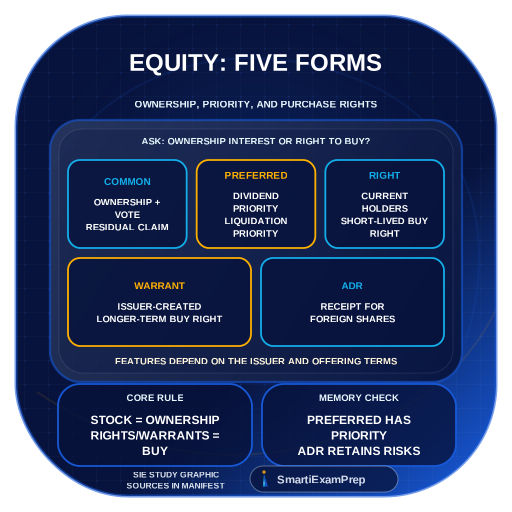
Equity securities differ in present ownership, priority, voting, dividends and future purchase rights. Use those distinctions before comparing potential returns.
Remember Identify what is owned now and what requires exercise or conversion.
Common stock supplies permanent corporate capital and normally has no maturity. An investor can benefit from appreciation or dividends, or lose value; a bondholder instead holds a creditor’s contractual claim.
Common stock
A proportional ownership interest
No maturity
Ownership is generally perpetual
Capital growth
Price can rise or fall
Dividends
Possible distributions
Not a loan
The holder is an owner
Remember Owners share business results; creditors have debt claims.
In liquidation, creditors have priority over equity. Preferred has its stated preference before common; common receives the residual, which may be nothing. Limited liability generally prevents corporate debts from becoming a shareholder’s personal debts merely through ownership.
Creditors
Contract claims first
Preferred
Equity preference next
Common
Residual claim last
Remember Limited liability does not protect the share price or guarantee recovery.
Common shares typically vote on directors and major corporate matters. A proxy authorizes another person to cast the shareholder’s vote; the proxy statement explains the matters and nominees. Shareholders do not manage daily operations.
Shareholders
Elect directors
Board
Oversees management
Officers
Run operations
Remember Typical voting rights depend on the share class and governing terms.
Statutory voting allocates up to the number of shares owned to each separate director contest. Cumulative voting multiplies shares by seats and permits concentrating votes, which can help minority shareholders elect a director.
Statutory voting
Shares owned for each separate seat
Cumulative voting
Shares times seats; votes may be concentrated
Remember Shares × seats gives the cumulative voting pool.
The board may distribute earnings as cash or shares, or retain earnings for business needs. Common dividends are discretionary and follow applicable creditor protections and preferred-dividend priorities. Growth can support larger payouts, but does not guarantee them.
Board declares
No declaration, no common dividend
Cash or stock
The distribution form can vary
Not guaranteed
Earnings may be retained
Growth upside
Payout and price can rise
Remember Possible income is different from promised income.
Common ownership generally includes transfer rights, required disclosures, access to specified records under applicable law and a residual asset claim. Charter, bylaws, class terms and jurisdiction can change the details; these rights do not give daily operational control.
Transfer
Sell shares in the market
Disclosure
Receive required information
Inspection
Specified records under law
Residual assets
Only after senior claims
Remember Common is a package of rights, not a guarantee of profit.
Preemptive rights can preserve an ownership percentage
Where provided by governing documents and law, existing holders may buy a proportional part of a new issue. A 10% owner who buys 10% of the eligible new shares can remain a 10% owner; nonparticipation can cause dilution.
10% owner
Before new shares
Rights offer
Proportional opportunity
Buy 10%
Maintain the percentage
Remember Preemptive rights are conditional, not automatic for every corporation.
Common has no promised maturity value or dividend and ranks last. Company results, industry conditions, rates and investor demand affect price. An outright, fully paid share purchase can lose its entire cost; margin borrowing or other arrangements create separate obligations.
Risk
Last claim, volatile price, no promised dividend
Reward
Growth, dividend increases, voting, liquidity
Remember Growth potential and liquidity are possibilities, not price protection.
Preferred often states a dividend as a percentage of par. For an explicitly stated $100 par and 5% rate, the annual stated dividend is $5. Par values vary; use the problem’s terms rather than assuming every preferred share has $100 par.
Given par
$100 in this worked example.
Given dividend rate
5% of par.
Annual stated dividend
0.05 × $100 = $5, subject to declaration and the issue’s terms.
Remember Dividend dollars = stated rate × the stated par value.
A stated preferred dividend is not the same obligation as bond interest. Declaration and issuer capacity still matter. Omission is not automatically a bond default, while required preferred distributions retain priority over common under the security’s terms.
Fixed rate
Stated in the terms
Board declares
Payment is not automatic
Before common
Dividend priority applies
Remember Fixed rate, payment priority and actual payment are three separate ideas.
Preferred generally receives dividends and liquidation preference before common, but remains behind creditors. It usually lacks ordinary common voting rights. A fixed dividend makes its price sensitive to competing yields: rising rates can pressure price, all else equal.
Dividend priority
Paid before common
Asset priority
Ahead of common, behind debt
Usually no vote
Common normally elects directors
Rate sensitive
Fixed income affects price
Remember Preferred is senior to common equity, not to debt.
Unpaid cumulative dividends become arrears that must be addressed before common dividends resume. Skipped noncumulative dividends generally do not accumulate. Cumulative terms preserve priority; they do not require immediate payment or remove issuer risk.
Cumulative
Missed dividends build in arrears
Noncumulative
A skipped dividend is generally lost
Remember Arrears preserve a place ahead of future common distributions.
Participating preferred can share extra distributions
Participation terms can allow a payment beyond the stated preferred dividend when specified common-dividend or performance conditions are met. The added feature may allow a lower stated rate than comparable nonparticipating shares. Extra payments are conditional.
Standard preferred
Dividend entitlement generally stops at the stated dividend.
Participating
May receive an additional distribution under the issue’s terms.
Remember Participating means potential extra distributions under the terms.
A call permits repurchase at the stated price after any protection period. Falling market rates may encourage refinancing and leave the holder reinvesting at a lower yield. Call risk can constrain appreciation and cause investors to seek more compensation.
Rates fall
Old dividend looks expensive
Issuer calls
Shares are repurchased
Reinvest lower
Investor loses the high rate
Remember Callable benefits the issuer and creates reinvestment risk for the holder.
Conversion exchanges preference for common ownership
The terms establish a conversion ratio, subject to specified adjustments such as stock splits. Rising common prices can make conversion attractive. The option may support a lower dividend, but after conversion the holder gives up preferred priority for common rights and risks.
Preferred
Income and priority
Conversion ratio
Fixed common shares
Common
Growth and voting exposure
Remember Conversion changes the security and the investor’s priority.
Subscription rights offer current holders a short purchase window
Rights usually offer proportional participation in a new issue and may expire in weeks. A below-market subscription price can give immediate intrinsic value. If transferable, rights can be exercised, sold or allowed to expire, subject to their terms.
Right
Privilege offered to current holders
Short term
Often measured in weeks
Below market
Discounted subscription price
Proportional
Helps limit dilution
Exercise or sell
If the terms permit
Remember Current holders, short life and proportional participation point to rights.
Warrants may be separate or attached to debt or preferred as a sweetener. They often last years and begin above the stock’s market price. No initial intrinsic value does not mean no time value. Cash exercise of an issuer-created warrant can supply new capital.
Warrant
Privilege to buy at a stated price
Longer term
Usually valid for years
Above market
Common at issuance
Sweetener
Can accompany debt or preferred
New capital
Exercise sends cash to issuer
Remember Typical duration and purpose help distinguish a warrant from a right.
Use the recipient, duration, price relative to the market and purpose. These are common patterns, not requirements for every contract. Neither privilege alone provides the underlying common share’s vote or dividend before exercise.
Rights
Current holders · weeks · below market · anti-dilution
Warrants
Often a sweetener · years · commonly above market
Remember Holding a purchase privilege is not yet holding the underlying share.
Exercise comes before underlying shareholder rights
Under a typical cash-exercise arrangement, the holder pays the exercise price and receives shares. New issuance can dilute owners who do not maintain their percentage. Transferable instruments can instead be sold; specific exercise terms control.
Remember Instrument → exercise → underlying ownership, with rights subject to the share terms.
A U.S. depositary bank issues receipts backed by deposited foreign shares, often held through a foreign custodian. A receipt may represent one, several or a fraction of a share. Dollar trading and U.S. settlement do not turn the foreign issuer into a U.S. company.
Foreign shares
Held with a custodian
U.S. depositary
Creates the receipt
ADR
Trades and settles in U.S. dollars
Remember Identify the foreign shares behind the U.S.-traded receipt.
A weakening foreign currency can reduce the dollar value of a dividend or ADR even if the local share price is unchanged. Political, economic, accounting, disclosure and trading conditions abroad can also affect value and liquidity.
Currency risk
Conversion changes dollar value
Country risk
Political and economic conditions
Market risk
Foreign share price can fall
Liquidity
Trading conditions can differ
Remember Look through the dollar quote to the underlying business and currency.
The depositary can convert dividends, maintain records, forward communications and process voting instructions. Fees and foreign withholding can reduce distributions. Sponsored programs involve the issuer; unsponsored programs lack its direct participation. U.S. tax reporting still applies.
Dividend conversion
Foreign currency becomes dollars
Communication
Materials and voting instructions
Depositary fees
Custody and processing costs
Sponsored status
Issuer participation can differ
Remember Convenient access still carries depositary fees, tax considerations and foreign risks.
A holder owns 100 common shares and four directors are being elected. The ability to place all 400 votes on one candidate describes cumulative voting. Statutory voting would allow up to 100 votes in each separate contest.
Remember Concentrating the 100 × 4 pool identifies cumulative voting.
Current owners receive a 30-day proportional opportunity to buy new common shares below market. The combined clues identify subscription rights. The privilege must still be exercised to obtain the underlying shares and their applicable rights.
Remember Current owners + 30 days + proportional purchase + discount → rights.
Common offers residual ownership and potential growth. Preferred adds a preference with issue-specific features. Rights and warrants offer future purchases. ADRs provide an interest in foreign shares through a depositary. Continue to Lesson 7’s debt instruments or the available companion practice.
Common
Vote · growth · residual claim
Preferred
Priority · fixed-income traits
Rights + warrants
Purchase privileges before ownership
ADRs
Foreign shares through a depositary
Remember First identify ownership, then priority, then any exercise or foreign-share relationship.
The investor lends to the issuer instead of buying ownership. Par is principal due under the contract; maturity is its repayment date. The coupon sets stated interest using par, not market price. For the worked example here, par is explicitly $1,000; denominations vary.
Remember Read the stated par value rather than treating $1,000 as universal.
A 5% coupon on $1,000 par produces $50 annual stated interest. With semiannual payments, each is $25. Trading at $900 or $1,100 changes current yield, not the fixed $50 coupon. Not every debt instrument pays semiannually.
Principal maturities and interest payments are different schedules
A term issue has a common maturity date. A serial issue has portions maturing over successive years, often matching municipal repayment resources. Semiannual interest describes coupon timing, not whether the issue is serial.
Term bonds
The issue matures at one time
Serial bonds
Portions mature across several dates
Remember Term = common maturity; serial = staggered maturities.
Marketable Treasuries are direct U.S. obligations backed by full faith and credit. They can trade after issuance, so a sale before maturity can lose value when rates rise. Inflation can reduce purchasing power, and longer duration generally increases rate sensitivity.
Full faith + credit
Direct U.S. government backing
Rate risk
Prices can fall before maturity
Inflation risk
Purchasing power can erode
Marketable
Can be sold before maturity
Remember Strong credit backing does not guarantee a stable resale price.
T-bills use short maturities and discount-style income
Bills mature in a year or less and pay no periodic coupon. They can be issued at a discount or par; income is the difference between purchase price and face value received. TreasuryDirect currently lists 4, 6, 8, 13, 17, 26 and 52 weeks; cash-management bill terms can vary.
Remember A bill’s interest is not a semiannual coupon.
Current new-issue Treasury notes have 2-, 3-, 5-, 7- or 10-year terms; Treasury bonds have 20- or 30-year terms. Both repay principal at maturity. An outstanding security’s remaining maturity can be shorter than its original term.
Treasury notes
2, 3, 5, 7, or 10 years
Treasury bonds
20 or 30 years
Remember Original term identifies the product; remaining maturity changes as time passes.
Competitive bids name a rate; noncompetitive bids accept the result
A competitive bidder specifies the relevant rate, yield or discount margin and may receive a partial award or none. A noncompetitive bidder accepts the auction result and receives the requested amount within applicable limits. TreasuryDirect accepts noncompetitive bids.
Competitive bid
Names the rate and risks no award
Noncompetitive
Accepts the auction result
Remember Naming the rate involves award risk; accepting the result is noncompetitive.
Special Treasury structures change principal or cash flow
TIPS adjust principal for CPI and pay a fixed rate on that adjusted amount; maturity payment is at least original principal. Two-year FRNs reset interest using a 13-week bill index plus a spread. STRIPS separate principal and interest into zero-coupon components.
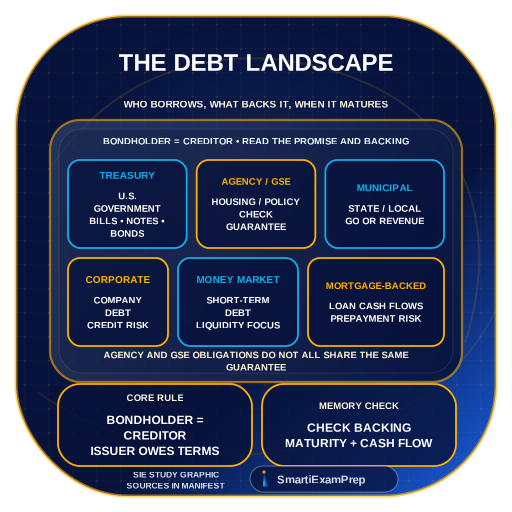
Federal agencies and government-sponsored enterprises have different legal backing. A higher yield than a comparable Treasury may reflect credit, liquidity, call or prepayment differences. Identify the issuer and security before assuming federal support.
Federal agency
Backing can include U.S. full faith and credit
GSE
Congressional charter is not a direct guarantee
Remember The name “agency” alone does not establish full-faith-and-credit backing.
Separate an explicit federal guarantee from GSE obligations
Ginnie Mae is a federal government corporation within HUD whose qualifying mortgage-security guarantees carry full-faith-and-credit backing. Fannie Mae and Freddie Mac are GSEs; their securities are not direct Treasury obligations. Their conservatorship and federal support arrangements do not erase that legal distinction.
Ginnie Mae
Federal corporation; explicit backing
Fannie Mae
Government-sponsored enterprise
Freddie Mac
Government-sponsored enterprise
Remember Credit support and mortgage cash-flow timing are separate issues.
Mortgage cash flow can return principal early or late
A pass-through distributes pooled borrower principal and interest after applicable servicing. Refinancing or home sales can accelerate principal return. When rates rise and refinancing slows, expected cash flows can extend.
Homeowners
Pay principal and interest
Mortgage pool
Collects the cash flow
Investors
Receive pass-through payments
Remember Falling rates can accelerate prepayment; rising rates can create extension risk.
A special-purpose issuer or trust can hold auto loans, leases, credit-card receivables, student loans or other financial assets. Collections fund investor payments. Delinquencies, credit quality, servicing, prepayments and tranche structure affect outcomes.
Loans + receivables
Financial assets generate cash
Trust or issuer
Holds and structures the pool
ABS investors
Receive structured payments
Remember Identify the cash-producing pool rather than assuming a general corporate or tax pledge.
GO and revenue bonds begin with different repayment support
Municipalities and public authorities borrow for public purposes. General obligation debt relies on the governmental pledge and taxing resources; revenue debt relies on designated revenues. A public purpose alone does not identify the security pledge.
GO bond
Taxing power and general resources
Revenue bond
Specified project or enterprise income
Remember Taxes versus specified enterprise revenue is the first municipal distinction.
State GO resources can include income and sales taxes; local GO debt often relies on property taxes. Ad valorem means based on value. Credit analysis considers the tax base, collections, economy, budget, debt burden and legal taxing authority.
GO bond
Governmental full faith and credit
State revenues
Broad taxes and resources
Property tax
Common local support
Public facility
May not charge users
Tax base
Central credit factor
Remember A property-tax pledge differs from user fees collected by one project.
State or local law may require voter approval and impose constitutional or statutory debt limits. These are useful GO clues, not universal requirements. Assessed property value, tax rates and collection strength all affect the pledged resources.
Voter approval
May be required by law
Debt limit
Can cap outstanding GO debt
Ad valorem
Property tax according to value
Jurisdiction
Exact legal rules can differ
Remember Do not turn a common GO feature into a rule for every municipality.
Tolls, airport fees, utility charges, hospital receipts or housing revenue can service revenue debt. Examine demand, feasibility, rates, costs, debt-service coverage, management and competition. Unrelated taxes generally are not pledged unless the documents add that support.
Revenue bond
Specified income supports debt
Tolls
Roads and bridges
Utility rates
Water or electric systems
Facility fees
Hospitals or dormitories
Coverage
Revenue versus debt service
Remember Self-supporting debt may fall outside general debt limits, subject to applicable law.
Many municipal bonds pay interest exempt from federal income tax; some are taxable. Gains above adjusted basis generally remain taxable. Certain private-activity interest can affect AMT. State or local exemptions depend on the bond and investor’s jurisdiction.
Interest income
Often federally exempt; security and investor circumstances matter.
Capital gain
Generally remains taxable; it is not converted into exempt interest.
Remember Municipal does not mean every payment is tax-free.
For a 4% federally exempt yield and a 30% marginal federal rate, taxable-equivalent yield is 0.04 ÷ (1 − 0.30) = 5.714285…%, about 5.71%. At the exact equivalent yield, taxable income after that tax equals 4%; a higher yield produces more.
Remember Income equivalence does not establish equal credit risk, liquidity or suitability.
Land, buildings or facilities secure the claim. An open-end mortgage can permit additional bonds against the collateral under stated tests; closed-end terms restrict further debt against it. Collateral may be insufficient for full recovery.
Mortgage bond
Lien on corporate real property
Collateral
Land, buildings, or facilities
Open end
More debt may share the lien
Closed end
Additional liens are restricted
Recovery risk
Value still may be insufficient
Remember A lien on real property distinguishes a mortgage bond from unsecured debt.
Transportation assets such as aircraft, railcars or ships can support secured financing. A trustee may hold title while scheduled payments are made; default remedies can include repossession or sale under the agreement.
Mortgage bond
Secured by real property
Equipment trust
Secured by aircraft, railcars, or ships
Remember Equipment collateral differs from real-property collateral and from no specific collateral.
A debenture is unsecured, so financial condition, cash flow, rating and covenants matter. A subordinated debenture agrees to stand behind senior debt and generally needs more yield than otherwise comparable senior debt.
Debenture
General unsecured corporate promise
Subordinated
Paid after senior unsecured debt
Remember Unsecured means no specific collateral, not no enforceable debt claim.
Distinguish secured recovery from the residual claim
Secured claims look to pledged collateral; a collateral shortfall can leave an unsecured deficiency. Applicable bankruptcy priorities, administrative claims and contractual subordination affect distributions. Creditors precede preferred equity, and common is residual.
Remember This is a recognition framework, not a universal waterfall overriding bankruptcy law.
Short maturity reduces some risks but does not remove them
Money-market instruments help governments, companies and banks manage liquidity and working capital. They generally have less rate sensitivity than long bonds, but credit, marketability, insurance status and issuer quality still matter.
Short term
Liquidity and working capital
Debt product
Not common stock
Credit still matters
Short does not mean risk free
Name the product
Instrument, fund, or deposit
Remember A short-term instrument, a money-market mutual fund and a bank deposit account are different products.
Match the short-term instrument to its issuer and purpose
Treasury bills finance the government. Commercial paper is generally unsecured corporate short-term borrowing, commonly within 270 days. Bankers’ acceptances support trade through a bank-accepted time draft. Negotiable CDs are transferable bank time deposits under their terms.
T-bill
U.S. Treasury discount debt
Commercial paper
Unsecured corporate short-term note
Banker’s acceptance
Bank-backed trade draft
Negotiable CD
Transferable bank time deposit
Remember Treasury, corporate borrower, bank-supported trade or bank deposit: identify the obligation.
A public authority funds a bridge and pledges only tolls and other bridge revenue, with no general tax pledge. This describes a revenue bond. A GO bond would instead rely on the governmental credit and taxing pledge.
Remember The government issuer does not decide the answer; the pledged payment source does.
Use issuer, repayment support, maturity and cash flow to distinguish Treasuries, agencies, municipal debt, corporate bonds and pooled receivables. Then assess tax treatment and risks. Continue to Lesson 8’s prices and yields or the available companion practice.
Government
Treasury and agency support
Municipal
Taxes or project revenue
Corporate
Collateral or general credit
Money market
Short-term issuer matching
Remember Find the repayment source before calculating or classifying the bond.
AD VALOREM TAX; DEBT LIMIT; GENERAL OBLIGATION BOND; RATE COVENANT; ADDITIONAL BONDS COVENANT; TAXABLE EQUIVALENT YIELD; stable definitions, not current jurisdiction-specific law
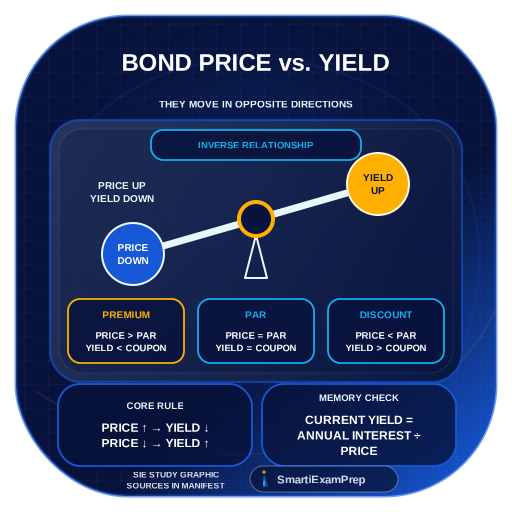
Bond questions become manageable when you keep price, par value, coupon, current yield, and yield to maturity in separate boxes. Build one central map: the coupon cash flow is fixed by the bond contract, the market price can change, and the yield an investor earns changes in the opposite direction from price.
The bond contract separates par, coupon, and maturity
Start with the bond contract. Par value, usually one thousand dollars in an exam question unless another amount is stated, is the principal the issuer promises to repay at maturity. The coupon rate is applied to par value, not to the bond's changing market price. Maturity is the date when the issuer is scheduled to return principal. A five-percent coupon on one thousand dollars produces fifty dollars of annual interest even if the bond later trades for nine hundred fifty dollars or one thousand fifty dollars. Keep the promised cash flow separate from the market price.
Corporate and municipal bond prices are commonly quoted as a percentage of par. A quote of one hundred means one hundred percent of one thousand dollars, or one thousand dollars. A quote of ninety-five means ninety-five percent of par, or nine hundred fifty dollars. A quote of one hundred two point five means one hundred two and one-half percent of par, or one thousand twenty-five dollars. Translate the quote before doing yield math. Below one hundred is a discount, exactly one hundred is par, and above one hundred is a premium.
Coupon yield, also called the nominal yield in many exam materials, begins with the stated coupon rate. Multiply that rate by par to find annual interest. A four-and-one-half-percent coupon on a one-thousand-dollar bond pays forty-five dollars each year, usually in two equal semiannual payments. The coupon yield remains four-and-one-half percent because both the coupon dollars and par value come from the contract. It does not change merely because a later buyer pays a premium or discount. Market price matters when you calculate current yield and the broader return measures.
Current yield compares annual interest with market price
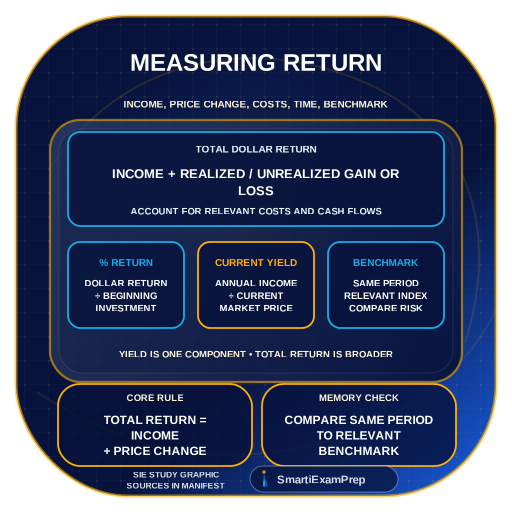
Current yield answers a different question: how much annual coupon income is produced relative to the price paid now? The formula is annual interest dollars divided by current market price. Do not put the coupon percentage directly over the price. First turn the coupon rate into dollars by multiplying it by par. Then divide those annual dollars by the market price. Current yield ignores the time remaining, the gain or loss when principal is repaid, and reinvestment assumptions. It is an income snapshot, not the bond's complete expected return.
A five-percent bond at 95 yields about 5.26 percent
Work through this example. A five-percent bond with one thousand dollars par pays fifty dollars per year. A market quote of ninety-five means a price of nine hundred fifty dollars. Divide fifty by nine hundred fifty. The current yield is approximately five point two six percent. The result is higher than the five-percent coupon because the same fifty-dollar income stream was purchased for less than par. Before choosing an answer, perform a direction check: buying fixed income at a discount should make current yield greater than coupon yield.
The same formula can solve for market price. If annual coupon interest is sixty dollars and current yield is six point five percent, divide the annual interest by the yield written as a decimal. Sixty divided by zero point zero six five equals about nine hundred twenty-three dollars and eight cents. Because six point five percent current yield is greater than the six-percent coupon yield on one thousand dollars par, the answer must be below par. That direction check catches decimal errors and reversed formulas before they cost you an exam point.
Yield to maturity includes income and the path back to par
Yield to maturity is broader than current yield. It estimates the annualized return if the investor holds the bond to maturity, the issuer makes the promised payments, and the calculation's reinvestment assumptions are met. It includes coupon interest, the price paid, the time remaining, and the gain or loss as the bond moves toward par at maturity. A discount bond can add a gain when one thousand dollars is repaid. A premium bond can produce a loss of premium. That is why yield to maturity sits farther from coupon yield than current yield does.
Callable bonds add yield to call and yield to worst
A callable bond may be redeemed before maturity, so investors also evaluate yield to call. Yield to call uses the assumed call date and call price instead of the final maturity date and par repayment. Yield to worst compares the relevant return paths and identifies the lowest potential yield under the stated assumptions, without treating issuer default as the scenario. Current yield, yield to maturity, and yield to call answer different questions. When a problem says earliest call date or call price, do not automatically use the maturity calculation.
For a bond selling below par, memorize the yield order and understand why it works. Coupon yield is based on par. Current yield is higher because the same interest is divided by a lower market price. Yield to maturity is higher still because it also includes the gain from buying below par and receiving par at maturity. The order from lowest to highest is coupon yield, current yield, then yield to maturity. Written from highest to lowest, it is yield to maturity, current yield, coupon yield. The direction comes from the discount's built-in gain.
When a standard fixed-rate bond trades exactly at par and no special feature changes the calculation, coupon yield, current yield, and yield to maturity align. The investor pays the same principal amount that will be repaid, so there is no discount gain or premium loss. A five-percent bond bought at one thousand dollars produces fifty dollars divided by one thousand dollars, or five percent current yield, and the maturity path does not add a price adjustment. This equality is a useful anchor between the discount and premium yield ladders.
For a bond selling above par, the order reverses. Coupon yield remains tied to par. Current yield becomes lower because the annual coupon dollars are divided by a price above par. Yield to maturity is lower still because it includes the loss of premium as the investor receives only par at maturity. From highest to lowest, the order is coupon yield, current yield, then yield to maturity. If a premium bond's proposed current yield is above its coupon rate, stop: the direction is wrong.
Market rates and existing bond prices move inversely
The defining relationship is inverse. When market interest rates rise, newly issued bonds can offer higher coupons or yields, so an older fixed coupon becomes less attractive. Its market price must fall until its return becomes competitive. When market rates fall, an older higher fixed coupon becomes more attractive, so investors may bid its price upward. The coupon dollars do not change; the price changes, which changes yield. Picture a seesaw with market rates and yields on one side and existing fixed-rate bond prices on the other.
A four-percent bond falls when new bonds yield five percent
Suppose an outstanding bond pays a four-percent coupon while comparable new bonds begin yielding five percent. Investors will not normally pay one thousand dollars for the older forty-dollar income stream when a new bond can provide fifty dollars at the same par amount and similar risk. The older bond must trade below par so its current and overall yield rise toward the market. The precise price depends on maturity and other features, but the direction is clear: market rates rose, so the fixed-rate bond's price falls to a discount.
A six-percent bond rises when new bonds yield five percent
Now reverse the numbers. An outstanding bond pays six percent while comparable new bonds yield five percent. The older bond's sixty-dollar annual income is more attractive than the fifty dollars available from a new one-thousand-dollar issue with similar risk. Buyers may pay more than par for that larger fixed cash flow. The price rises to a premium until the return becomes competitive with the market. Again, the coupon stays six percent of par; paying the premium reduces the buyer's current yield and yield to maturity.
Lower-coupon bonds are generally more rate sensitive
When two otherwise similar bonds have the same maturity and credit quality, the lower-coupon bond generally has greater interest-rate sensitivity. More of its value arrives later through principal repayment, while the higher-coupon bond returns more cash earlier. Distant cash flows are affected more by changes in the discount rate. This comparison assumes the other features are truly similar. Do not compare coupon alone when maturities, call features, credit risk, or embedded options differ. For the clean exam setup, lower coupon means greater price movement when rates change.
Longer maturities are generally more rate sensitive
Maturity also changes sensitivity. Between otherwise similar fixed-rate bonds, the longer-maturity bond generally moves more when market rates change. Its principal and more of its total cash flow remain exposed to the new rate environment for longer. A short-maturity bond is pulled toward par sooner because repayment is closer. The exam usually asks for a relative ranking, not an exact price change. Hold coupon and credit quality constant, then choose the longer maturity as the bond with greater interest-rate risk.
Combine coupon and maturity to rank interest-rate risk
Put the two sensitivity rules together. Long maturity increases interest-rate exposure, and low coupon increases it. Therefore, among plain fixed-rate bonds with comparable credit and features, the long-term low-coupon bond is usually the most price sensitive. The short-term high-coupon bond is usually the least. The remaining combinations sit between those endpoints. This matrix is more reliable than memorizing isolated slogans because it forces you to compare both dimensions. Always check for an embedded call, conversion feature, or unusual cash flow before applying the plain-bond ranking.
A zero-coupon bond makes no periodic coupon payments. The investor buys it below par and receives par at maturity if the issuer pays as promised. Because the cash flow is concentrated at the end, a zero-coupon bond with a given maturity is generally more sensitive to interest-rate changes than a coupon bond with the same maturity and credit quality. Its current yield is zero because it pays no annual coupon interest, even though its yield to maturity can be positive through the discount accreting toward par.
Duration summarizes price sensitivity to rate changes
Duration is a sensitivity measure that combines the timing and present value of a bond's expected cash flows. A higher duration generally means a larger price response to a given change in yield. Duration is expressed in years, but it is not simply the bond's remaining maturity. Coupon level, time to maturity, yield, and embedded features can affect it. For an introductory exam question, use duration as the bridge from rate movement to approximate price movement: higher duration means more sensitivity, and lower duration means less.
Duration gives a first approximation of price movement
A common approximation says that a bond's percentage price change is roughly the negative of its duration multiplied by the change in yield, for a relatively small rate move. If duration is five and yield rises by one percentage point, the estimated price change is about negative five percent. If yield falls by one percentage point, the estimate is about positive five percent. The negative sign captures the inverse relationship. This is an approximation, not an exact promise, because bond-price curvature, changing cash flows, and embedded options can alter the result.
Hold the coupon dollars constant and change only the market price. A bond pays fifty dollars annually. At a price of nine hundred fifty dollars, current yield is about five point two six percent. If the price rises to one thousand fifty dollars, current yield becomes fifty divided by one thousand fifty, or about four point seven six percent. The numerator did not move, so the higher denominator pushed the yield lower. This simple arithmetic is the inverse price-yield relationship in miniature and gives you a fast direction check.
Use remaining maturity, not the bond's original term
A bond may have been issued as a thirty-year bond, but an investor who buys it with eight years left owns an eight-year remaining cash-flow stream. Yield to maturity and interest-rate sensitivity depend on the time remaining now, not the original label alone. The maturity date is fixed in the contract, while remaining maturity shrinks as time passes. On a question, subtract the current date from the maturity date when needed. Do not automatically treat every bond originally issued for thirty years as though thirty years remain.
Treasury credit strength does not remove market-price risk
U.S. Treasury securities are commonly used as the baseline for very low credit risk, but their market prices can still move sharply when interest rates change. A long-term Treasury bond can lose market value when yields rise even though investors expect the federal government to make the promised payments. If the investor holds to maturity, interim price movement may not change the stated principal payment, but selling early can realize a loss. Separate credit risk from interest-rate risk and from opportunity cost; they are different questions.
An investor buys a one-thousand-dollar par bond at a quote of one hundred four. The bond has a five-percent coupon and will mature at par. Without calculating an exact yield to maturity, rank coupon yield, current yield, and yield to maturity. The bond is at a premium. Current yield must be below the five-percent coupon because fifty dollars is divided by more than one thousand dollars. Yield to maturity is lower still because the investor also loses the premium by maturity. The correct order from highest to lowest is coupon yield, current yield, yield to maturity.
Bring the Lesson Eight map together. Par is the principal due at maturity, coupon interest is based on par, and price is what the market pays now. Current yield is annual interest divided by price. Yield to maturity adds time and the path back to par; callable bonds add yield to call and yield to worst. Discount bonds have yield to maturity above current yield above coupon yield, while premium bonds reverse that order. Rates and existing fixed-rate bond prices move inversely. Longer maturity, lower coupon, higher duration, and zero-coupon cash flows generally increase sensitivity.
Read the bond's risk features before chasing its yield
A bond's coupon never tells the whole story. Credit quality affects the chance of repayment, call and put provisions can change the date cash returns, conversion can connect debt value to common stock, collateral changes claim priority, and the sale method explains how a new issue reaches investors. Rapid-fire questions remain in the practice video.
Credit risk is the possibility that a bond issuer will fail to make interest or principal payments as promised. Analysts examine the issuer's cash flow, debt burden, collateral, economic exposure, and legal protections. A Treasury security and a speculative corporate bond may both promise interest and principal, but they do not carry the same credit profile. Credit risk is also distinct from interest-rate risk: a bond can lose market value because rates rise even when the issuer remains financially strong. First ask whether the problem is about payment ability or market-price movement.
A credit rating is a third party's opinion about the relative creditworthiness of an issuer or debt security. Ratings typically use letter grades, with stronger ratings indicating a lower assessed likelihood of default than weaker ratings. A rating is not issued by the SEC, is not investment advice, and does not guarantee repayment. It also does not fully measure market, interest-rate, inflation, or liquidity risk. Treat the rating as one input, then examine the offering documents, issuer finances, security provisions, and other risks that matter to the investment.
Investment grade and high yield meet at the BBB boundary
On a common rating scale, triple A sits at the top, followed by double A, single A, and triple B. A rating of triple B minus or higher is generally investment grade on the scale described by the SEC bulletin. Below that boundary, double B and lower are non-investment-grade, speculative, or high-yield categories. Rating agencies use related but not identical symbols, so read the scale the question provides. The boundary is the key exam distinction: triple B is the lowest broad investment-grade category; double B begins the speculative range.
Plus, minus, and number modifiers rank bonds within a category
Rating agencies refine broad letter categories with modifiers. One agency may add plus or minus signs; another may use the numbers one, two, and three. These marks rank relative standing inside a category rather than creating an entirely new broad tier. A single A plus is stronger than single A, which is stronger than single A minus. Likewise, a one modifier is generally stronger than a two or three within the same Moody's letter category. Do not compare symbols mechanically across agencies without recognizing which scale is being used.
Upgrades and downgrades can move prices and required yields
An upgrade means the rating agency now assesses the issuer or security more favorably. All else equal, lower perceived credit risk can support the bond's price and reduce the yield investors demand. A downgrade signals a weaker assessment. The bond's price may fall and its required yield may rise to compensate investors for greater risk. Rating changes can occur at any time and may follow watches or outlooks, but not every change is announced in advance. Separate the direction: credit improves, price tends to rise and yield fall; credit weakens, price tends to fall and yield rise.
A fallen angel is a bond that was investment grade when issued or purchased but was later downgraded into non-investment-grade territory. The label describes a change in credit status, not a bond that began as speculative debt. That downgrade can force certain institutional investors or funds to sell if their mandates permit only investment-grade holdings, adding market pressure. The bond may then offer a higher yield, but the higher yield compensates for greater perceived credit risk; it is not a free return. Track where the rating started and where it moved.
Unrated does not automatically mean unsafe or high yield
An unrated bond has not received a rating from a particular rating agency. That absence is not itself proof that the issuer is safe, unsafe, investment grade, or speculative. Some issuers may choose not to pay for a rating or may have a small or unusual offering. Investors must perform independent due diligence using financial statements, cash flow, collateral, covenants, repayment sources, and offering documents. On the exam, reject the shortcut that unrated always means low quality. It means the rating label is unavailable, so other evidence must do more work.
Higher credit risk generally requires a higher yield
Investors generally demand more yield for accepting more credit risk. If two bonds have similar maturities, coupons, tax treatment, liquidity, and features, the lower-rated bond should ordinarily offer the higher required yield and lower price. That spread compensates for greater uncertainty about repayment. The comparison breaks down when other features differ, so do not treat rating as the only variable. A higher yield may reflect credit risk, interest-rate risk, liquidity limits, call risk, or several factors together. Identify what risk is paying the extra yield.
A call feature gives the issuer the early-redemption right
A callable bond gives the issuer, not the investor, the right to redeem the security before its stated maturity according to the bond's terms. If the issuer calls the bond, it pays the call price and accrued interest, and future coupon payments stop. The feature benefits the issuer because it creates refinancing flexibility. It creates uncertainty for the investor because the expected stream of interest may end early. Always identify who controls the feature: the issuer controls a call; the investor controls a put or a typical voluntary conversion.
Call protection is an initial period during which the issuer may not exercise an ordinary optional call. After the first call date, the feature may become available according to a schedule. A call premium sets the redemption price above par, such as one thousand twenty dollars for a one-thousand-dollar bond, and may decline as later call dates arrive. Protection and premium soften call risk but do not remove it. Read the prospectus or official statement for the actual dates, prices, extraordinary redemption clauses, sinking-fund provisions, and make-whole terms.
Falling rates make a call more attractive to the issuer
Issuers are most likely to consider an optional call when market interest rates fall below the coupon on their outstanding debt. The issuer can redeem the expensive bond and refinance with new lower-rate debt, much like replacing a high-rate loan. The investor receives principal back sooner than expected and loses the attractive old coupon. When rates rise, refinancing at a higher rate is usually unattractive, so an optional call becomes less likely. On the exam, falling rates favor the issuer's call option and create reinvestment risk for the bondholder.
A call can force reinvestment when available yields are lower
Reinvestment risk is the danger that cash returned from interest, maturity, prepayment, or a call must be invested at a lower rate. A callable five-percent bond is most likely to disappear when comparable new bonds yield less than five percent. The investor receives the call price but may be unable to replace the lost income without taking more risk. This creates an asymmetry: the bond's upside can be limited when rates fall because the call becomes more valuable to the issuer, while its market price can still decline when rates rise.
Yield to maturity assumes the bond remains outstanding until maturity. Yield to call assumes redemption on the relevant call date at the stated call price. For a callable bond, investors compare those return paths because early redemption can produce a lower realized yield than holding to maturity. Yield to worst is the lowest applicable yield among the modeled call and maturity outcomes under the stated assumptions, excluding an issuer default scenario. When the bond sells at a premium and can be called soon, yield to call is often the more conservative figure.
A put feature gives the investor an early-sale right
A putable bond reverses the control. The investor may require the issuer to repurchase the bond on specified dates and at specified prices. The feature can protect the holder when market rates rise and the old coupon becomes unattractive, because the investor may put the bond back and seek a higher-yielding alternative. That investor protection generally allows the issuer to offer a lower yield than an otherwise similar nonputable bond. Keep the direction straight: call belongs to the issuer and is most valuable when rates fall; put belongs to the investor and is most valuable when rates rise.
A convertible bond can become the issuer's common stock
A convertible bond is debt that may be exchanged for a stated number of common shares of the same issuer according to its terms. In a typical voluntary conversion, the bondholder decides whether and when to convert. Before conversion, the investor is a creditor entitled to the bond's contractual payments, subject to issuer risk. After conversion, the investor becomes a common shareholder and gives up the bond claim. The conversion feature offers equity upside, so a convertible bond can usually carry a lower coupon than otherwise similar nonconvertible debt.
Conversion price and conversion ratio describe the same exchange
The conversion ratio is the number of common shares received for each bond. The conversion price is the effective price per share built into that exchange. For a one-thousand-dollar par convertible bond, divide par by the conversion price to find the ratio. If the conversion price is forty dollars, the ratio is twenty-five shares. Conversely, divide par by the ratio to find the conversion price. Corporate actions and the security's terms can adjust these numbers, so use the figures stated in the problem rather than assuming they never change.
Conversion value follows the market value of the stock
Conversion value equals the conversion ratio multiplied by the current market price of the common stock. If a bond converts into twenty-five shares and the stock trades at forty-four dollars, conversion value is one thousand one hundred dollars. The bond may trade above that value because it still provides debt payments and has time value, but the stock connection becomes increasingly important as the share price rises. If the stock trades well below the conversion price, voluntary conversion is unattractive because the investor would surrender a bond claim for lower-value stock.
Conversion trades creditor status for equity upside
The convertible investor owns a hybrid opportunity. Remaining a bondholder preserves the contractual interest and principal claim, subject to the issuer's ability to pay. Converting replaces that creditor position with common stock ownership, which participates in equity gains and losses and stands lower in liquidation. The conversion feature can support the bond's market value when the stock rises, but it does not eliminate credit or interest-rate risk before conversion. On the exam, identify the trade: income and claim priority on one side, voting and equity upside on the other.
A secured corporate bond has a lien or pledged interest in specified collateral. Security can improve potential recovery if the issuer defaults, but collateral does not guarantee full repayment and does not remove the need to assess credit quality. The indenture describes the pledged property, covenants, trustee role, and bondholder rights. Common exam categories include mortgage bonds backed by real property, equipment trust certificates backed by equipment, and collateral trust bonds backed by securities the issuer owns. Match the bond's name to the asset supporting the claim.
Open-end and closed-end indentures treat new liens differently
A mortgage bond is secured by a lien on real estate. Under an open-end mortgage indenture, the issuer may sell additional bonds secured by the same property, usually subject to tests in the indenture. Under a closed-end indenture, the issuer generally cannot place additional equal claims against that collateral. Earlier or senior liens can still outrank later claims. The distinction is about whether more debt may share the pledged property, not whether the property value is certain. Read the lien terms and priority rather than assuming every mortgage bond has identical protection.
Equipment trust certificates are supported by titled equipment
Equipment trust certificates are commonly associated with transportation assets such as aircraft or railcars. A trustee may hold title or a security interest while the issuer uses the equipment and makes scheduled payments. If the issuer defaults, the equipment can be repossessed or sold according to the governing documents, with proceeds applied to the debt. Because the asset can generate operating revenue and may be resold, it offers identifiable collateral. Recovery still depends on legal priority, condition, market value, and the costs of repossession and sale.
A collateral trust bond is secured by stocks, bonds, or other financial securities that the issuer places with a trustee. The pledged portfolio supports the bondholder's claim, and the indenture may require coverage tests or substitution rules if values change. This differs from a mortgage bond, which uses real property, and an equipment trust certificate, which uses physical equipment. The same warning applies: the existence of collateral does not guarantee complete recovery. The value and liquidity of the pledged securities can fall when the issuer is under stress.
Debentures rely on general credit instead of specific collateral
A debenture is an unsecured corporate bond backed by the issuer's general credit rather than a lien on identified property. Unsecured does not mean the investor has no legal claim; it means there is no specific collateral claim. A subordinated debenture agrees to stand behind senior unsecured debt in liquidation. Strong companies may borrow without pledging assets, but investors then focus heavily on cash flow, covenants, and credit quality. All else equal, lower claim priority generally requires a higher yield to compensate for lower expected recovery in distress.
In a simplified corporate liquidation, secured creditors look first to the value of their pledged collateral. Senior unsecured creditors follow according to applicable priority, then subordinated creditors. Preferred shareholders stand behind all creditors, and common shareholders receive only the residual after senior claims are satisfied. A secured creditor whose collateral is insufficient may have an unsecured deficiency claim for the unpaid amount rather than secured priority for all of it. The exam principle is sequential: each higher tier must be addressed before value flows to the next.
Municipal bonds commonly use competitive or negotiated sales
In a competitive municipal sale, the issuer publishes a notice of sale and underwriters or syndicates submit bids under the stated terms. The issuer generally awards the bonds to the qualifying bidder that produces the lowest total interest cost. In a negotiated sale, the issuer selects an underwriter or syndicate before final pricing and works with that team on structure, marketing, order priorities, and price. Competitive describes underwriters bidding for the issue; negotiated describes the issuer working with a selected underwriter. Both are primary-market methods.
Treasury auctions accept noncompetitive and competitive bids
U.S. Treasury marketable securities are sold through public auctions. A noncompetitive bidder agrees to accept the rate, yield, or discount margin determined at the auction and, within the current limit, receives the full requested amount. A competitive bidder specifies the desired return and may receive all, part, or none of the bid depending on the auction results. TreasuryDirect itself accepts only noncompetitive bids. All successful bidders receive the same price corresponding to the highest accepted competitive rate, yield, or discount margin. Do not confuse this auction process with municipal competitive underwriting.
An investor owns a premium corporate bond with a seven-percent coupon. Comparable new bonds now yield four-and-one-half percent, and the bond has passed its first call date. Which risk should the investor emphasize? The issuer can refinance at a lower cost, so the call has become economically attractive. If exercised, the investor loses the high coupon and must reinvest returned cash when comparable yields are lower. The central risk is call and reinvestment risk, and yield to call may be more useful than assuming the bond survives to maturity.
Bring the Lesson Nine map together. Ratings estimate relative credit risk but are opinions, not guarantees; triple B is the broad investment-grade boundary, and downgrades can pressure price and raise required yield. Calls belong to issuers and become more attractive when rates fall, while puts belong to investors and become more valuable when rates rise. Conversion exchanges the creditor claim for common stock under stated terms. Collateral identifies a recovery source, while debentures rely on general credit and subordination lowers priority. Municipal issues use competitive or negotiated sales, and Treasury securities use auctions.
Options language becomes manageable when you identify four things in order: call or put, buyer or writer, the strike price, and the stock price. Those facts tell you the right or obligation, the market outlook, and whether the contract has intrinsic value. Then the premium lets you calculate a breakeven or a maximum gain or loss. This lesson builds that complete map before we apply it to calls, puts, moneyness, and expiration breakeven.
An option is a contract tied to an underlying interest
An option is a contract whose value is connected to an underlying interest. The underlying may be an individual stock, an exchange-traded product, or an index. A listed option does not make the holder a shareholder merely because the holder owns the contract. Instead, it conveys a defined right under standardized terms. The buyer pays for that right, while the writer accepts the matching obligation. Keep the option contract separate from the underlying asset because their prices, ownership rights, and settlement mechanics are not the same.
The holder has a right; the writer has an obligation
Every basic options position begins with the holder and the writer. The holder buys the option, pays the premium, and receives a right. The writer sells the option, receives the premium, and assumes an obligation if assigned. The holder decides whether to exercise an American-style contract while it remains exercisable. The writer cannot demand that the holder exercise and cannot ignore an assignment. On the exam, the words buyer, holder, and long describe one side; seller, writer, and short describe the other.
Strike, expiration, underlying, and premium answer different questions
Four contract terms must stay in separate boxes. The underlying identifies what the option is based on. The strike price is the fixed exercise price. The expiration date tells you when the contract's rights end, subject to its specific terms and exercise style. The premium is the market price paid for the option. Strike and expiration are standardized terms for a listed series, while the premium changes with market forces. Never use the premium as though it were the strike price, and never assume every option shares one expiration calendar.
A standard equity option usually represents one hundred shares
For standard equity options, one contract generally represents one hundred shares. That multiplier converts a per-share premium into the total contract cost. A premium quoted at four dollars per share normally costs four hundred dollars for one standard contract. Corporate actions can create adjusted contracts with a different deliverable, so one hundred is the standard rule, not an exception-proof promise. Read the contract specifications when a question signals a split, merger, special distribution, or other adjustment.
A call gives its holder the right to buy the underlying at the strike price. A put gives its holder the right to sell the underlying at the strike price. The writer takes the opposite side of that right. Therefore, a call writer may be obligated to sell, and a put writer may be obligated to buy. Start every problem from the holder's verb: call means buy and put means sell. Only after that should you switch to the writer's opposite obligation.
Map all four basic positions before adding an outlook
Build the four-position map. A long call has the right to buy. A short call has the obligation to sell if assigned. A long put has the right to sell. A short put has the obligation to buy if assigned. Notice that long and short tell you who owns the right and who carries the obligation; call and put tell you the direction of the underlying transaction. This grid prevents the most common reversal error before any profit calculation begins.
The premium is cost to the holder and income to the writer
The premium is a nonrefundable payment from the holder to the writer for the rights conveyed by the option. For the holder, that premium is the maximum possible loss when the option is purchased outright. For the writer, the premium received is the maximum possible profit from the written option by itself. Premium is influenced by the relationship between the underlying price and strike, time remaining, expected volatility, interest rates, and other market factors. It changes continuously and is not fixed by OCC.
American and European describe when exercise is permitted
Exercise style answers a timing question, not a geography question. An American-style option may generally be exercised on any business day up to and including expiration. A European-style option may be exercised only during the permitted period at expiration. Standard U.S. equity options are American-style, while many index options are European-style. Always read the product terms because the underlying, settlement method, and exercise style work together. European does not mean that the contract trades only in Europe.
Equity options can deliver shares; index options can settle in cash
Settlement tells you what performance looks like after exercise. A standard physical-delivery equity call can result in the holder buying shares and the assigned writer delivering them. A physical-delivery put can result in the holder selling shares and the assigned writer buying them. Cash-settled options instead pay the amount determined by the difference between the settlement value and strike, multiplied by the contract multiplier. Many index options are cash-settled, so do not automatically picture one hundred shares for every option product.
Moneyness compares the stock price with the strike price
Moneyness is determined by comparing the underlying market price with the strike price. The premium does not enter that classification. A call is in the money when the stock price is above the strike because the holder can buy below market. A put is in the money when the stock price is below the strike because the holder can sell above market. At the money means stock price and strike are equal. Out of the money means immediate exercise would provide no economic value.
A fifty call is out of the money when stock is forty-eight
Apply the call rule. XYZ stock trades at forty-eight dollars and the call strike is fifty dollars. The holder would not use the contract to buy at fifty while shares are available in the market for forty-eight. The call is therefore out of the money by two dollars and has zero intrinsic value. A premium of three dollars does not change that classification. The premium only changes the holder's cost and the stock price needed for a net profit at expiration.
A fifty put is in the money when stock is forty-eight
Now use the same stock price and strike for the put. XYZ trades at forty-eight dollars and the put strike is fifty dollars. The holder has the right to sell at fifty when the market offers only forty-eight, so the put is in the money by two dollars. Its intrinsic value is two dollars per share. Again, a four-dollar premium does not determine moneyness. It matters when you calculate total cost, time value, or expiration profit and loss.
When the underlying stock trades exactly at the strike price, both the call and put with that strike are at the money. Neither contract has intrinsic value because immediate exercise offers no price advantage. They may still trade for a positive premium because time remains and the market sees a possibility of a favorable move before expiration. This is why at the money does not mean free, worthless, or at breakeven. Moneyness and net profitability are different questions.
Intrinsic value is the amount by which an option is in the money. For a call, subtract strike from stock price, but never report less than zero. A seventy call with stock at seventy-two has two dollars of intrinsic value. For a put, subtract stock price from strike, again with a floor of zero. A fifty put with stock at forty-six has four dollars of intrinsic value. Out-of-the-money and at-the-money options have zero intrinsic value even when their premiums are positive.
An option's premium can be separated into intrinsic value and time value. If the total premium is seven dollars and intrinsic value is four dollars, time value is three dollars. Time value reflects the possibility that market movement before expiration could make the option more valuable. It is influenced by time remaining, expected volatility, and other market variables. Never add intrinsic value to the quoted premium. Intrinsic value is already one component inside that premium, so subtract it to isolate time value.
A long call is a bullish position. The holder expects the underlying price to rise enough to make the right to buy at the strike valuable. The maximum loss is the premium paid because the holder can let an unfavorable contract expire. The maximum gain is theoretically unlimited because a stock price has no fixed ceiling. At expiration, the call first becomes in the money above the strike, but net profit does not begin until intrinsic value also recovers the premium.
At expiration, calculate a long call's breakeven by adding the per-share premium to the strike price. A fifty call purchased for four dollars has a fifty-four-dollar breakeven. At fifty-two, the call is two dollars in the money, but the holder still has a two-dollar net loss because only half of the four-dollar premium has been recovered. Above fifty-four, ignoring transaction costs, the position has a net gain. Keep moneyness at fifty separate from breakeven at fifty-four.
A long put is a bearish position. The holder expects the stock price to fall, making the right to sell at the strike valuable. The maximum loss is the premium paid. The maximum gain is limited because a stock cannot fall below zero. If the stock becomes worthless, a long put's maximum per-share gain is the strike price minus the premium. Like the call, the put can be in the money before it reaches net profitability because the premium must still be recovered.
At expiration, calculate a long put's breakeven by subtracting the per-share premium from the strike price. A forty-five put purchased for three dollars has a forty-two-dollar breakeven. At forty-three, the put is two dollars in the money but still has a one-dollar net loss after the premium. Below forty-two, ignoring transaction costs, the position has a net gain. Calls add the premium to strike; puts subtract it. That direction follows the price movement each holder needs.
A call writer receives premium and may have to sell
A short call is the writer's side of the call contract. The writer receives the premium and may be assigned the obligation to sell shares at the strike. The maximum gain is the premium received. If the call is uncovered, the possible loss is theoretically unlimited because the writer may have to acquire shares after an unlimited price increase and deliver them at the lower strike. A neutral-to-bearish outlook may motivate the trade, but the risk depends critically on whether the call is covered.
A covered call combines long stock with a written call on that stock. If assigned, the writer can deliver shares already owned instead of buying them at a higher market price. The premium produces income and offers only a small cushion against a stock decline. The trade-off is capped upside because the shares may be called away at the strike. Covered does not mean risk-free: the investor still bears most of the stock's downside risk and may lose appreciation above the strike.
A short put receives premium in exchange for the possible obligation to buy shares at the strike price. The position is generally neutral to bullish because the writer benefits if the stock stays at or above the strike and the option expires without exercise. Maximum profit is the premium. If the stock falls to zero, the maximum per-share loss on the option position is the strike price minus the premium received. That loss is large but not unlimited because the stock price has a floor of zero.
Opening, closing, exercising, and expiring are different exits
Buying or writing a contract to establish a new position is an opening transaction. A holder can usually close before expiration by selling the same option series, while a writer can close by buying the same series. A holder may instead exercise, and an unexercised contract can expire. Exercise creates performance under the contract; a closing trade offsets the position in the options market. Most exam questions become clearer when you name which event occurred instead of using the vague phrase sold the option.
Separate moneyness from breakeven in one calculation
Finish with one integrated scenario. XYZ stock is fifty-two dollars. An investor owns a fifty call purchased for four dollars per share. The call is in the money by two dollars because stock exceeds strike by two. But the expiration breakeven is fifty-four dollars because the four-dollar premium must be added to the fifty-dollar strike. At a fifty-two-dollar expiration price, the holder has two dollars of intrinsic value and a two-dollar net loss per share. Classification comes first; profitability comes second.
Bring the lesson together. First identify call or put: calls use the holder's right to buy, and puts use the holder's right to sell. Next identify holder or writer: holders have rights and writers have obligations. Compare stock with strike to classify moneyness, without using the premium. Then use the premium for total contract cost, time value, breakeven, and risk. Long-call breakeven is strike plus premium; long-put breakeven is strike minus premium. That sequence turns a dense options question into a short checklist.
Options positions become much easier when you start with the investor's objective. A directional trader may speculate on a rise or fall. A stockholder may buy protection against a decline. Another investor may write a covered call to collect income. The contract can later be closed, exercised, assigned, or allowed to expire. This lesson connects those objectives to the four basic positions and follows the exercise and assignment chain without mixing up the holder and writer.
Long options buy rights and limit loss to the premium
Buying an option creates a long position. The long holder pays the premium and receives a right without taking on the writer's matching obligation. A long call owns the right to buy; a long put owns the right to sell. If the market never moves favorably, the holder can generally let the option expire and lose the premium. This limited-loss structure can be used for speculation or as part of a hedge, but limited loss does not mean a favorable outcome or a guarantee that the premium will be recovered.
A long call is bullish speculation when nothing is being hedged
An investor who buys a call without an offsetting stock position is usually making bullish speculation. The call can gain value as the underlying rises because the holder owns the right to buy at the strike. The holder's maximum loss is the premium, while the potential gain is theoretically unlimited. If the investor instead is short the underlying stock, a purchased call may serve as a hedge. The same contract can therefore support different objectives; look at the entire position before labeling it speculation or protection.
A long put is bearish speculation or protection for long stock
A put purchased by itself is generally bearish speculation because it benefits as the underlying falls. The holder owns the right to sell at the strike, and the maximum loss is the premium. When that same put is paired with stock the investor already owns, its purpose can change to protection. It establishes a price at which the shares may be sold if the market declines. Always read the stock position and the objective together: a long put alone and a protective put use the same contract but describe different strategies.
Short options collect premium and accept obligations
Writing an option creates a short position. The writer receives the premium but accepts an obligation if assigned. A call writer may have to sell the underlying at the strike; a put writer may have to buy it at the strike. The premium is the maximum profit on the written option by itself, while potential loss can be far larger. Time passing may help an option writer when other factors remain stable, but assignment can occur whenever the contract terms and exercise style permit it.
A short call is neutral to bearish and obligates a sale
A call writer generally expects the stock to remain at or below the strike. If the call expires without value, the writer keeps the premium. If the holder exercises, the writer may be assigned the obligation to sell at the strike even when the market price is higher. The writer's breakeven at expiration is strike plus premium received. Above that level, the short call loses money. Whether that risk is theoretically unlimited or covered by owned shares depends on the writer's underlying position.
An uncovered call has theoretically unlimited loss
An uncovered call writer does not own the shares needed to satisfy a physical-delivery assignment. If the stock rises sharply, the writer may have to acquire shares at the high market price and sell them at the lower strike. Because a stock price has no fixed ceiling, the loss is theoretically unlimited, reduced only by the premium received. This is the defining risk distinction. Do not describe every written call as uncovered; first check whether the writer owns the underlying shares or another qualifying covering position.
Long stock plus a short call creates a covered call
A covered call combines ownership of the underlying shares with a written call. If the writer is assigned, the owned shares can be delivered. That removes the need to buy shares after an unlimited price increase, but it does not eliminate risk. The stock can still decline substantially, and the premium offsets only part of that loss. The position earns premium income and gives up appreciation above the strike. Its typical outlook is neutral to moderately bullish rather than strongly bullish.
A short put is neutral to bullish and obligates a purchase
A put writer generally expects the stock to remain at or above the strike. If the put expires without value, the writer keeps the premium. If the stock falls and the holder exercises, the writer may be assigned the obligation to buy at the strike even when the shares are worth less. The writer's expiration breakeven is strike minus premium received. Maximum loss occurs if the stock reaches zero and equals the strike minus premium on a per-share basis.
Cash can be reserved for a written put's purchase obligation
A cash-secured put is a written put backed by enough cash to buy the shares if assigned. The reserved cash does not remove market risk: the writer can still be required to purchase stock above its current value and can lose substantially if the shares collapse. It does address the funding obligation by setting aside the strike price multiplied by the contract quantity, subject to account rules. Investors may use the strategy to earn premium while accepting the possibility of acquiring shares at an effective cost below the strike.
The four positions pair outlook with right or obligation
Use a four-box matrix. Long call: bullish, right to buy, loss limited to premium. Short call: neutral to bearish, obligation to sell, premium is maximum profit. Long put: bearish, right to sell, loss limited to premium. Short put: neutral to bullish, obligation to buy, premium is maximum profit. These descriptions assume each option is considered by itself. Adding an underlying stock position can change the purpose and the combined risk, which is why the next step is to identify the hedge.
A hedge offsets a risk already present in the portfolio
Hedging means taking an offsetting position intended to reduce an existing risk. Start by identifying what the investor already owns or owes. Long stock is harmed by a decline, so its direct option hedge is a long put. Short stock is harmed by a rise, so its direct option hedge is a long call. The premium is similar to an insurance cost: it reduces the position's net return if protection is not needed, but it creates a defined response when the adverse move occurs. A hedge reduces risk; it does not make the portfolio risk-free.
Long stock plus a long put creates downside protection
A protective put combines long stock with a purchased put on the same underlying. The stockholder retains the possibility of upside appreciation while the put establishes a floor near the strike. If the stock falls below the strike, the holder can exercise the put and sell at that fixed price, subject to the contract terms. Maximum combined loss includes the decline from the stock's cost to the put strike plus the premium paid. Protection is real, but the premium makes the hedge more expensive than simply holding stock.
A forty-five put limits the loss on fifty-dollar stock
Suppose an investor owns one hundred shares purchased at fifty dollars and buys a forty-five put for two dollars per share. If the stock falls to thirty, the investor can sell at forty-five under the put. The stock loss is five dollars from cost to strike, and the premium adds two more, producing a seven-dollar maximum loss per share under these simplified assumptions. Without the put, the market decline would create a twenty-dollar loss per share. The hedge exchanges the premium for a defined floor.
A covered call emphasizes income, not full downside protection
The primary purpose of a covered call is commonly to generate premium income from stock the investor already owns. The premium provides a small downside cushion, but the stock can still fall far more than the income received. If the stock rises above the strike and the writer is assigned, the shares may be sold at the strike, limiting further appreciation. This makes the strategy most consistent with a neutral or moderately bullish outlook. Use a protective put for a defined downside floor; use a covered call for income with capped upside.
A fifty-five call caps the sale price on fifty-dollar stock
Suppose an investor owns one hundred shares at fifty dollars and writes a fifty-five call for three dollars per share. If the stock stays below fifty-five, the call may expire and the writer keeps the three-hundred-dollar premium. If the stock rises to seventy and the writer is assigned, the shares are sold at fifty-five. The investor still earns the five-dollar stock gain plus the three-dollar premium, but gives up appreciation above fifty-five. The premium improves income; it does not preserve unlimited upside.
Protective puts and covered calls solve different problems
Compare the two stock-and-option combinations. A protective put pays premium to establish downside protection while preserving upside, subject to the premium cost. A covered call receives premium income and slightly reduces the net cost of the stock, but does not establish a firm downside floor and gives up upside above the strike. If the question emphasizes protection against a severe decline, think long stock plus long put. If it emphasizes income on stock expected to remain relatively stable, think long stock plus short call.
A long call can cap the risk of a short stock position
Short stock loses money when the share price rises, and that loss can be unlimited because the stock has no fixed ceiling. Buying a call on the same stock creates a right to buy at the strike. If the market surges, the call can provide shares or value that offsets the short position's increasing loss, subject to the contract terms. The call premium is the cost of that protection. Do not confuse this with a covered call, which combines long stock with a written call.
A holder does not have to exercise in order to realize value. The holder can often sell the same option series in a closing transaction before expiration. A writer can buy the same series to close the short position. Exercise instead invokes the contract right and produces the required delivery or cash settlement. Closing occurs in the options market; exercise triggers performance under the contract. This distinction matters because many investors close positions rather than take or deliver the underlying, while assignment remains possible until the short position is actually closed.
Exercise belongs to the holder; assignment activates the writer
Exercise is the holder's action to use the contract right. Assignment is the notice that makes a particular short position responsible for the matching obligation. A call holder exercises a right to buy, so the assigned call writer must sell or deliver as required. A put holder exercises a right to sell, so the assigned put writer must buy. Writers do not exercise the contracts they wrote; they may close their positions by purchasing the same series, but an open short position remains exposed to assignment.
Assignment moves through OCC and the clearing system
When a holder exercises, instructions move through the brokerage and clearing system. OCC assigns the exercise to a Clearing Member account carrying a short position in that same option series. The Clearing Member or broker-dealer then allocates the assignment to an eligible customer short position under its approved procedures. The original buyer is not paired permanently with the original writer. OCC's system matches aggregate holder rights with aggregate writer obligations, which is why a writer can be assigned without knowing which holder exercised.
Firms use a fixed approved method to allocate assignments
FINRA Rule Twenty-Three Sixty requires members to establish fixed procedures for allocating exercise assignment notices to customers with short positions. The permitted approaches include first in, first out, an approved automated random method, or a specified manual random method. The firm must disclose its method to customers and use it consistently. Firms cannot simply choose any allocation method that seems fair. The method is governed, documented, and subject to the applicable approval requirements.
Read the contract's expiration instead of assuming one calendar
Traditional monthly equity options commonly expire on the third Friday of the expiration month, but modern markets also list weekly, quarterly, and other expiration structures. Some products can have expirations on multiple trading days. Therefore, the safest exam habit is to use the expiration date stated in the contract or question. One Friday schedule and a single trading cutoff do not apply to every product. That is not reliable across equity, exchange-traded product, and index options with different specifications.
Expiring standardized equity options may be subject to OCC's exercise-by-exception procedure. Unless contrary instructions are given and when the procedure applies, contracts that are in the money by the specified amount are automatically exercised. The key exam point is not to assume that every in-the-money option will simply disappear unused. Holders and firms still must understand the applicable threshold, exceptions, account funding, and instructions. A holder can give contrary instructions under the governing procedures, and OCC can waive the process for an options class.
The regulatory exercise decision cutoff is not every firm's cutoff
For expiring standardized equity options covered by FINRA Rule Twenty-Three Sixty, holders have until five-thirty p.m. Eastern Time on the business day of expiration to make the final exercise decision, or the prior business day when the option expires on a nonbusiness day. A broker-dealer may establish an earlier customer instruction deadline so it can process the decision. Separate submission deadlines can apply to the firm's contrary exercise advice. For exam purposes, distinguish the customer's final decision rule from the operational cutoff stated by the firm.
Standard equity-option exercise delivery generally settles T plus one
For standard equity options, an exercise notice tendered on a business day generally results in delivery of the underlying stock on the first business day after exercise, or T plus one. A call exercise requires payment for and delivery of shares; a put exercise requires delivery of and payment for shares, subject to brokerage and margin requirements. Cash-settled products follow their specified cash-settlement method instead. Keep the trade in the option, the exercise decision, and the resulting stock or cash settlement as three separate events.
Identify the complete position before naming its purpose
Apply the full decision rule. An investor owns one hundred XYZ shares, expects the price to remain near fifty dollars, and writes one fifty-five call for income. This is a covered call because the writer owns the deliverable shares. The premium provides income and a small downside cushion, while assignment can force a sale at fifty-five and cap upside. It is not a protective put because no put was purchased, and it is not an uncovered call because the delivery obligation is backed by the existing shares.
Use objective, position, and lifecycle as one checklist
Bring the lesson together. Start with the investor's objective: speculation, protection, or income. Then map the complete position. Long stock plus long put creates a protective put; long stock plus short call creates a covered call; short stock plus long call can hedge a rise. Holders exercise rights, while writers receive assignments and must perform. OCC and member firms route those obligations through governed procedures. Finally, separate closing, exercise, expiration, assignment, and settlement so each event stays in the correct place in the contract's lifecycle.
Structure tells you how an investment company behaves
Investment-company questions become easier when you classify the structure before judging the investment. Ask whether shares are issued continuously, traded between investors, or sold once as units in a fixed trust. Then separate those funds from a variable annuity, which is an insurance contract with securities investment options. This lesson builds that structure map and connects it to pricing, redemption, management, liquidity, and risk.
Investment companies pool money into a securities portfolio
An investment company pools money from many investors and invests primarily in securities. Each share or unit represents a proportional interest in the underlying portfolio and the income it produces. Pooling can provide diversification and professional administration, but it does not eliminate market, credit, interest-rate, liquidity, or fee risk. The legal structure determines how ownership interests are created, priced, and sold. Do not assume every pooled vehicle trades on an exchange or offers the same redemption right.
The law organizes investment companies into three basic types
The three basic investment-company types are open-end companies, closed-end companies, and unit investment trusts. Mutual funds are open-end funds. Most exchange-traded funds are also organized as open-end funds, although some use a unit-investment-trust structure. A variable annuity is not a fourth statutory investment-company type; it is an insurance contract whose separate-account interests are securities. On an exam question, classify the legal structure from the stated facts instead of relying only on a product nickname.
An open-end mutual fund issues and redeems shares continuously
An open-end mutual fund offers new shares as investors purchase and redeems shares presented back to the fund. Those transactions change the number of shares outstanding and occur with the fund or through an intermediary acting for it. This is a continuous primary-offering structure, not ordinary exchange trading between one investor and another. If a question describes new money causing the fund to issue shares and an exiting owner returning shares for redemption, the controlling classification is open-end mutual fund.
Open-end transactions use the next calculated NAV-based price
Mutual-fund purchases and redemptions use a price based on the next net asset value calculated after the order is received in proper form. Net asset value equals total assets minus total liabilities, divided by shares outstanding. The purchase price may add an applicable sales charge, while a redemption may subtract a disclosed redemption or deferred sales charge. The essential structure rule is that the fund transaction is NAV based. Intraday supply and demand do not create a continuously changing exchange quote for a traditional mutual fund.
The board oversees a management investment company
A management investment company is governed by a board that oversees the fund for shareholders. The Investment Company Act requires at least forty percent of the board to be independent, and funds relying on common exemptive rules may face additional governance conditions. The board approves and monitors important service arrangements rather than selecting every portfolio trade itself. Keep oversight separate from day-to-day investment management: the board governs, while the investment adviser manages the portfolio under an approved contract.
Adviser, custodian, and transfer agent perform different jobs
Three service roles should remain in separate boxes. The investment adviser researches securities and manages the portfolio to pursue the stated objective. The custodian safeguards fund cash and securities. The transfer agent maintains shareholder records, processes ownership changes, and supports distributions and account administration. Separating investment decisions from asset custody and shareholder recordkeeping creates operational controls. A job-description question is usually solved by naming the task before selecting the service provider.
The distributor sells shares; the adviser manages assets
A mutual fund may use a principal underwriter, also called a distributor or sponsor, to distribute its shares directly or through broker-dealers. That sales function is different from the investment adviser's portfolio-management function. The distributor supports the offering and selling network; the adviser decides how the portfolio is invested. Sales charges and distribution or service fees can compensate distribution activity, but their amount and treatment must come from the current prospectus rather than from a product label alone.
Transaction charges and operating expenses are not the same
A shareholder may pay a sales load or another transaction charge when buying, redeeming, or exchanging shares. Separately, the fund pays recurring operating expenses from fund assets, including management, custody, transfer-agent, legal, accounting, and sometimes distribution or service expenses. Those operating costs reduce the fund's net return and are summarized by the expense ratio. A no-load fund has no sales load, but it can still have operating expenses and separate account-level charges. Lesson Thirteen will calculate and compare these costs in detail.
A closed-end fund generally begins with a fixed public offering
A publicly traded closed-end fund generally sells shares in a public offering and then closes that offering. Unlike an open-end mutual fund, it does not continuously issue redeemable shares whenever retail investors enter and leave. This creates a comparatively stable capital base for the portfolio manager. The word closed describes the capital structure, not whether the manager is active, whether the fund owns bonds, or whether a separate open-end mutual fund has stopped accepting new investors.
Closed-end fund shares trade between investors on an exchange
After the public offering, shares of a publicly traded closed-end fund trade on a national securities exchange. An investor who wants to sell generally enters a secondary-market order and sells to another market participant instead of redeeming shares with the fund. Exchange trading permits intraday market prices and familiar order types, subject to broker and market rules. The fund calculates net asset value for transparency, but the execution price is established in the market rather than fixed to that net asset value.
A closed-end fund's net asset value measures the per-share value of its portfolio, while its exchange price reflects supply and demand for the shares. If market price is above net asset value, the shares trade at a premium. If market price is below net asset value, they trade at a discount. A discount does not automatically mean the fund is cheap or that the gap will close. Investor sentiment, distribution policy, leverage, liquidity, expenses, and portfolio risk can all affect the relationship.
Stable capital can support less-liquid assets and leverage
Because ordinary shareholder exits do not require daily fund redemptions, a closed-end manager may have more flexibility to hold less-liquid investments. Some closed-end funds also use borrowing, preferred shares, or other leverage to increase investment exposure. Leverage can magnify income or gains when results exceed financing costs, but it can also magnify losses, volatility, and pressure on common shareholders. Stable capital is therefore a portfolio-management feature, not a promise of stable market price or a guarantee of distributions.
A managed distribution is a policy, not a guaranteed return
Some closed-end funds use a managed distribution policy and pay shareholders on a stated monthly or quarterly schedule. The regular schedule may create predictable cash flow, but it does not guarantee investment performance or prove that every dollar distributed came from portfolio income. Depending on the fund and period, a distribution can include income, realized gains, or return of capital. Review the fund's reports and notices, and keep the distribution rate separate from total return and the sustainability of the portfolio.
A unit investment trust begins with a fixed portfolio
A unit investment trust raises money through a one-time public offering of a specific number of redeemable units and invests in a generally fixed portfolio. The trust is established under governing documents rather than operated by a board and active investment adviser in the manner of a management company. Investors can inspect the listed portfolio in the prospectus and know the intended holdings. The fixed design reduces discretionary trading, but it does not remove security, interest-rate, credit, or market risk.
A unit investment trust does not employ an investment adviser to trade the portfolio continuously in response to forecasts. The sponsor selects the portfolio when the trust is created, and the securities generally remain in place for the trust's life. Limited changes may occur under the governing documents when an extraordinary event affects a holding. The exam distinction is fixed versus actively managed, not zero versus high risk. Lower portfolio turnover or management activity does not make the underlying investments safe.
A unit investment trust has a stated termination date
A unit investment trust is created with a stated termination date. A bond trust may end as its portfolio securities mature, while an equity trust may end on a date specified in its documents. At termination, remaining portfolio assets are sold or distributed as provided, and proceeds go to the unit holders. Some sponsors may offer a rollover into a new trust series, but terms and charges vary. The finite life sharply contrasts with an open-end mutual fund, which can continue without a preset dissolution date.
Unit investment trust units are generally redeemable, so the trust or sponsor can repurchase an investor's units at an approximate net-asset-value-based price, subject to applicable fees. Many sponsors also maintain a secondary market and resell units to other investors, which can help preserve the original portfolio. That sponsor market is not the same as national-exchange trading in a publicly traded closed-end fund. Liquidity method, current value, spreads, and charges should be confirmed in the trust's prospectus.
A variable annuity combines insurance and investment features
A variable annuity is a contract between an owner and an insurance company. It can accumulate value through selected investment options and later provide periodic income, while also including insurance features that vary by contract. Unlike a fixed annuity's declared or guaranteed values, a variable annuity's contract value changes with the performance of its investment options. Because the owner bears securities-market risk, the variable contract is a security and is offered with a prospectus as well as insurance-contract disclosures.
Purchase payments allocated to variable investment options enter an insurance-company separate account rather than the general account used to support traditional fixed guarantees. The separate account contains subaccounts that may invest in stock, bond, or money-market portfolios. The owner selects among the contract's available options and bears the resulting investment performance. The subaccounts may resemble mutual funds economically, but the investor owns a variable-annuity contract interest, not ordinary retail mutual-fund shares held directly in a brokerage account.
Accumulation units measure value before income begins
During the accumulation phase, purchase payments allocated to variable investment options buy accumulation units. The number and value of those units determine the contract's variable account value, and unit value changes as the underlying investments perform and expenses are deducted. Earnings can grow tax deferred inside the contract, meaning tax is generally postponed until a taxable distribution occurs. Tax deferral is not tax elimination, and using a variable annuity inside another tax-advantaged account does not create an extra layer of federal tax deferral.
Annuitization converts contract value into an income stream
When the owner annuitizes, accumulation value is converted under a selected payout option into periodic income. In a variable payout, the number of annuity units is generally fixed while each unit's value changes with investment performance relative to the contract's assumed investment return. Payments can therefore rise or fall. Annuitization is different from taking an occasional withdrawal and can be difficult or impossible to reverse under the contract. Read the payout terms before assuming continued liquidity, a fixed payment, or a remaining account balance.
Annuity payout choices trade income against survivor protection
A straight-life payout generally provides income only while the annuitant lives and therefore may produce a higher periodic amount than an option that protects beneficiaries. Life with period certain continues for life but guarantees payments for at least the stated period. A joint-and-survivor option continues while either covered person remains alive, usually with a lower initial payment than straight life under otherwise similar assumptions. The exact payment depends on age, contract value, rates, payout design, and contract terms.
Taxes and surrender charges can reduce early access
In a nonqualified variable annuity, taxable earnings are generally taxed as ordinary income when distributed, while the owner's after-tax investment in the contract is not taxed again. A taxable withdrawal before age fifty-nine and one half may also face a federal tax penalty unless an exception applies. Separately, the insurer may impose a surrender charge during an early contract period, often declining over time. The tax rule and the contract charge are different costs, and neither should be inferred without the current contract and tax facts.
Insurance features add protection and additional costs
Many variable annuities include a death benefit that promises a beneficiary at least a contract-defined amount if the owner dies before income payments begin, subject to withdrawals and contract terms. Optional living-benefit riders may add other guarantees. These protections cost money. Common charges can include mortality and expense risk charges, administration, surrender charges, rider fees, and expenses of the underlying investment options. Compare the value of the insurance feature with every layer of cost, liquidity restriction, and investment risk.
Match issuance, trading, redemption, and management
Use one four-column map. An open-end mutual fund continuously issues and redeems NAV-based shares and uses active or passive portfolio management. A publicly traded closed-end fund generally offers a fixed share base that later trades at market prices. A unit investment trust makes a one-time offering of redeemable units, holds a generally fixed portfolio, and ends on a stated date. A variable annuity is an insurance contract with market-sensitive separate-account options and an optional income phase.
Continuous issuance and fund redemption identify open-end
Apply the structure test. A fund issues new shares whenever investors purchase and redeems shares returned by owners at a price based on the next calculated net asset value. Those facts identify an open-end mutual fund. The investor does not need another investor on an exchange to complete the exit. Do not choose a closed-end fund merely because both structures hold managed securities portfolios, and do not choose a unit investment trust because its units are also redeemable. Continuous issuance is the decisive additional clue.
Closed to new investors does not mean closed-end fund
A mutual fund announces that new investors may no longer purchase shares, but it continues to calculate net asset value and redeem shares for existing owners. It remains an open-end fund. Closed to new investors describes an access policy adopted by the fund; closed-end describes a different legal and capital structure whose publicly traded shares usually change hands in the secondary market. Classify from issuance, redemption, and trading mechanics rather than from the word closed appearing by itself.
Use the structure checklist before comparing investments
Bring the lesson together. Open-end mutual funds continuously issue and redeem shares at NAV-based prices. Publicly traded closed-end funds generally have a fixed share base and trade at market prices that can differ from net asset value. Unit investment trusts offer redeemable units in a generally fixed portfolio with a stated termination date. Variable annuities are insurance contracts with market-sensitive separate accounts, contract charges, and possible income guarantees. Identify structure first, then examine management, liquidity, price, fees, and risk.
Separate fund value, investor price, and ongoing cost
Mutual-fund pricing questions become manageable when you separate three layers. Net asset value measures the fund's per-share value. Public offering price is what a buyer pays when an applicable sales charge is added. Fees and expenses determine how much reaches the portfolio and how much return remains over time.
Remember This lesson builds that sequence, then applies it to share classes, breakpoints, rights of accumulation, and letters of intent.
Traditional mutual funds use open-end pricing mechanics
A traditional mutual fund is an open-end investment company. The fund continuously issues redeemable shares, and investors purchase from or redeem with the fund, directly or through an intermediary acting for it. That structure explains why mutual-fund orders use a net-asset-value-based price instead of an intraday exchange quote.
Remember Publicly traded closed-end funds and exchange-traded funds can have market prices above or below net asset value, so identify the product before applying the mutual-fund formulas in this lesson.
NAV per share starts with assets minus liabilities
Net asset value begins with the current value of the fund's assets. Subtract total liabilities to find the fund's net assets, then divide by the number of shares outstanding to calculate net asset value per share. Assets include the marked value of portfolio securities plus other fund assets. Liabilities include amounts the fund owes.
NAV per share
(Assets − liabilities) ÷ shares outstanding
Remember The formula measures portfolio value per share; it does not include a front-end sales load paid by a buyer and does not predict the fund's future return.
A simple fund balance sheet produces NAV per share
Suppose a mutual fund owns one hundred ten million dollars of assets, owes ten million dollars of liabilities, and has ten million shares outstanding. Assets minus liabilities equals one hundred million dollars of net assets. Divide by ten million shares, and the net asset value is ten dollars per share. If portfolio values, liabilities, or shares outstanding change, the next calculation can produce a different NAV.
Calculation
($110 million − $10 million) ÷ 10 million shares = $10 per share
Remember Keep every amount in compatible units before dividing and label the result per share.
Mutual funds generally calculate NAV every business day
Mutual funds generally calculate net asset value at least once each business day, typically after the major United States exchanges close. The fund values portfolio holdings, recognizes liabilities, and computes a per-share result at its disclosed pricing time. Some assets may require fair-value procedures when a market quote is unavailable or unreliable.
Remember The key exam rule is not that NAV changes every second; it is that mutual-fund orders receive the next NAV calculated under the fund's procedures after the order is properly received.
Forward pricing means the next computed NAV controls
Rule twenty-two c one uses forward pricing for redeemable fund securities. A purchase or redemption order receives a price based on the current net asset value next computed after the order is received in proper form. An investor therefore does not lock in the previously published NAV and does not know the exact execution price when submitting the order. Forward pricing protects existing shareholders from stale-price trading.
Remember Always distinguish the time an order is received from the later time the fund calculates its NAV.
Before or after the pricing time changes which NAV applies
Assume a fund calculates net asset value once daily at its stated four o'clock Eastern pricing time. An order received in proper form before that time receives that day's next calculation. An order received after the cutoff receives the next business day's calculation. Four o'clock is a common example, not a universal promise for every fund, intermediary, or early market close.
Remember Use the prospectus and the firm's procedures to determine when an order is treated as received and which calculation applies.
Public offering price can equal NAV plus a sales charge
The public offering price is the price an investor pays to purchase fund shares when a front-end sales charge applies. Conceptually, public offering price equals net asset value plus the applicable sales charge. The sales charge compensates distribution activity and reduces the portion of the investor's payment that buys fund shares. It is not an increase in portfolio value and is not included in NAV.
Remember If no front-end sales load or purchase fee applies, the purchase price can equal the next calculated NAV, subject to the fund's terms.
When the load is a percent of POP, divide by the net percent
A fund has a nineteen-dollar net asset value and a five-percent front-end sales charge stated as a percentage of public offering price. Because ninety-five percent of the public offering price reaches net asset value, divide nineteen dollars by point nine five. The public offering price is twenty dollars. The one-dollar difference is five percent of twenty, not five percent of nineteen.
POP
NAV ÷ (1 − load rate) = $19 ÷ 0.95 = $20
Dollar load
$20 − $19 = $1
Remember Use this division formula only when the charge is expressly quoted as a percentage of public offering price.
Sales-charge percentage uses POP as the denominator
To calculate a front-end sales-charge percentage, subtract net asset value from public offering price to find the charge, then divide by public offering price. If public offering price is twenty dollars and net asset value is nineteen dollars, the one-dollar charge divided by twenty equals five percent. Dividing by net asset value would produce the wrong percentage because the load is conventionally expressed as a percentage of the offering price.
Sales-charge rate
(POP − NAV) ÷ POP = ($20 − $19) ÷ $20 = 5%
Remember Keep the dollar charge and percentage charge as two separate answers.
Redemption begins with the next NAV and subtracts charges
When an investor redeems mutual-fund shares, the pricing basis is the next calculated net asset value after proper receipt of the redemption order. The investor may receive that NAV minus any applicable deferred sales charge, redemption fee, or other disclosed amount. A front-end load paid years earlier is not added back. Redemption is a transaction with the fund, so do not substitute a bid price from a secondary market.
Remember The prospectus controls the calculation, holding-period schedule, and any exception or waiver.
A front-end load reduces the amount initially invested
A front-end sales load is deducted when the investor purchases shares. If an investor pays ten thousand dollars and the applicable front-end load is five percent of the purchase price, five hundred dollars goes to the sales charge and nine thousand five hundred dollars buys fund shares, assuming no other purchase fees. The account begins below the check amount because not every dollar entered the portfolio.
Load
$10,000 × 5% = $500
Invested
$10,000 − $500 = $9,500
Remember A breakpoint may reduce the rate for an eligible larger purchase, but the exact schedule comes from the fund's prospectus.
A deferred sales charge applies when shares are redeemed
A back-end or contingent deferred sales charge is paid when shares are redeemed, usually during an early holding period. The percentage often declines over time and may eventually reach zero. Many funds calculate the charge on the lesser of the original investment or the current redemption value, but the prospectus controls. A deferred load allows the full purchase amount to enter the fund initially, yet it can reduce exit proceeds later.
Remember Do not assume no front-end charge means no sales charge at all.
A no-load mutual fund does not impose a sales load. It can still pay management, custody, transfer-agent, legal, accounting, and other operating expenses from fund assets. Depending on the share class, a permitted distribution or service fee may also appear. Separately, a brokerage account might charge a transaction fee, or an advisory account might charge an asset-based advisory fee. No-load describes one cost category.
Remember It does not mean the fund, the account, or the investment experience is free.
The expense ratio measures annual operating expenses
A fund's expense ratio expresses total annual fund operating expenses as a percentage of average net assets. It commonly includes management fees, distribution or service fees when applicable, and other operating expenses. These costs are paid from fund assets, so shareholders do not receive a separate bill, but the deductions reduce net asset value and investment return.
Remember The expense ratio does not normally include every transaction cost, sales load, brokerage commission, advisory-account fee, or cost generated inside the portfolio.
The prospectus fee table standardizes fund cost disclosure
Before purchase, use the mutual fund prospectus fee table to compare costs in a standardized format. The table separates shareholder fees, such as sales loads or redemption fees, from annual fund operating expenses, such as management, distribution or service, and other expenses. It also includes a hypothetical cost example over stated periods. A price chart, past-performance table, trade confirmation, or adviser's financial statement does not replace this disclosure.
Remember Confirm that the table applies to the exact share class being considered.
A rule twelve b one fee is an annual operating expense paid from mutual-fund assets for distribution and, in some cases, shareholder-service activities. It can help compensate brokers and others who sell shares or cover advertising and service costs. Because the fund pays it from assets, investors may never see a separate invoice, but it still reduces the return available to shareholders.
Remember Do not confuse this ongoing expense with a front-end load paid at purchase or a contingent deferred sales charge paid at redemption.
Share classes own the same portfolio with different cost wrappers
A mutual fund can offer several classes of shares that invest in the same underlying portfolio but impose different sales charges, operating expenses, eligibility rules, and distribution arrangements. Because costs differ, classes can produce different net returns even when their gross portfolio performance is identical. A class letter is only an identifier; it does not create one universal fee schedule across the industry.
Remember Compare the exact fund's current prospectus, the investor's eligibility, purchase amount, account type, and expected holding period.
Class A commonly uses a front-end load and lower annual charge
Class A shares commonly impose a front-end sales load, so part of the purchase payment does not enter the portfolio. They may also charge an ongoing distribution or service fee, often lower than the fee on other load-bearing classes. Eligible larger purchases can receive breakpoint discounts, and some investors or account arrangements may qualify for a load waiver. Common does not mean universal.
Remember The current prospectus controls the actual rate, waiver, breakpoint schedule, expenses, and eligibility for that fund.
Class B commonly defers the load and may convert later
Class B shares historically avoided a front-end load but commonly imposed a contingent deferred sales charge that declined with the holding period and higher annual distribution expenses. Some converted to Class A after the deferred charge ended. Class B shares are no longer widely available, so never assume a fund offers them.
Remember When they appear in an exam scenario, recognize the back-end charge and higher ongoing-cost pattern, then use the stated prospectus terms instead of treating the label as a universal contract.
Class C often trades a low initial cost for higher annual expenses
Class C shares commonly have no front-end load and may impose a short contingent deferred sales charge if redeemed early. Their ongoing distribution expenses are often higher than Class A, and conversion to a lower-cost class depends on the fund’s current terms. That can make a low initial charge expensive over a long holding period. The class may fit some circumstances and not others.
Remember Compare total disclosed cost over the expected ownership period, and confirm the actual fund's terms before drawing a conclusion.
Compare total cost over the investor's expected holding period
Share-class selection is a total-cost problem, not a contest to find the smallest purchase-day charge. One class may impose a front-end load with lower annual expenses, while another may avoid that initial load but deduct a higher annual amount. As the holding period grows, recurring cost differences compound and can outweigh the opening charge. Consider investment size, expected holding period, liquidity needs, account type, available waivers, and breakpoint eligibility.
Remember Then compare the actual prospectus cost examples rather than relying on a class stereotype.
Breakpoints reduce a front-end load at stated purchase levels
A breakpoint is an investment threshold at which a fund reduces the percentage front-end sales load, commonly for eligible Class A purchases. As the eligible amount increases, the sales-charge rate may decline and can eventually reach zero under the fund's schedule. Breakpoint amounts and eligible investments vary by fund family, so there is no universal dollar table to memorize for every product.
Remember Use the current prospectus and statement of additional information to identify the actual threshold, linked accounts, and qualifying holdings.
Rights of accumulation can count eligible existing holdings
A right of accumulation can combine an investor's current purchase with eligible existing holdings to determine whether a breakpoint has been reached. Depending on the fund family, holdings in related funds or qualifying family accounts may count, and the fund may use current net asset value or another disclosed method. The investor or representative may need to identify outside or related accounts. Rights of accumulation look backward at value already held.
Remember They do not promise future purchases and do not use one universal aggregation rule.
A letter of intent can count planned future purchases
A letter of intent states the investor's intention to purchase a specified eligible amount within the fund's defined period, commonly thirteen months. It can allow the reduced breakpoint rate to apply from the first covered purchase. The fund may hold shares in escrow to protect the unpaid sales-charge difference. If the investor does not complete the stated amount, the fund can recalculate the charge using the amount actually purchased and use escrowed shares as the prospectus permits.
Look back
Rights of accumulation count eligible existing holdings.
Look forward
A letter of intent counts planned purchases under the fund’s terms, commonly over 13 months.
Remember A letter of intent looks forward; rights of accumulation look back.
Do not split purchases to avoid a breakpoint discount
A breakpoint sale occurs when fund shares are sold in a way that improperly deprives an eligible investor of an available quantity discount, such as recommending separate purchases just below a threshold without a valid reason. The representative should identify eligible holdings, related accounts, planned purchases, and fund-family terms before processing the recommendation. A purchase below a breakpoint is not automatically improper, but intentionally structuring transactions to avoid the discount is a serious concern.
Remember Document the analysis and deliver every available discount.
The eight-and-one-half-percent limit is conditional
FINRA Rule twenty-three forty-one treats aggregate sales charges as excessive when they exceed the limits that apply to the fund's features. Eight and one half percent of offering price is the outer limit for certain investment companies without an asset-based sales charge. Lower limits apply when rights of accumulation, quantity discounts, or asset-based charges are absent or present in specified combinations. Do not convert eight and one half percent into a universal permitted rate.
Conditional ceiling
8.5% is not a universal permitted sales-charge rate; Rule 2341(d) can require lower limits.
Remember First identify the fund's disclosed charge structure and the rule conditions.
An ongoing distribution expense is a twelve b one fee
A prospectus states that the mutual fund pays an annual fee from fund assets for distribution and shareholder-service activities. That description identifies a rule twelve b one fee. The shareholder may not receive a separate bill, but the cost is included in annual fund operating expenses and reduces net return.
Remember It is not a front-end sales load because it is not deducted once at purchase, and it is not a contingent deferred sales charge because it is not triggered by redemption during a stated holding period.
No-load status does not eliminate fund or account costs
An investor buys a no-load mutual fund through an advisory account. The fund still deducts management and other operating expenses, and the advisory account charges a separate asset-based fee. Both costs can apply. No-load means only that the fund does not impose a sales load. It does not erase the expense ratio, transaction fees that another account might charge, or the advisory fee disclosed for this account.
Remember Always review both the fund prospectus and the brokerage or advisory account's fee disclosures.
Class A purchase price uses the next NAV plus its load
An investor submits an eligible Class A mutual-fund purchase before the fund's disclosed pricing cutoff. The shares receive the next net asset value calculated after the order is properly received, plus the applicable front-end sales charge after any available breakpoint or waiver. The investor does not receive the previous day's net asset value and does not trade at an intraday exchange quote.
Remember Sequence the answer carefully: confirm order receipt, calculate the next net asset value, apply the correct prospectus discount, and determine public offering price.
Bring the lesson together. Calculate net asset value as assets minus liabilities divided by shares outstanding. Use forward pricing so the next calculated net asset value controls a properly received order. Add an applicable front-end sales charge to reach public offering price, and keep redemption charges separate. Read the prospectus fee table for shareholder fees and annual operating expenses. Compare share classes over the expected holding period.
Remember Finally, test single purchases, existing holdings, and planned purchases for breakpoint, rights-of-accumulation, and letter-of-intent eligibility.
Match each municipal fund security to its user and purpose
Municipal fund securities are easier to separate when you ask two questions: who is allowed to use the program, and what purpose does the pooled money serve? A 529 plan supports qualified education costs. An ABLE account supports qualified disability expenses for its eligible owner. A local government investment pool helps governmental entities manage short-term cash.
Remember We will build each structure, then compare control, tax treatment, liquidity, and risk.
A municipal fund security is an interest in a pooled program
Do not confuse a municipal fund security with an ordinary municipal bond. A bond represents debt and generally promises principal and interest according to its terms. A municipal fund security represents an interest in a pooled program established or sponsored by a state or local governmental entity. The money is invested through the program rather than loaned for one public project.
Remember For this lesson, the tested map includes 529 savings plans, ABLE programs, and local government investment pools, each with a different participant and purpose.
The participant tells you which program you are looking at
Start with the participant. A family member, friend, or other owner saving for a designated student's education points toward a 529 plan. An eligible person with a qualifying disability who owns an account for disability-related expenses points toward ABLE. A city, county, school district, or other governmental unit pooling operating cash points toward an LGIP. All three may hold portfolios, but they are not interchangeable retail products.
Remember The identity of the participant is the fastest classification clue.
A 529 plan separates the account owner from the beneficiary
A 529 account has an owner and a designated beneficiary. The owner opens and controls the account, selects among the plan's available investments, decides when to request distributions, and may be able to change the beneficiary under current law and plan terms. The beneficiary is the person whose qualified education expenses may be paid. A beneficiary does not automatically control the assets.
Remember The state or state agency establishes and maintains the program, while financial firms may provide investment, distribution, recordkeeping, or administrative services.
Prepaid tuition and education savings solve different problems
There are two broad 529 designs. A prepaid tuition plan generally lets the purchaser buy tuition units or credits under the plan's rules, often with residency, enrollment, school, or covered-cost limitations. A 529 savings plan is an investment account whose value depends on contributions, withdrawals, fees, and portfolio performance. It can usually be used at a broader range of eligible institutions and for more categories of qualified expenses.
Remember Prepaid does not mean every education cost is covered, and savings does not mean the investment is guaranteed.
Follow the 529 savings-plan money from contribution to use
The owner contributes cash to the 529 plan. The plan invests it through the portfolio option the owner selected from the available menu. Earnings can accumulate without current federal income tax inside the account. Later, the owner requests a distribution for the beneficiary. The federal result depends on how that distribution is used and on current law. The sequence is owner contribution, plan investment, then distribution for an eligible cost.
Remember Do not treat the account as a checking account with unrestricted tax-free withdrawals.
Qualified use depends on the expense and current program rules
Qualified higher-education expenses commonly include eligible tuition, required fees, books, supplies, equipment, and limited room-and-board costs for qualifying students. Current law also permits certain other uses subject to specific limits and conditions, including eligible apprenticeship costs, limited student-loan repayment, and some elementary or secondary tuition. The exact federal category, dollar limit, school eligibility, enrollment status, state treatment, and plan procedure matter.
Remember A payment is not qualified merely because it benefits the named student in a general way.
Separate contributions, account growth, and distributions
A 529 contribution is not deductible for federal income-tax purposes, although a state may offer its own benefit under state law. Earnings can grow federal income-tax deferred inside the plan. A qualified distribution is generally federal income-tax free when used for eligible expenses. A nonqualified distribution can cause the earnings portion to become taxable and may trigger an additional federal tax unless an exception applies. State recapture or other state consequences may also apply.
Remember Keep these three tax layers separate instead of calling the entire account tax free.
The owner may change the 529 beneficiary when the rules allow
Consider whether a 529 owner may change the designated beneficiary. The accurate answer is that a change may be permitted, but the owner must follow current federal relationship rules and the plan's procedures. A qualifying change to another eligible family member may avoid treating the change as a taxable distribution, while a different fact pattern can produce another result.
Remember Never turn the word beneficiary into ownership, and never assume every change is automatically tax free.
529 rollovers have narrow routes and detailed conditions
Unused 529 money may have several possible routes, but none should be described as unlimited. A plan-to-plan rollover, a beneficiary change, a permitted 529-to-ABLE transfer, or a limited transfer to the beneficiary's Roth individual retirement account can each have relationship, timing, annual, lifetime, or holding-period conditions. The plan documents and current tax law control the result.
Remember For an exam question, identify the proposed destination and beneficiary relationship before deciding whether the transfer can preserve favorable treatment.
The plan offers a menu; the owner does not trade the portfolio
A 529 savings-plan owner typically selects among investment options offered by the program, such as age-based portfolios, static allocations, or principal-protection choices when available. The owner does not direct the purchase and sale of individual securities inside the pooled portfolio. Federal rules limit how often investment selections may be changed, and the current plan disclosure controls available options.
Remember An age-based option may become more conservative over time, but it can still lose value and does not guarantee enough money for future education costs.
Distribution channel changes service, choice, and cost
A direct-sold 529 plan is purchased from the program without a broker selling the investment. A broker-sold plan uses a financial professional and may include sales charges, asset-based fees, or different share classes. The broker may offer a limited set of plans. An investor should compare total costs, investment choices, services, and any home-state tax benefit that might be lost by selecting an out-of-state program.
Remember Professional help can be valuable, but the cost and conflict analysis still matters.
Compare the home-state plan before choosing another state
Many 529 savings plans accept out-of-state owners and beneficiaries, so residence does not automatically decide which plan can be used. State tax deductions, credits, matching contributions, fee levels, creditor protections, or recapture rules can differ. A lower-cost out-of-state plan may be attractive, but it could cause the owner to give up a home-state benefit.
Remember The correct process is to compare the actual state rules, the plan disclosure, investment quality, and total expenses rather than assuming the local plan or the lowest advertised fee is always best.
Tax advantages do not remove investment or program risk
A 529 savings plan can lose value because its portfolio owns market investments. Fees reduce the amount available for education. A prepaid plan can impose limits on participating schools, residency, enrollment periods, or covered costs. State support and guarantees vary by plan and should never be assumed. Changes in the beneficiary's plans, financial-aid treatment, tax law, or qualified expenses can also affect the outcome.
Remember Read the official disclosure and separate the tax feature from the investment risk and the program's contractual terms.
A 529 plan is not an UGMA or UTMA custodial account
Separate a 529 account from a custodial account; the later ownership chapter develops custodial accounts further. In a 529 plan, the account owner generally retains control and may be able to change the beneficiary. In an UGMA or UTMA account, an irrevocable gift belongs to the minor and must eventually be transferred under applicable state law.
Remember A custodial account can hold broader assets, but it does not provide the same owner-beneficiary structure or qualified-education distribution framework as a 529 plan.
ABLE accounts save for qualified disability expenses
An Achieving a Better Life Experience account is a tax-advantaged account for an eligible individual with a qualifying disability. Its purpose is broader than education. Qualified disability expenses are expenses related to maintaining or improving the owner's health, independence, or quality of life. Examples can include housing, transportation, education, employment support, assistive technology, personal support, health care, financial management, and administrative services.
Remember The current law and program determine whether a particular expense qualifies.
ABLE eligibility turns on qualifying disability onset
As of January first, twenty twenty-six, the disability-onset age threshold increased. The beneficiary must have incurred qualifying blindness or disability before age forty-six, even though a person of any age may own the account. Eligibility can be established through qualifying benefit status or disability certification under current rules. Do not confuse age when the account is opened with age when disability began.
Effective January 1, 2026
Qualifying blindness or disability must have begun before age 46; this is not the age for opening the account.
Remember Because eligibility details can change and individual facts matter, the current program and federal guidance must be checked before opening or funding an account.
The eligible individual is both ABLE owner and beneficiary
An ABLE account must be opened in the name of the eligible individual. That person is both the owner and the beneficiary, which is different from the usual 529 owner-beneficiary split. An adult with capacity may open the account or select someone to assist. If the eligible person is a minor or lacks contractual capacity, an authorized person may open or manage the account in the priority order provided by law.
Remember Assistance does not transfer beneficial ownership away from the eligible individual.
ABLE contribution limits apply to the account, not each donor
An ABLE account can receive contributions from the owner and other people, but the regular annual limit applies in total to the single account rather than separately to each contributor. An eligible working owner may qualify to add a limited employment-income contribution when the current requirements are met. State aggregate balance limits also apply. Because annual figures and federal poverty amounts change, this lesson emphasizes the rule structure instead of freezing a dollar amount on screen.
Remember Verify the current year before applying a number.
ABLE tax treatment follows the same three-layer discipline
ABLE contributions are not deductible for federal income-tax purposes. Investment earnings can grow without current federal tax, and distributions remain federal income-tax free when used for qualified disability expenses. A nonqualified use can cause the earnings portion to become taxable and may produce an additional tax. The account's state program may have its own features. Always separate contribution treatment, growth, and distribution use.
Remember The tax advantage depends on compliance; it is not a promise that every withdrawal or every investment result is protected.
ABLE programs offer choices but still carry investment risk
An ABLE program may offer mutual-fund, money-market, bank, or spending-access options, depending on the state program. The owner or authorized person chooses from the offered menu rather than trading each underlying security. Short-term spending needs should not be placed automatically into a volatile option, and a cash-access feature should not be mistaken for federal insurance on every investment. Review objectives, fees, access methods, liquidity, and risk.
Remember A tax-advantaged wrapper does not eliminate market loss or program-specific restrictions.
ABLE accounts coordinate savings with public-benefit rules
ABLE accounts were designed so eligible individuals can save for qualified expenses without automatically losing certain means-tested federal benefits solely because the account exists. But balance thresholds, housing distributions, timing, and the rules of each benefit program can still matter. Do not promise that every balance or withdrawal is ignored. The correct analysis identifies the benefit involved, the account balance, the distribution purpose, and current agency guidance.
Remember This is another reason to avoid treating ABLE as merely a disability-labeled 529 college plan.
ABLE program interests are municipal fund securities
ABLE programs are generally established and administered through states, and interests sold through the program are treated as municipal fund securities. The Municipal Securities Rulemaking Board writes rules for dealers that underwrite or sell these interests. That does not mean the MSRB administers an individual's disability benefits or guarantees the account. Separate the program sponsor, the investment manager, the selling dealer, and the federal or state agencies responsible for benefit and tax rules.
Remember Regulatory responsibility follows the activity being performed.
LGIPs are cash-management pools for governmental entities
A local government investment pool is established so eligible governmental units can combine short-term cash for professional investment and operating liquidity. Participants may include cities, counties, school districts, and other public entities allowed by state law. An LGIP is not a retail education or disability account. The governmental participant buys shares or units in the pool, and the pool invests under an adopted policy.
Remember Begin every LGIP question by identifying the public participant and its need to preserve, invest, and access operating funds.
LGIP governance can follow several state-authorized structures
State law controls who may form and participate in an LGIP. A pool may be sponsored by a state, administered through a county treasurer, or created by local governments under a joint-powers agreement. A treasurer, authorized board, or board of trustees oversees the program. The pool may hire an investment adviser, administrator, transfer agent, distributor, custodian, auditor, or counsel.
Remember The governance documents and investment policy define responsibilities, so do not assume every LGIP uses the same sponsor or service-provider arrangement.
The investment policy controls what an LGIP may hold
An LGIP invests according to its stated objectives and the limits of state law. Depending on the policy, holdings may include government obligations, bank certificates of deposit, commercial paper, corporate notes, qualifying money-market funds, or municipal obligations. The policy can also set credit-quality, maturity, liquidity, concentration, and diversification limits. The presence of short-term holdings does not remove credit or liquidity risk.
Remember For a test question, use the actual investment policy rather than assuming every pool follows the same money-market-fund rules.
An LGIP may target a stable NAV or permit a floating NAV
The pool's investment policy and governing law determine its valuation method. Some LGIPs seek to maintain a stable one-dollar net asset value and operate in ways that resemble money-market funds. Others may permit a floating net asset value. A stable objective is not the same as a guarantee. Credit deterioration, market movement, redemptions, or liquidity pressure can affect a pool.
Remember Participants should understand how units are valued, when purchases and redemptions are processed, and whether any sponsor support is discretionary rather than legally assured.
LGIP oversight does not eliminate credit or liquidity risk
An LGIP may emphasize principal stability and ready access because participants need operating cash, but those objectives do not create certainty. The pool can face issuer credit risk, counterparty risk, interest-rate risk, concentration risk, and liquidity pressure. A rating, if obtained, evaluates specified factors and is not a government guarantee. State authorization also does not prove that every participant may invest without limit.
Remember The participant's own investment authority, cash-flow needs, and the pool offering statement all remain part of the analysis.
Classify the program by participant before looking at investments
A school district wants to combine temporary operating cash with other public entities and maintain access for near-term expenditures. The portfolio may hold short-term government and bank obligations under a state-authorized policy. Do not choose a 529 plan just because a school is mentioned, and do not choose ABLE because the pool may own fund shares. The participant is the school district acting as a governmental unit, and the purpose is public cash management.
Remember That combination identifies the structure.
Use participant, purpose, control, and risk to classify the product
Bring the lesson together with four checks. First, identify the participant: a 529 owner and education beneficiary, an eligible ABLE owner-beneficiary, or a governmental unit in an LGIP. Second, identify the purpose: qualified education, qualified disability expenses, or short-term public cash management. Third, identify who controls contributions, selections, and distributions. Fourth, apply the actual tax, investment, liquidity, and program rules without assuming a guarantee.
Remember That sequence separates the three municipal fund securities cleanly.
Classify the structure before you evaluate return or tax claims
Alternative investments can sound similar because they pool money and promise access to specialized assets. The structure separates them. A direct participation program passes business tax consequences through to participants. A real estate investment trust is a company that owns or finances income-producing real estate. A hedge fund is a private pooled fund with a flexible mandate.
Remember We will compare control, liquidity, tax treatment, strategy, and risk before applying any label.
Three pooled structures create three different investor relationships
A DPP connects investors directly to the economic and tax results of a business program, often through a limited partnership or partnership-taxed entity. A REIT issues company shares, earns income from owned or financed real estate, and distributes income under the REIT rules. A hedge fund pools private capital under offering and fund documents that authorize its strategy. None of these labels guarantees diversification, liquidity, profit, tax benefits, or principal protection.
Remember Identify the legal and economic relationship before evaluating the sales pitch.
FINRA Rule twenty-three ten defines a direct participation program as a program providing flow-through tax consequences, regardless of the legal entity used for distribution. The definition includes real-estate, oil-and-gas, agricultural, and other similar programs. The business generally calculates its operating results, then allocates relevant items to participants according to the governing agreement and tax rules. Flow-through does not mean tax free.
Remember It means the entity and investor relationship can move income, gain, loss, deduction, or credit information to the participant for separate tax treatment.
DPP describes the tax program, not one mandatory entity form
Most exam examples use a limited partnership, but the DPP definition does not require one single entity label. A program may use another legal vehicle if it provides the defined flow-through tax consequences. At the same time, FINRA's rule expressly excludes real estate investment trusts, tax-qualified retirement plans, individual retirement arrangements, tax-sheltered annuities, and registered investment companies from the DPP definition.
Remember That exclusion is why a REIT is not simply another DPP even though both may distribute income and invest in real estate.
The general partner manages; limited partners invest
In the common limited-partnership DPP, the general partner organizes and manages the venture. The general partner makes operating decisions, controls property or projects, maintains records, and owes duties under the partnership agreement and applicable law. Limited partners contribute capital and share in allocated economic and tax results, but they do not run day-to-day operations. Their liability is generally limited to their investment and agreed commitments when they preserve limited-partner status.
Remember Keep management authority and investor ownership in separate columns.
Limited liability comes with limited operating control
A limited partner may vote on major matters allowed by the agreement without becoming the daily manager, and any effect of management participation on liability depends on applicable law. The investor should understand capital commitments, voting rights, transfer restrictions, conflicts, and circumstances that can require additional funds. Limited liability is not a promise against investment loss. The entire contributed capital can be at risk, and contractual obligations may matter.
Remember The safe exam distinction is general partner management versus limited partner economic participation, subject to the actual agreement and law.
Cash distributions and taxable allocations are not the same thing
A DPP can allocate taxable income without distributing the same amount of cash, or distribute cash that includes return of capital. Depreciation and other deductions may reduce taxable income without creating current cash. Debt, reserves, capital spending, and operations affect available distributions. That is why a large stated distribution should not be presented automatically as investment yield or profit. Read the source of the cash, the program's financial condition, and the participant's tax schedule.
Remember Cash flow and taxable result must be analyzed separately.
Passive losses face basis, at-risk, and passive-activity limits
Remember that a paper loss is not a blank check against salary or portfolio income. Partnership deductions can be limited by the investor's tax basis, amount at risk, passive-activity rules, and other current law. A suspended passive loss may carry forward and become usable against qualifying passive income or when the activity is disposed of in a qualifying transaction. Apply the limits in order and never promise an immediate deduction.
Remember Individual tax facts and current IRS rules control the result.
DPP interests are commonly long-term and difficult to sell
DPP interests often lack an active secondary market. The partnership agreement may restrict transfers, require consent, or provide no routine redemption. Valuation can be difficult because the program owns specialized assets and publishes information less frequently than an exchange-traded company. A participant may need to hold until assets are sold or the program liquidates, and the projected date can change. FINRA requires pertinent liquidity and marketability facts to be explained before a covered purchase.
Remember Treat illiquidity as a core risk, not a footnote.
Review the investor and the program before a DPP purchase
A DPP review must go beyond the advertised tax feature. The investor needs sufficient financial capacity for loss and illiquidity, objectives consistent with the program, and a time horizon long enough for the venture. The program review considers the sponsor's experience and financial stability, conflicts, compensation, physical properties, tax aspects, appraisals, and other material reports. The offering document should disclose the basis for evaluating those risks.
Remember A recommendation must be grounded in both customer facts and program facts.
Real-estate DPP strategies differ by development stage
Organize real-estate programs by where the property sits in its life cycle. Raw land seeks future appreciation before income exists. New construction accepts development risk in exchange for potential appreciation and later rent. Existing-property programs begin with completed assets and may target current rental income. Government-assisted housing can combine operating economics with credits or subsidies under detailed compliance rules. These are teaching categories, not guarantees.
Remember Each actual program must be evaluated from its offering documents and assets.
Raw land emphasizes future appreciation and carrying risk
A raw-land program buys undeveloped property and depends on future demand, zoning, entitlement, infrastructure, or resale conditions to create value. Land itself does not produce rent merely because the partnership owns it, and the program must still pay taxes, financing costs, maintenance, and professional fees. Development permission may never arrive, and a buyer may not appear when planned. Raw land is highly speculative.
Remember Evaluate the location, approvals, carrying period, sponsor assumptions, exit plan, and total capital required.
New construction adds completion, budget, and leasing risk
A construction program acquires or controls a site and develops a new property. It may seek appreciation and later rental income, but there is usually no stabilized operating cash flow during construction. Costs can exceed budget, financing can tighten, schedules can slip, contractors can fail, codes can change, and completed space may lease more slowly than projected. Depreciation begins only when qualifying property is placed in service under tax rules.
Remember Do not treat an unfinished building as if it already produced the income shown in a forecast.
Existing property begins with operations, not certainty
An existing-property program buys completed real estate, often with tenants already in place. That can support current rental cash flow and provides operating history for review. It does not eliminate risk. Leases can expire, tenants can default, vacancies can rise, repairs can exceed reserves, refinancing can become expensive, and property values can fall. Depreciation may affect taxable results, but a deduction is not cash and may be limited.
Remember Compare actual leases, expenses, debt, reserves, market demand, and sponsor assumptions before calling the program conservative.
Housing credits depend on qualification and continuing compliance
A government-assisted or low-income housing program may qualify for credits tied to eligible buildings and compliance with federal and state requirements. A tax credit can reduce tax liability differently from a deduction, but the benefit is not automatic or permanent. Construction, occupancy, rent restrictions, tenant qualifications, reporting, and compliance periods matter. A violation can reduce or recapture benefits. A promise of consistent and predictable value is therefore too broad.
Remember Evaluate the program documents, current tax rules, operating economics, and compliance risk together.
Match real-estate strategy to stage, cash flow, and risk
Compare the categories without turning them into fixed rankings. Raw land usually has no current property income and depends heavily on future appreciation or development. New construction adds completion risk before stabilized rent can begin. Existing property may have immediate operations, but vacancy, maintenance, debt, and valuation remain material. Assisted housing adds program benefits and compliance obligations. All can be illiquid and sponsor dependent.
Remember The exact property, leverage, market, agreement, and offering disclosure control the actual risk rather than the category name alone.
Oil-and-gas programs differ by exploration and production stage
Oil-and-gas DPPs place participant capital into mineral interests, drilling, development, or producing properties. Consider three broad teaching categories. An exploratory program searches for new reserves and accepts a high dry-hole risk. A developmental program drills around reserves believed to be proven, reducing geological uncertainty but not eliminating operating or price risk. An income program buys interests in producing wells and depends more directly on current production and commodity prices.
Remember Each remains illiquid, specialized, and dependent on the sponsor and offering terms.
Exploratory drilling creates the highest discovery uncertainty
An exploratory program, sometimes called wildcat drilling, searches in an area where commercial reserves have not been established. A successful discovery can create substantial value, but a dry hole can consume the drilling capital without producing an income stream. Geological interpretation, lease terms, drilling cost, operator quality, commodity prices, environmental obligations, and access to transportation all matter.
Remember A simple total-success-or-total-loss framing is too absolute; the central distinction is that discovery uncertainty makes exploration highly speculative.
Developmental drilling reduces discovery risk, not business risk
A developmental program drills in or near a field where reserves are believed to be proven. That generally reduces the geological uncertainty compared with exploration, but wells can still underperform and costs can exceed estimates. Production decline, equipment failure, regulatory requirements, transportation constraints, financing, and changing oil or gas prices can reduce returns. The program still needs capital before production and may remain illiquid for years.
Remember Lower discovery risk should never be translated into guaranteed production or a guaranteed distribution.
An oil-and-gas income program buys current production exposure
An income program generally acquires interests in wells that are already producing. Existing production can provide operating information and potential current cash flow, but output normally declines over time and commodity prices remain volatile. The operator must maintain equipment, comply with environmental and safety obligations, and manage transportation and purchaser relationships. A producing asset can still stop, become uneconomic, or require new capital.
Remember Treat current production as evidence to analyze, not as a bond-like promise of fixed income.
Oil-and-gas tax features are specialized and conditional
Oil-and-gas programs may discuss depletion, intangible drilling costs, depreciation, or other tax items. The availability, amount, timing, characterization, basis effect, passive treatment, and recapture consequences depend on current tax law and the investor's facts. A deduction cannot make an uneconomic well profitable, and a projected tax benefit cannot replace geological or operating review.
Remember Read the tax section of the offering materials, apply basis and at-risk limits, and separate cash economics from tax accounting before evaluating the investment.
A tax allocation does not prove that cash was distributed
A limited-partnership DPP reports a passive loss to an investor, but the investor received no cash distribution and has no passive income this year. The correct first step is not to deduct the loss against salary automatically. The investor must apply basis, at-risk, and passive-activity limits. Some or all of the loss may be suspended for later use.
Remember This example illustrates the passive-loss principle; it is not personal tax advice.
A REIT provides company-level exposure to real estate
A real estate investment trust is a company that owns or finances income-producing real estate or related assets. Investors purchase REIT securities rather than becoming direct co-owners of each building or loan. Professional management selects, operates, finances, or services the portfolio. A REIT can provide real-estate exposure and potential dividend income, but it remains a security with market, management, property, credit, interest-rate, and fee risk.
Remember Unlike a DPP, a REIT does not pass operating losses through for shareholders to deduct personally.
REIT qualification includes a ninety-percent distribution rule
A qualifying REIT must distribute at least ninety percent of its taxable income to shareholders annually in the form of dividends. That rule helps explain the income focus, but it does not guarantee a particular dividend or prevent a reduction. Property performance, financing costs, reserves, asset sales, and management decisions still affect cash available. Shareholders generally pay tax according to the character and current rules applicable to distributions they receive.
Qualification rule
At least 90% of REIT taxable income, subject to statutory adjustments; not 90% of rent or a guaranteed investor return.
Remember Keep the ninety-percent qualification rule separate from investment return and from the DPP flow-through of losses.
Equity REITs own and operate income-producing property
An equity REIT primarily owns and operates real estate. Revenue commonly comes from tenant rent and related property operations, while gains or losses can occur when assets are sold. Portfolios may specialize in apartments, offices, shopping centers, warehouses, health-care facilities, hotels, data centers, or other sectors. Sector focus can make results sensitive to one economic trend. Vacancy, lease rollover, operating expense, property value, debt, and local market conditions all affect performance.
Remember Real-estate ownership is the classification clue.
Mortgage REITs finance real estate instead of operating it
A mortgage REIT provides financing to real-estate owners or invests in mortgages, mortgage-backed securities, and related credit assets. Its earnings depend heavily on interest income, funding costs, leverage, borrower credit, prepayments, and the value of financing instruments. Rapid interest-rate changes can compress spreads or reduce asset values, while defaults can interrupt payments.
Remember A mortgage REIT may have limited direct property ownership after foreclosure, but the primary classification clue is financing and interest income rather than rent from operating buildings.
A hybrid REIT combines property ownership and real-estate financing
A hybrid REIT uses both equity-REIT and mortgage-REIT strategies. It can own operating properties while also holding mortgages or providing financing. The label hybrid does not create an even split or automatic diversification. Investors must examine the actual portfolio weighting, leverage, income sources, and risk concentrations. If most assets are buildings, property operations may dominate. If financing assets are larger, interest-rate and credit risk may dominate.
Remember Classify what the portfolio actually owns and how it earns money.
Registration and exchange listing are separate REIT questions
Publicly traded REITs are registered with the Securities and Exchange Commission and bought and sold on national securities exchanges. Public non-traded REITs are also registered, but their shares do not trade on a national exchange and may offer only limited redemption opportunities. Private REITs are not registered in the same manner and are generally offered through exemptions to investors meeting applicable standards. The word public does not prove exchange liquidity.
Remember Ask both questions: is it registered, and is it exchange listed?
REIT liquidity, valuation, and fees depend on the product
Publicly traded REITs usually provide exchange liquidity, but their prices can move sharply. Non-traded and private REITs can be difficult to sell, may calculate values infrequently or under model assumptions, and can charge substantial offering or servicing fees. Distributions can come partly from sources other than recurring operating income and should not be confused automatically with yield. All REITs face property, financing, management, and economic risk.
Remember Review registration, listing, valuation method, redemption limits, fees, leverage, and distribution source together.
A hedge fund pools money from eligible individuals and institutions in a private investment vehicle. The adviser manages the portfolio under the fund's offering documents and strategy mandate. Hedge funds are not marketed like ordinary retail mutual funds and generally rely on exemptions from investment-company registration.
Remember Investor eligibility, adviser status, disclosure, custody, and offering rules still apply according to the actual structure.
Strategy flexibility can magnify both opportunity and loss
A hedge fund may buy long positions, sell securities short, use options or futures, borrow through leverage, trade credit, concentrate in a sector, pursue relative-value spreads, or combine multiple approaches. The word hedge does not mean the portfolio is fully protected or market neutral. Leverage increases exposure, so it can magnify gains and losses. Short positions can lose when prices rise, derivatives add complexity and counterparty exposure, and concentration increases dependence on one thesis.
Remember Read the actual mandate instead of inferring safety from the name.
Hedge-fund access, valuation, and fees differ from mutual funds
Hedge funds often impose a lockup period, limited redemption windows, advance notice, redemption fees, or authority to suspend withdrawals under specified conditions. Holdings may be difficult to value, and reports may arrive less frequently than retail-fund disclosures. Fees can include both management and performance-based components according to the documents. These constraints can prevent an investor from exiting during market stress.
Remember A strategy that needs patient capital may explain the restriction, but it does not remove liquidity, valuation, conflict, or operational risk.
A hedge fund does not provide retail mutual-fund protections
A registered open-end mutual fund generally provides daily redeemability at the next calculated net asset value and operates under detailed rules governing pricing, disclosure, conflicts, and leverage. A hedge fund may use broader strategies and impose much tighter withdrawal terms under its private documents. That does not make every hedge fund unregulated, but it does mean investors should not assume the same product-level protections or liquidity.
Private equity usually owns companies for a longer transformation
The SIE outline places private equity beside hedge funds, so preserve the distinction. A private equity fund pools capital to acquire interests in companies and often seeks long-term operational improvement, growth, restructuring, or a later sale. Investors may commit capital that is called over time, and the holding period can extend for many years. Hedge funds more often trade securities and market exposures under a flexible portfolio mandate.
Remember Both can be private, illiquid, fee intensive, difficult to value, and limited to eligible investors.
Use four columns to separate the structures. DPPs emphasize a defined business venture and flow-through tax consequences, commonly with difficult transfers. REIT investors own company securities providing real-estate exposure; liquidity depends heavily on whether the shares are exchange traded. Hedge funds pool private capital under a flexible trading mandate with fund-specific withdrawal terms. Private equity pools private capital for longer-term company ownership. None of these structures guarantees tax savings, income, liquidity, diversification, or profit.
Remember The documents and actual assets control the answer.
Structure first, then liquidity, risk, tax treatment, and control
Bring the lesson together in sequence. First, name the structure and the investor's legal relationship to the assets. Second, identify who manages and what the portfolio actually owns. Third, determine how and when the investor can exit. Fourth, separate cash distributions from taxable allocations and verify every claimed tax benefit. Finally, test sponsor quality, fees, leverage, valuation, conflicts, and loss capacity.
Remember That process distinguishes DPPs, REITs, hedge funds, and private equity without relying on a sales label or promised outcome.
Fund or note? That question reveals the relationship behind two products that can trade beside each other on an exchange. Ownership means an ETF investor holds shares in an investment fund with a portfolio. A promise means an ETN investor holds the issuing institution's unsecured debt, with payments determined by the note terms. Risk follows that structure.
Remember By the end, you will separate trading, pricing, costs, and issuer credit before comparing either product.
An exchange listing does not tell you the legal structure
An ETF share represents an interest in a fund portfolio. In this lesson, ETF means a registered investment company, commonly an open-end fund or unit investment trust. Its assets and investment objective matter. Some other exchange-traded products use different legal structures, so the broader label ETP does not automatically mean registered fund. An ETN is issuer debt. A financial institution promises payments determined by specified terms, often linked to a benchmark after fees. The noteholder does not own a separate portfolio of benchmark securities.
Remember Similar ticker symbols and exchange access cannot turn that unsecured claim into fund ownership.
An ETF pools assets without promising a safe return
The fund portfolio is the starting point. Shareholders participate proportionately in a pool of investments and its income, subject to the fund's expenses. Holdings reveal the exposures: stocks, bonds, or other investments permitted by the objective. A fund name is a starting clue, not a complete inventory. Concentration still matters. A sector fund can hold many companies that respond to the same industry shock, so many positions do not necessarily create broad diversification. Value can fall when the underlying assets decline.
Remember Professional management and registration do not guarantee principal or a profitable result.
A retail order begins with an investor asking a broker to buy or sell ETF shares. The order specifies the transaction, not a right to receive the fund's calculated net asset value. The exchange market matches available buying and selling interest. Executions occur at market prices, which can move during the trading day. Existing shares generally change hands between market participants. The fund interest passes to the buyer. This secondary-market transaction is distinct from a large institution creating or redeeming shares directly with the ETF.
Remember Keeping those two channels separate prevents a common pricing error.
ETF trading and mutual-fund processing use different prices
ETF market price is the price available in a market transaction. An investor buying during the day can see a quote and submit an order, but execution depends on the order and market conditions. A quote is not the fund's promise to redeem one retail share at net asset value. Mutual-fund net asset value is used to process a traditional open-end fund purchase or redemption at the next NAV calculated after receipt of the order. Applicable sales charges or redemption fees must also be considered.
Remember Submitting both orders at noon does not give both investors the same pricing method.
Net asset value measures portfolio value per share
Assets include the fund's investments and other property. For a simplified example, assume the fund has eleven million dollars of assets at the valuation time. Less liabilities means subtract obligations owed by the fund. With one million dollars of liabilities, net assets are ten million dollars. This is a simplified calculation with all relevant values supplied. Divide by shares outstanding. Ten million dollars divided by one hundred thousand shares gives a NAV of one hundred dollars per share.
NAV per share
($11,000,000 − $1,000,000) ÷ 100,000 = $100
Remember That accounting measure does not force every exchange transaction to occur at one hundred dollars.
Premium and discount compare market price with NAV
A premium occurs when the market price exceeds NAV. With a market price of one hundred two dollars and a NAV of one hundred dollars, the share trades at a two-dollar premium, or two percent of NAV. Compare values from the same relevant observation time. A discount occurs when the market price is below NAV. Ninety-eight dollars against a one-hundred-dollar NAV is a two-percent discount. Neither condition identifies active management, guarantees reimbursement, or proves that the market price will promptly return to NAV.
Authorized participants connect the fund and share market
Authorized participants are financial institutions with contractual arrangements to create and redeem ETF shares directly with the fund. They are commonly large broker-dealers. Creation units are large blocks of shares. The exact size and procedures depend on the fund; a textbook illustration is not a universal minimum. Assets or cash are exchanged under the ETF's arrangements. Many transactions use an in-kind basket, while cash transactions can also occur. Distinct roles matter.
Remember A market participant quoting shares does not automatically have the contractual creation and redemption role.
Creation adds shares; redemption reverses the exchange
Deliver a basket to create shares. The authorized participant transfers the specified securities and cash, or an allowed cash amount, to the fund according to its procedures. Receive shares in return. The ETF issues a creation unit, increasing the available supply. The authorized participant can then sell those shares in the secondary market. Reverse the process to redeem. The authorized participant delivers a qualifying block of shares and receives the specified assets or cash.
Remember A retail investor normally exits by selling shares on the market rather than carrying out this institutional exchange.
Arbitrage can narrow a gap without guaranteeing parity
When price is high relative to the portfolio, an authorized participant may find it profitable to acquire the required basket, create shares, and sell them. Additional share supply can help narrow a premium. The opportunity depends on transaction costs, asset access, and execution. When price is low, buying shares and redeeming a qualifying block for assets may help narrow a discount. These are economic incentives, not a contractual guarantee to retail investors.
Remember Market stress, trading restrictions, or hard-to-value holdings can interfere with the mechanism and allow gaps to persist.
Trading structure and portfolio strategy are separate choices
Passive management seeks to track a stated index. A fund may hold all index components or use a sampling approach permitted by its strategy. Tracking an index does not promise a positive return: if the index falls, a successful tracker can also fall. Active management gives the manager discretion to choose investments consistent with the fund's objective. Both ETFs and traditional mutual funds may be active or passive. Exchange trading tells you how shares transact; it does not tell you how the manager selects securities.
Remember Avoid turning a common association into a definition.
A benchmark return is not automatically the investor return
The benchmark is the reference being tracked. Confirm whether the comparison uses price return or includes reinvested distributions, and use matching periods. The fund result can differ because of expenses, transaction costs, sampling, and the timing of portfolio activity. Tracking success is evaluated against the specified objective. The investor result also reflects purchase and sale prices, spreads, any brokerage charges, and distributions received. A retail investor can lose from a changing premium even if the fund closely follows its benchmark.
Remember Separate portfolio performance from the price paid for access.
Fund expenses reduce the assets available to shareholders. The expense ratio is useful, but it is not a complete estimate of an individual's cost. Trading costs include the bid-ask spread and any applicable commissions or account charges. Commission-free trading does not remove every cost. Holding pattern affects the comparison. Frequent small transactions and a long holding period weight different costs differently. Read current disclosures for each ETF and mutual fund rather than assuming one wrapper always wins.
Remember No-load mutual funds can still have operating expenses.
The bid-ask spread is a cost even without commission
Buy at the ask in this simplified example. The displayed ask is fifty dollars and ten cents, while the displayed bid is fifty dollars. Assume one share can execute at each quoted price and no commission applies. Sell at the bid immediately without a market move, and the investor receives fifty dollars. The ten-cent difference is the quoted spread. It is not the expense ratio and does not require a separate fee line on a statement. Check depth and conditions. Real execution can differ for larger orders or moving quotes.
Quoted spread
$50.10 ask − $50.00 bid = $0.10 per share
Remember A narrow spread observed once does not guarantee the same trading cost later.
A market order generally seeks prompt execution at available prices. It does not guarantee the last displayed price, especially during a fast move or in a thin market. A visible ticker should never be confused with a guaranteed exit price. A limit order sets the highest purchase price or lowest sale price acceptable to the investor. It can remain unfilled. ETF shares may also be eligible for margin purchases or short selling, subject to account, broker, and regulatory requirements.
Remember Those features can add borrowing, margin-call, or short-position risks; the ETF label does not remove them.
Exchange access does not guarantee easy liquidation
Liquidity concerns the ability to buy or sell on acceptable terms when needed. A listing creates a venue, but not a guaranteed buyer for every desired quantity. The share market provides clues through spreads, quoted size, and trading conditions. A volatile period can change those conditions quickly. Underlying investments matter too. If portfolio assets are hard to trade or value, share pricing and creation or redemption can become more difficult. Narrow exposure can concentrate risk even in a fund.
Remember Trading flexibility and diversification are separate characteristics that must each be evaluated.
Tax efficiency is a mechanism, not a tax exemption
In-kind exchange can let a fund meet redemptions by transferring securities instead of selling them for cash. That mechanism can reduce capital-gain distributions compared with a fund that must sell appreciated holdings. The result depends on actual transactions and the fund's strategy. Tax still matters to shareholders. Distributions and gains on selling shares can create tax consequences in a taxable account. An ETF is not automatically tax-free, and the result can differ by product and account type.
Remember Tax efficiency alone also does not establish lower total cost or suitability for an investor.
Leveraged and inverse funds have a stated measurement period
Leveraged funds seek a specified multiple of a benchmark's return over the stated measurement period, commonly one day. A two-times objective is not a guaranteed return. Inverse funds seek performance opposite to the benchmark over their stated period. Leveraged inverse funds combine both features. The objective must be read precisely. Resetting means that returns compound from each new day's starting value. Over multiple days, the result can differ greatly from a simple multiple of the benchmark's total change.
Remember Specialized products require attention to this path dependence, their risks, and their intended use.
Day one begins with an index and a hypothetical two-times daily fund both at one hundred. If the index gains ten percent, an exactly achieved two-times daily objective takes the fund to one hundred twenty. Ignore all fees and tracking differences. Day two brings a ten-percent index decline. The index moves to ninety-nine. A twenty-percent decline from the fund's new base of one hundred twenty leaves ninety-six. The two-day result is an index loss of one percent and a fund loss of four percent. Four percent is not simply twice one percent.
Index
100 × 1.10 × 0.90 = 99: a 1% loss
Idealized 2× daily fund
100 × 1.20 × 0.80 = 96: a 4% loss, ignoring fees and tracking differences
Remember Daily compounding explains the difference even under these idealized assumptions.
An unsecured note is the central relationship. The investor relies on the issuing financial institution's obligation rather than owning a dedicated portfolio of index assets. The benchmark defines the reference exposure used in the payment formula. It can represent an asset class, market, or strategy. Issuer credit determines whether the institution can honor its obligation. Strong benchmark performance cannot rescue a promise the issuer cannot pay. The contract sets fees, maturity, and early-exit conditions.
Remember Read the prospectus and pricing supplement for the particular note; similar names do not ensure identical terms.
An unchanged index does not remove an ETN credit loss
An ETN issuer weakens financially while the reference index remains unchanged. The note can fall because investors now place less value on the institution's unsecured promise. That movement need not come from the benchmark itself. If the issuer defaults, the investor may lose some or all of the investment. ETF portfolio ownership creates a different relationship. Its share is not the same unsecured benchmark-payment promise. Yet an ETF can still lose value, including from defaults in bonds it holds or other portfolio exposures.
Remember The correct distinction is the source of risk, not a claim that ETFs have no credit-related risks.
Maturity and early redemption depend on the note terms
Maturity is the specified date when payment is determined under the note's terms. A maturity date does not itself promise return of the original investment or a conventional fixed coupon. An issuer call or other early-termination provision may end the investment before the investor planned. Conditions and amounts payable depend on the document. An investor exit may be a market sale, while direct redemption can require a large minimum block, advance notice, or other conditions.
Remember Retail investors should not assume that they can always redeem a few notes directly at the calculated value.
Indicative value and market price are different measures
Indicative value is a calculation under the note's formula, generally reflecting benchmark performance and applicable fees. It is not a portfolio NAV and is not necessarily an executable quote. The documents explain the calculation and its limitations. Market price is what buyers and sellers transact at in the secondary market. It can diverge from indicative value. For example, paying one hundred twelve for a note with an indicative value of one hundred exposes the buyer to loss if that premium disappears, even with an unchanged benchmark.
Premium to indicative value
($112 − $100) ÷ $100 = 12%; indicative value is not a guaranteed exit price.
Remember The example illustrates pricing risk, not a forecast.
Issuance halts can constrain the supply of notes even when investor demand remains. The issuer controls whether to issue more under the product's arrangements. A premium may build as buyers bid for the available notes. Benchmark linkage alone does not force the trading price to equal indicative value. Supply returning can help a premium shrink, exposing buyers who paid above indicative value to losses. Before comparing returns, distinguish a change in the benchmark from a change in the price premium.
Remember This is one reason to inspect product notices and trading conditions.
Read the formula for the actual note. Investor fees can reduce its calculated return; brokerage charges and market trading costs can affect the holder separately. Do not infer the investor's net result from the benchmark's gross gain. An illustration that ignores fees must say so. Check tax treatment for the particular ETN and investor's account. Tax consequences can vary with the nature and terms of the note. It is inaccurate to teach that all ETNs have one tax advantage over all ETFs.
Remember Identify the structure and current disclosures before making a tax comparison; no universal tax benefit belongs in the definition.
Read disclosures in an order that exposes the risks
Structure comes first: determine whether the investor owns registered fund shares or the issuer's unsecured note. Confirm what the documents actually say, beyond the marketing name. Objective comes next: identify the benchmark or active strategy, what investments or contracts create exposure, and any daily leveraged or inverse target. Cost and exit complete the comparison. Inspect ongoing expenses, transaction costs, pricing measures, liquidity, maturity or redemption terms, and relevant tax disclosures. Then connect those findings to the investor's needs.
Remember Similar exchange access is only one shared feature.
Three observations belong to three different dimensions
An active ETF uses manager discretion within a fund objective. That identifies strategy while retaining fund ownership and exchange trading. It does not become a note because it departs from an index. An ETF premium identifies a pricing relationship. It does not identify active management or create a refund entitlement. The portfolio and share market remain distinct. An ETN credit problem identifies the condition of an unsecured obligor. An unchanged index can coexist with a falling note price.
Remember By naming the dimension first, you avoid treating every market quote or benchmark link as evidence of the same risk.
Fund ownership and issuer promises lead to different risks
Identify first what the investor owns, then examine the product's behavior. That sequence keeps the comparison accurate. Structure separates ETF fund shares from an ETN issuer's unsecured obligation. Pricing separates ETF market price from NAV, and ETN market price from indicative value. Total risk includes strategy, costs, liquidity, tax treatment, and any issuer-credit exposure.
Remember Use the matching course lesson to explain these distinctions in your own words, then apply them in practice.
February 23, 2023; What is an ETF?; similarities/differences with mutual funds; How do ETFs work?; potential risks and benefits, including costs and tax efficiency
Name the risk by tracing the event to the investor's exposure. A falling price is an outcome; it does not identify the cause by itself. Capital risk concerns losing invested principal. Credit risk concerns a promised payment that an obligor may fail to make. Market and business risk distinguish broad forces from company-specific problems.
Remember We will connect these four ideas to bonds, funds, and business ventures, then practice separating overlapping exposures.
Capital describes the loss; other labels explain its source
Capital risk asks whether the invested amount can be lost. A security falling below its purchase cost exposes the investor to a principal loss. Credit risk asks whether an obligor will honor promised payments. For a bond, think of interest and principal. Market risk arises from broad forces that affect many investments. It remains possible in a diversified portfolio. Business risk comes from operating conditions and decisions affecting a company or industry.
Remember These labels can overlap; a business failure can impair a debt payment and produce a capital loss.
Capital at risk means the original investment can shrink
The amount invested in this simplified example is four thousand dollars for shares bought entirely with cash. Ignore dividends, taxes, and transaction costs so the principal comparison is clear. Lower value of three thousand dollars creates a one-thousand-dollar unrealized loss. The investor has not sold, but the exposure is real and the shares might not recover. A realized loss results if the investor sells at that lower value. Holding longer does not guarantee that the original principal will return.
Principal comparison
$4,000 − $3,000 = $1,000 loss; unrealized before sale, realized on sale under the stated assumptions.
Remember Capital risk is broader than bankruptcy; an investment can lose value while the issuer continues to operate.
A price decline alone does not identify credit risk
Payments remain current on one bond, but its market price falls after prevailing rates rise. The investor faces a possible capital loss on sale. The stated cause is interest-rate exposure, not evidence that the issuer missed a payment. Risk Map Two will develop that mechanism further. A payment is missed on another bond because the issuer lacks cash. That directly illustrates credit risk and may also depress the bond's price. Look for the source of the loss rather than treating all declining prices as default.
Remember More than one risk can be present at the same time.
Payment ability is central to credit risk. A contractual promise remains exposed if the obligor cannot meet it when due. Cash flow matters because operating receipts and other available funds must support interest and principal commitments. Debt burden matters because a company may owe many creditors, with different maturities and priorities. Conditions can change the outlook. A strong past record is evidence to examine, not a promise that future payments are certain.
Remember Credit analysis considers the particular issuer and security rather than only a familiar company name.
A credit rating is an opinion about creditworthiness
An agency opinion summarizes an assessment of creditworthiness. Ratings come from rating organizations, not a government promise that the investment is safe. Defined scope is essential. A credit rating does not measure every market, liquidity, interest-rate, or prepayment risk. A highly rated bond can still have a volatile market price. Independent review remains necessary. Read the issue terms, issuer information, and agency definitions. Agencies may disagree, use different methods, and revise an assessment.
Remember A letter grade is not personalized advice to buy or sell.
The S and P and Fitch category sequence begins with triple A, double A, single A, and triple B for investment-grade categories. Double B and lower categories are generally speculative or high yield. Read the displayed symbols carefully instead of relying on how several letters sound when spoken. Moody's uses mixed-case symbols. The first four categories are triple A, double A, single A, and B double A; B A and below are speculative categories. B double A and B A are different. They must not be collapsed into the same spoken or written label.
S&P / Fitch investment-grade categories
AAA, AA, A, BBB
Moody’s investment-grade categories
Aaa, Aa, A, Baa
Speculative categories
BB and below for S&P/Fitch; Ba and below for Moody’s
Remember The scales communicate relative credit assessments, not a certainty of repayment.
Modifiers refine a grade without making it a guarantee
Plus and minus signs refine relative standing within eligible Fitch rating categories. The notation must be read with that agency's definitions, including any exclusions at the ends of its scale. A more detailed symbol still describes an opinion rather than an exact forecast. One, two, and three refine Moody's categories from Aa through Caa: one is the higher end, two the middle, and three the lower end. The familiar lowest investment-grade thresholds are triple B minus and B double A three.
Lowest investment-grade ratings
BBB− and Baa3
Moody’s modifiers
1 = higher, 2 = middle, 3 = lower within Aa through Caa
Remember A symbol from one agency should not be treated as proof of an identical default probability at another.
Higher promised yield compensates for risk, not certainty
Lower credit risk generally means investors require less compensation for that risk, all else equal. A stronger issuer can often borrow at a lower yield than a comparable weaker issuer. Comparison still requires attention to maturity, features, taxes, and market conditions. Higher credit risk generally requires higher promised yield. That is not a guarantee of a higher realized return. Missed payments, losses on sale, or a default can more than offset the promised income.
Remember A high yield may therefore be a warning about the risk investors are being asked to bear.
Ratings can change before or after market prices move
New information about earnings, debt, or financing can change investors' assessments of the issuer. The market can react before an agency announces a rating action. A rating action may follow the agency's analysis. An upgrade can support a bond's value, while a downgrade can increase the yield investors demand, all else equal. Price response is not mechanical. Other risks and expectations operate at the same time, and an anticipated announcement may already be reflected in trading prices.
Remember Do not teach a fixed price move merely because a rating changed.
Crossing the investment-grade boundary can affect demand
A fallen angel is a bond downgraded from investment grade into speculative or high-yield territory. The change can affect investors whose mandates limit their holdings to investment-grade debt. Any required sales depend on the actual mandate and rules, not a universal order to every institution. An unrated bond lacks a published assessment from the rating agency being considered. That absence is not itself a finding of good or poor credit quality, and the reason may vary.
Remember Analyze the issuer, disclosures, and obligation instead of inventing a rating or assuming that no rating means no risk.
Collateral changes the claim without removing default risk
Secured debt is supported by a claim on specified collateral under the documents. Collateral can help recovery if the issuer defaults, but its value, enforceability, and competing claims matter. A security interest does not guarantee full or immediate repayment. Unsecured debt lacks that pledge of particular collateral. A debenture is a familiar form of unsecured corporate bond in this context. It relies on the issuer's general ability to pay and the creditor's legal claim.
Remember A strong unsecured issuer can still be safer than a weak secured issuer; compare actual facts.
Senior claims have priority according to the obligation and applicable law. Secured claims have rights to specified collateral, but this simplified diagram is not a complete bankruptcy waterfall. Expenses and other legally preferred claims can matter. Subordinated debt sits behind designated senior debt. Its lower priority can increase the risk of receiving little or nothing when available assets are insufficient. Equity follows creditor claims. Preferred shareholders generally stand ahead of common shareholders, and common owners receive only the residual.
Remember Being ahead of someone else is not the same as being guaranteed payment.
Comparable claims from the same issuer can carry different risks because of collateral and seniority. All else equal, investors may require more yield for a lower-priority claim. That is an economic comparison, not a rule that every junior bond must have a larger coupon. Different terms complicate actual comparisons. Bonds issued at different times may have different coupons, maturities, call provisions, and prices. Yield depends on both promised cash flows and the price paid.
Remember A simple ordering of coupon rates cannot establish the complete risk ranking of real securities.
A short maturity does not eliminate issuer credit exposure
Commercial paper is typically short-term unsecured corporate debt used to meet financing needs. Its short term distinguishes it from many corporate bonds; it does not turn the issuer's obligation into a bank deposit. A debenture generally refers here to an unsecured corporate bond. Investors examine the issuer's ability to meet its payments and the document's priority provisions. The contract comes first in either case. Ask about maturity, collateral, seniority, and sources of repayment.
Remember A short time to maturity can limit some exposures, but the issuer can still encounter a payment problem before that date.
A conversion feature adds equity exposure to a bond
Before conversion, a conventional convertible bond remains debt with an embedded right to exchange it for shares under stated terms. Its value can respond to issuer credit, interest rates, and the value of that equity feature. The conversion privilege can allow a lower coupon than a comparable nonconvertible issue. After conversion, the investor owns the resulting shares instead of the converted debt claim. Dividend and market outcomes differ from contractual bond payments. Some securities have variable or market-price-based conversion formulas, so never assume every convertible follows a fixed ratio.
Use the stated conversion terms, not a guessed ratio
Stated terms in this original example specify one thousand dollars of par value and a fixed conversion price of forty dollars per share. We assume no adjustment provisions are triggered. Shares on conversion equal par divided by the specified conversion price: one thousand divided by forty gives twenty-five shares. The bond's current market price does not change that stipulated ratio. Conversion value at a forty-four-dollar stock price is twenty-five times forty-four, or eleven hundred dollars.
Fixed conversion ratio
$1,000 par ÷ $40 conversion price = 25 shares
Conversion value
25 shares × $44 stock price = $1,100
Remember This arithmetic measures the shares received, not the best transaction after every cost or provision.
Parity is equal market value, not the bond’s par amount
Bond parity value in our example is eleven hundred dollars: the market value of the twenty-five shares available upon conversion. Parity compares the market values of the two positions. It is different from the bond's one-thousand-dollar face value. Stock parity price reverses the calculation. If the bond trades at one thousand fifty dollars and the ratio remains twenty-five shares, the stock price at parity is forty-two dollars.
Stock parity price
$1,050 bond price ÷ 25 shares = $42 per share
Remember The calculation explains a relationship; it does not guarantee that the market will price the bond exactly at parity or eliminate credit and equity risk.
Systematic risk comes from broad market forces that can affect many issuers. It is often called market risk in this course context. An economic shock can change expected profits, financing conditions, and investor demand across many companies at once. Different effects are possible. A broad event need not move every security in the same direction or by the same percentage. It remains present in a diversified portfolio.
Remember Owning many companies can reduce dependence on one issuer, but cannot guarantee protection from a broad market decline.
Business risk arises when a company's operations or decisions fail to deliver expected results. The problem can affect both shareholders and creditors. Customers matter. Losing a major contract can reduce revenue even while other companies and the broader economy remain stable. Products matter. A failed launch, recall, or technological change can undermine a particular business model. Operations matter too. Rising company-specific costs or poor execution can weaken cash flow.
Remember Identify the particular event before deciding whether the scenario primarily describes business, credit, or broad market risk.
Company-specific risk can arise from a problem centered on one issuer. Imagine a manufacturer losing its largest customer while competing businesses remain healthy. That is nonsystematic exposure, even if the manufacturer's shares happen to be widely traded. Industry-specific risk can affect several businesses with a shared activity. A new competing technology may threaten a group of firms using the older method. Holding many names from that same group can leave the investor concentrated.
Remember Distinguish a shared narrow exposure from broad market risk; ticker count alone does not make the distinction.
One business event can create several investor risks
A customer is lost in this original scenario, sharply reducing one company's revenue. That is the initial business event. We have not yet established that every issuer or the whole economy is affected. Payment strain follows as the company struggles to cover expenses and interest. The business problem has now created a credit concern for bondholders. Investor loss can follow if shares or bonds decline, or if payments fail. Capital risk describes the possible loss of invested principal.
Remember The labels are connected steps, so a scenario must specify which part of the chain it asks the learner to identify.
Diversification spreads dependence across investments
Within an asset class, spreading exposure across different issuers and industries can reduce dependence on one company or narrow business segment. Across asset classes, different investments may respond differently to changing conditions. The result depends on their actual relationships, not only their labels. Limits remain. Diversification does not guarantee profit or prevent loss in a falling market. Correlations can change, and multiple holdings may share the same underlying exposure.
Remember Review what the portfolio owns rather than treating a large number of positions as automatic protection.
Several funds can still repeat the same concentrated exposure
Different tickers can create the appearance of variety. Suppose three funds each place substantial weight in the same small group of technology companies. Dividing money equally among those funds can leave a large combined exposure to that group. Actual holdings show the dependence. Look through the funds to sectors, issuers, and investment strategies, and account for their weights. This is why a narrow ETF is not automatically a fully diversified portfolio.
Remember Diversification addresses exposure, while the fund wrapper describes a legal and operating structure.
A pass-through investment remains a business venture
Economic results drive a direct participation program's investment outcome. A real-estate or resource venture can suffer from weak demand, execution failures, costs, or unsuccessful operations. Passing items through to investors does not make those business risks disappear. A tax benefit does not establish a profitable business or justify ignoring its economic substance. Tax allocations in a partnership pass income, gains, deductions, and other items to partners under the applicable rules. Depending on the activity and law, deductions may include depreciation or depletion, and credits may also pass through. The partnership generally files an information return; partners report their shares. This generally avoids the separate entity tax on income followed by shareholder tax on dividends that can arise in a C corporation. Taxable allocations and cash distributions are distinct. A limited partnership is a common program structure; other arrangements, including eligible S corporation offerings, require their own tax analysis.
Remember Evaluate the applicable structure rather than promising cash income, a deduction, or a profitable investment.
Management, liability and cash flow are separate questions
The general partner manages a conventional limited partnership and ordinarily bears general-partner liability. The entity structure, governing documents, and applicable law affect how that liability is borne. A limited partner generally supplies capital with a more limited management role and liability protection under applicable rules. Avoid assuming that every structure exposes an individual's personal assets in the same way. Documents specify control, distributions, transfer restrictions, and the program's objectives.
Remember A planned exit date does not guarantee that the investment can be sold early or that liquidation will return the original amount.
A tax loss is not an automatic refund of an investment loss
Basis and at-risk limits apply before the passive-activity limits. Receiving a loss allocation does not by itself establish how much the investor can deduct. Passive limits generally prevent passive losses from offsetting wages or portfolio income. Exceptions and separate rules exist, including special treatment of publicly traded partnerships. Carryforward treatment may defer unused losses until qualifying income or a qualifying disposition permits their use. A simple offset example is valid only after the applicable limits and assumptions are supplied.
Remember A deduction never means the government repays the entire economic loss.
State the assumptions before using a tax-loss illustration
Assumptions come first. Consider an individual with qualifying non-publicly-traded-partnership passive activities. Assume basis and at-risk limits are satisfied, no special allowance applies, and all stated income and deductions qualify for the passive calculation. This year has six thousand dollars of passive deductions and two thousand dollars of passive income. The four-thousand-dollar excess is generally a disallowed passive loss for the year under these assumptions. Later years may allow use of that four thousand dollars under the applicable rules. The arithmetic is a teaching example, not an individualized tax determination.
Disallowed passive loss
$6,000 deductions − $2,000 passive income = $4,000 under the stated basis, at-risk and non-PTP assumptions.
Remember Without its assumptions, the same simple subtraction could misstate a real investor's deductible amount.
Liquidity and tax reporting add different kinds of complexity
Transfer limits and a limited secondary market can make an unlisted program difficult to sell. A business can still own valuable assets while an investor cannot quickly turn an interest into cash. That liquidity exposure is distinct from the venture failing economically. Schedule K-one reports the partner's share of tax items. An allocated taxable amount need not equal the cash distributed. Reporting obligations can therefore differ from those for an ordinary stock investment. Tax classification follows current entity rules and elections where available.
Remember It is not decided by counting how many corporate characteristics a venture lacks.
Different products can expose an investor to the same issuer
Company shares expose the owner to the company's results and market valuation. Dividends and capital gains are not guaranteed contractual bond payments. A company bond creates a creditor relationship. Repayment ability, priority, and market price all matter. A portfolio of bonds can diversify some issuer exposure while retaining other risks. A bank ETN adds benchmark-linked exposure to the financial institution's unsecured promise. Different notes from the same issuer need not diversify that issuer-credit exposure, even when their benchmark names differ.
Remember Identify both the investment exposure and the obligor.
Similar losses can begin with very different events
A customer loss at one issuer is a company-specific business event. If the scenario stops there, do not invent a missed bond payment or an economy-wide decline. Missed interest directly identifies a credit event. Its causes may include a business problem, but the failed contractual payment is the defining clue. A broad selloff across many issuers after a broad economic shock points to systematic exposure.
Remember All three events can produce capital losses, which is why the loss amount alone does not settle the risk classification.
Match each response to the exposure it can address
Diversify to reduce reliance on one issuer or narrow exposure. The goal is to spread risk, not to eliminate every possible loss. Review credit to understand payment ability, collateral, priority, and contract terms. A rating can inform the work but cannot replace it. Fit the plan to the investor's time horizon, liquidity needs, and capacity to bear losses. Rebalancing can restore intended weights. Hedging may offset a specified exposure but adds costs and limitations.
Remember No strategy is a universal solution to every risk on the map.
Trace the cause before choosing the risk label. Start with the event, identify the investor's claim, and then describe the possible loss. Capital concerns principal loss; credit concerns whether an obligor pays. Market concerns broad forces; business concerns the company's operations and related specific exposures. Manage and review these risks with evidence. Ratings, diversification, collateral, and tax features each have limits.
Remember Explain one example in the matching lesson, then test your understanding through the course practice.
Choose a business structure > Review common business structures > Partnership; introductory liability and management distinction only; Corporation > C corp for entity and shareholder taxation contrast
February 23, 2023; What is an ETF?; similarities/differences with mutual funds; How do ETFs work?; potential risks and benefits, including costs and tax efficiency
Trace the exposure before naming an investment risk. Rates and inflation can change prices and purchasing power even when an issuer pays as promised. Liquidity and timing affect the investor who needs cash before a planned exit. Currency movements change what foreign payments are worth at home. We will connect these risks to bond yields, international trade, and trading venues.
Remember The aim is to explain the mechanism, then identify which part of the investor's outcome it changes.
A bond can expose its owner to several risks at once. Interest-rate risk concerns a change in the market value of its promised cash flows. Inflation risk concerns the purchasing power of money received. Liquidity risk concerns the ability to sell promptly at an acceptable price. Currency risk concerns translation into another currency. These labels describe different mechanisms, so they can overlap. A foreign bond might pay on time, fall in local market price, and translate into fewer dollars.
Remember Credit quality alone does not settle all four questions about that investment.
Begin a currency calculation by writing the units. The quoted rate tells us how many dollars one unit of foreign currency buys. A stronger foreign currency buys more dollars, helping the dollar value of an unchanged foreign payment. A weaker foreign currency buys fewer dollars, reducing that value. Appreciation and depreciation are always relative to another currency. Do not reverse the relationship when a quote is written the other way around.
Remember First identify the currency received by the investor, then the conversion rate, and finally the currency used to measure the result.
Consider a simplified foreign bond with no price change, fees, or interest in this example. Buy one thousand units when each foreign unit costs one dollar and ten cents. Convert the same one thousand units later at ninety-nine cents per unit. The dollar result falls from eleven hundred dollars to nine hundred ninety dollars, a ten percent loss. The issuer has not defaulted. The entire change comes from conversion.
Dollar values
1,000 foreign units × $1.10 = $1,100; later 1,000 × $0.99 = $990
Return
($990 − $1,100) ÷ $1,100 = −10%
Remember A separate rise in the bond's local price could offset some of the currency loss, while a local price decline could make the combined result worse.
Two percentage changes need a combined calculation. Local investment growth of ten percent turns one hundred foreign units into one hundred ten. Currency depreciation of ten percent means each ending unit converts at ninety percent of the original rate. Multiplying the factors gives one point one times zero point nine, or zero point nine nine. The home-currency result is a one percent loss before costs, rather than an exact break-even. Adding the two percentage changes would miss their interaction.
Combined return
(1 + 10%) × (1 − 10%) − 1 = −1%, before costs
Remember Keep the starting value, investment return, and currency conversion separate until the final calculation.
Currency movements also affect businesses that buy or sell across borders. A stronger domestic currency can make foreign purchases cheaper when foreign-currency prices stay unchanged. A weaker domestic currency can make domestic products cheaper to foreign buyers under comparable assumptions. These are price channels, not guaranteed sales outcomes. Businesses may hedge currency exposure, change margins, or keep invoice prices stable. Demand, contracts, and production capacity also matter.
Remember A domestic exporter does not automatically earn more whenever its home currency falls, and a stronger currency does not automatically make every domestic investment less attractive.
Think about international transactions in separate groups. A trade surplus means exports exceed imports for the measured period. A trade deficit means imports exceed exports. Capital flows include cross-border purchases of investments and other financial claims. Trade is part of the broader balance of payments, which also records other transactions. A deficit does not mechanically force a currency to depreciate or interest rates to rise. Investment demand, expectations, policy, and other forces can outweigh a trade-related effect.
Remember Use surplus and deficit as descriptions of measured trade, rather than automatic judgments that an economy or currency is healthy or unhealthy.
International prices respond to policy as well as private transactions. Higher relative interest rates may attract investment seeking a better yield, but inflation, credit concerns, and exchange-rate expectations can change that response. Official intervention means authorities buy or sell currencies in an attempt to influence exchange conditions. Imported inflation can arise when a weaker home currency increases the home-currency cost of foreign goods. None of these channels guarantees a precise outcome.
Remember In a scenario, distinguish a stated currency movement from an assumption about what a policy announcement must cause in every market.
Now separate bond income from bond market price. The coupon rate is the contractual annual rate applied to par for this conventional fixed-rate bond. Par value of one thousand dollars and a six percent coupon produce sixty dollars of annual interest. The cash payment stays sixty dollars when the bond's market price changes, assuming the issuer performs and the terms remain fixed. If payments are semiannual, that is two thirty-dollar payments. A floating-rate bond follows different reset terms.
Annual coupon
$1,000 par × 6% = $60; two $30 payments if semiannual
Remember State the fixed-rate assumption before applying the simple relationship, and do not substitute market price for par in the coupon calculation.
Current yield measures annual coupon income against today's bond price. Start with annual interest of sixty dollars from the same fixed-rate bond. Divide by market price of nine hundred dollars. The current yield is about six point six seven percent. The coupon rate remains six percent because its denominator is par. Current yield changes because its denominator is the purchase price. This calculation does not include a gain or loss at maturity, reinvestment income, taxes, or transaction costs.
Current yield
$60 annual interest ÷ $900 market price ≈ 6.67%
Remember It is an income-to-price measure, not a promise about the investor's complete holding-period return.
Keep the annual interest unchanged while comparing two purchase prices. At a discount, sixty dollars divided by nine hundred dollars gives about six point six seven percent current yield. At a premium, sixty dollars divided by eleven hundred dollars gives about five point four five percent. The investor paying more receives the same annual dollars, so the income percentage is lower. Neither figure measures the eventual movement toward the redemption value.
Premium current yield
$60 ÷ $1,100 ≈ 5.45%
Remember Always ask which denominator the question supplies and which yield it requests before choosing a formula or comparing the numbers.
Yield to maturity connects the bond's price with its assumed future payments. Scheduled coupons are included at their payment dates. Principal repayment is included at maturity under the stated terms. The discount rate that makes those future cash flows equal the purchase price is the yield to maturity. The calculation assumes payments occur as promised and the position lasts to maturity. A quoted yield does not know the investor's future taxes, costs, or actual reinvestment rates.
Remember It gives a standardized pricing comparison, while the investor's realized return depends on what actually happens over the holding period.
Use yield ordering for a conventional fixed-rate bond redeeming at par, with comparable quoting conventions and no default or early call. At par, coupon rate, current yield, and yield to maturity are equal. At a discount, coupon rate is below current yield, which is below yield to maturity. At a premium, the order reverses. The discount adds a gain toward par; the premium subtracts value as repayment approaches. The simplified ordering is useful only when its assumptions fit.
Discount
Coupon rate < current yield < YTM
Par
Coupon rate = current yield = YTM
Premium
Coupon rate > current yield > YTM
Remember Special redemption terms, unusual payment structures, and a call before maturity require their own cash-flow analysis.
Market yields and fixed-rate prices move oppositely
Imagine investors can now buy otherwise comparable bonds at a higher required yield. When market yields rise, the price of an existing fixed-rate bond generally falls to make its cash flows competitive. When market yields fall, those fixed cash flows generally command a higher price. The comparison holds other features constant, including credit quality and cash-flow terms. An actual bond price may also respond to changing default expectations or call features. A central-bank decision does not force every bond yield to move by the same amount.
Remember Follow the relevant market yield rather than assuming all interest rates are identical.
Compare two otherwise similar conventional fixed-rate bonds, including comparable coupons and yields. A shorter maturity returns principal sooner, leaving less distant cash flow to reprice. A longer maturity generally makes the price more sensitive to a yield change. This is an all-else-equal comparison, not a ranking of every bond by its maturity date alone. Different coupons, embedded options, credit conditions, or amortization can change the result. A ten-year bond is not automatically more volatile than every two-year security.
Remember Identify the held-constant features before using the maturity shortcut.
Now hold maturity and yield comparable while changing coupon size. A higher coupon returns more cash earlier through periodic payments. A lower coupon places relatively more weight on the distant principal payment and generally increases rate sensitivity. A conventional zero-coupon bond has no periodic interest payments, so its promised cash arrives at maturity. It can be especially sensitive compared with coupon bonds of similar maturity and yield. That does not make it the riskiest debt instrument in every respect.
Remember Credit, leverage, options, and liquidity can produce very different overall risks in other securities.
Duration summarizes how bond cash-flow timing relates to price sensitivity. Modified duration of eight suggests an approximately eight percent opposite price move for a one percentage-point yield change. A half-point increase would therefore suggest roughly a four percent price decline under the same local approximation. The estimate is not an exact forecast: larger changes, curvature, changing cash flows, and embedded options can matter. Duration and maturity are different concepts.
Approximate price change
−Modified duration × yield change = −8 × 0.005 = −4% for a 0.5 percentage-point yield increase
Remember Maturity identifies the final scheduled repayment date; duration uses the timing and value of the cash-flow stream to describe sensitivity.
A United States Treasury security helps separate different risk labels. Credit protection concerns the government's promised payments. Market-price exposure remains because the present value of fixed payments changes with yields. Purchasing-power exposure remains because future dollars may buy less. Even a security with very strong payment backing can decline in market value before maturity. Calling it safe without naming the risk is incomplete.
Remember The investor's planned holding period also matters: someone who must sell next month faces a different practical concern from someone able to retain the security until its scheduled repayment.
Inflation risk is easiest to see by comparing money with what it buys. Nominal growth of three percent turns one thousand dollars into one thousand thirty dollars before tax. Prices rising five percent mean the old thousand-dollar basket now costs one thousand fifty dollars. Real purchasing power has fallen despite the larger account balance. Subtracting inflation from nominal return gives a useful rough estimate; the exact simple-period real return uses one point zero three divided by one point zero five, minus one.
Exact simple-period real return
1.03 ÷ 1.05 − 1 ≈ −1.90%, before tax
Remember That is about negative one point nine percent under these assumptions.
A bond can deliver every scheduled dollar and still create reinvestment risk. Receive a coupon or returned principal. Reinvest that cash at the opportunities then available. A lower available rate reduces the income that the new investment can earn, assuming comparable risk. This differs from the price risk of an existing fixed-rate bond, which generally benefits from falling yields. For a coupon bond, actually realizing the quoted yield as a compounded return depends on reinvestment conditions as well as promised payments.
Remember Keep the yield used to price the bond separate from a guarantee about future investment opportunities.
A callable bond adds another timing condition. Read the call terms to learn when and at what price the issuer may redeem it. Early redemption may occur when refinancing becomes attractive, subject to those terms. Replacement income can then be lower if comparable yields have fallen. Yield to call uses the relevant call date and redemption amount instead of maturity. Comparing applicable call and maturity outcomes helps explain why a high coupon is not a guaranteed long-term income stream.
Remember A call is a contractual redemption event; it is not the same thing as an issuer defaulting on a payment.
Liquidity asks how readily an investment can be sold on acceptable terms. Time to sell may increase when buyers are scarce. The sale price may need to fall to attract an immediate buyer. Trading costs can widen the difference between a displayed value and the cash actually received. A liquid market normally supports easier trading, but conditions can deteriorate during stress. Liquidity is not the same as credit quality or price stability.
Remember A high-quality bond can be difficult to sell in a particular market, while a volatile stock can trade actively with many willing counterparties.
Consider a simplified quote with no commission or other price movement. The bid is nineteen dollars and ninety-five cents, the displayed price at which a buyer is willing to purchase. The ask is twenty dollars and five cents, the displayed price at which a seller is willing to sell. The spread is ten cents per share. Buying at the ask and immediately selling at the same bid would lose ten cents before other costs. Available size and changing quotes also matter.
Quoted spread
$20.05 ask − $19.95 bid = $0.10 per share
Remember A narrow displayed spread does not guarantee that a large order can be completed at that price.
The need for cash can turn a price decline into a loss
The investment horizon connects rate and liquidity risks. A planned maturity date tells you when contractual principal is due. An earlier cash need may force a sale before that date. The realized result then depends on the market price and execution costs available at the time. Holding to maturity can avoid realizing an interim price decline if the issuer pays as promised, but it does not remove inflation, credit, or opportunity-cost concerns. Match expected cash needs to the investment's terms.
Remember Merely intending to hold for years does not ensure that circumstances will allow it.
Trading venues differ in what they display before execution. Lit markets display quoted buying and selling interest, although not every order or quantity must be fully visible. Dark pools are alternative trading systems that do not broadcast their order books in the same way. That distinction concerns pre-trade visibility. It does not mean dark-pool trades are outside securities regulation or permanently invisible. Venue structure may influence how an order interacts with other interest.
Remember For this lesson, separate the visibility of an order before matching from the reporting of a completed trade afterward.
An institution selling a large position must consider how its order affects the market. Displayed size can reveal trading intentions to other participants. Hidden matching can help seek a counterparty without broadcasting the full order. Execution remains uncertain because a suitable opposing order must exist at acceptable terms. Dark pools originated partly to handle institutional blocks, but activity is not limited to large trades or one fixed order size. Privacy does not guarantee a fill, the best possible outcome, or zero market impact.
Remember The investor must still consider pricing, information leakage, conflicts, and venue quality.
Dark before the trade does not mean hidden afterward
Separate three stages of an off-exchange listed-stock transaction. Before matching, a dark pool does not publish the same pre-trade order information as a displayed market. At execution, some systems reference public quotes, including the national best bid and offer, under their trading rules and applicable requirements. After execution, listed-stock trade data must be reported through the applicable reporting system and reaches the consolidated tape. Quote references are not a universal guarantee of a midpoint execution or an economically ideal price.
Remember Know the venue's actual terms instead of treating the word dark as a complete description of execution quality.
Alternative trading systems operate within a regulatory framework. Broker-dealer obligations and applicable trading rules remain relevant. Reporting duties preserve information about completed listed-stock trades. Fair-access requirements under Regulation A T S apply when the specified activity thresholds and other conditions are met, subject to the rule's provisions. They are not one identical blanket obligation for every system regardless of its activity. For the exam-level distinction, dark means reduced pre-trade display, not unregulated.
Remember Do not assume the venue eliminates volatility or that reduced transparency always benefits the investor submitting the order.
Distinguish a company halt from a market-wide halt
Trading interruptions serve different purposes. A single-security halt can allow dissemination of important company news, while volatility pauses can apply under the Limit Up Limit Down plan. A market-wide circuit breaker responds to a sufficiently large decline in the broad benchmark under coordinated rules. Neither mechanism promises that the price will recover when trading resumes. A pause may give market participants time to process information, but it can also delay an investor's exit.
Remember Identify whether the scenario concerns one security or the market as a whole before selecting the applicable trigger.
For a regular United States equity trading session, the benchmark is the prior day's closing value of the S and P five hundred index. Level one is a seven percent decline. Level two is a thirteen percent decline. Level three is a twenty percent decline. These are decreases from the prior close, not successive declines measured from the last halt. They do not use an individual company's share price. Timing determines the lower levels' response, while the third level has a different consequence.
Market-wide levels
7%, 13%, 20% below the previous S&P 500 close
Remember Keep the benchmark, percentage, and time of day together when applying the rule.
In a normal full trading day, a first level-one or level-two trigger before three twenty-five p.m. Eastern time halts market-wide trading for at least fifteen minutes. At or after that time, those lower-level declines do not cause the same market-wide halt. A level-three decline at any time during the trading day ends trading for the remainder of that day. Early-closing sessions have adjusted timing, so do not apply the normal-day clock blindly.
Normal full day
Level 1/2 before 3:25 p.m. ET: minimum 15-minute halt; Level 3: rest of day. Early-close timing differs.
Remember The mechanism interrupts trading; it does not set a guaranteed reopening price or protect an existing position against further economic loss.
Three investors may all receive less money than expected for different reasons. The foreign payment converts into fewer dollars after a currency decline, even though the issuer pays in full. The fixed-rate bond sells for less when comparable market yields rise. The urgent sale requires a concession because available buyers will not take the position at its earlier valuation. The first is currency risk, the second interest-rate risk, and the third illustrates liquidity and timing. More than one mechanism may apply in a real investment.
Remember Use the facts stated in the scenario to identify the specific cause being tested.
Bring the risk map together. Read the exposure before relying on a product label. Compare rates and cash flows to explain fixed-rate bond prices, current yield, and reinvestment risk. Check purchasing power and currency conversion to distinguish more nominal dollars from a better economic result. Plan the exit around liquidity, time horizon, and possible trading interruptions. Strong credit does not remove these risks, and a quoted price is not a promised sale result.
Remember In the next lesson, connect the identified exposure to diversification, rebalancing, or a hedge chosen for a specific purpose.
Public outline Sections 1.1.4 (participant roles), 1.2 (markets), 1.3.3 (international factors), 2.1.2 (debt), 2.1.3 (options), 2.1.4 (packaged products), 2.1.9 (ETPs), 2.2 (investment risks), 3.1.1–3.1.2 (orders and returns); internal lesson organization is not an official weighting.
Understanding Currency Risk; How Currency Risk Can Impact Your Investments; currency direction only: the article’s 10%/−10% break-even example is arithmetically incorrect; this lesson preserves the corrected −1% compounded result.
Match the tool to the exposure you want to manage. Diversification spreads investments so one narrow problem matters less. Rebalancing restores a chosen allocation when weights drift. Hedging adds an offsetting position aimed at a specific adverse movement. We will connect these ideas to stock options, mutual funds, and exchange-traded funds. Each tool has a purpose and a limit.
Remember Naming the technique is only the beginning; explain what risk it addresses, what it costs, and what risk remains afterward.
Risk management begins with the investor rather than the product. Time horizon describes how long the money can remain invested before it is needed. Risk tolerance concerns the investor's willingness and ability to bear losses. Cash needs affect whether a position could require an inconvenient early sale. Two people of the same age can have very different circumstances. A strategy suited to a distant goal may be unsuitable for money needed soon.
Remember Assess the purpose and constraints before choosing an allocation, buying a specialized fund, or adding an option whose protection ends at expiration.
Begin with a portfolio concentrated in one technology company. Add other issuers so a single company's management mistake has less influence on the whole portfolio. Add other industries so the holdings are less dependent on one sector's conditions. Consider different asset classes whose returns may respond differently to economic forces. The change can reduce concentration and company-specific exposure without guaranteeing a positive result. Diversification is about the mix of underlying exposures.
Remember Buying more shares of the original company increases the position; it does not create a new source of diversification.
Separate a narrow business event from a broad market event. Company-specific trouble, such as a lost major customer, may hurt one issuer while leaving unrelated holdings less affected. Broad market stress can hurt many securities together, including a diversified portfolio. Relationships among asset returns can also change during difficult markets. Spreading holdings can reduce some concentrations, but it does not guarantee profit or remove every possibility of loss. Avoid interpreting the word diversified as a promise that one asset will always rise whenever another falls.
Remember The benefit depends on actual exposures and how they interact.
A collection of funds can hide a concentrated portfolio. Fund overlap occurs when several funds own the same companies or follow very similar strategies. A narrow sector fund can hold many securities while remaining exposed to one industry's fortunes. The combined holdings reveal more than the number of account positions. Look through the wrappers to issuers, sectors, geography, and asset classes. A portfolio with three fund names is not necessarily more diversified than one broadly invested fund.
Remember The assessment depends on the securities and risks inside each vehicle, together with the amounts invested.
Suppose an investor has chosen a sixty percent stock and forty percent bond target. The starting target reflects the current goal and risk assessment. Market movement can make stocks represent a larger part of the portfolio even without a new purchase. Rebalancing restores the intended mix when those weights drift. It does not require predicting the next winning asset class. If the investor's needs have changed, the target itself may need review; that is a separate decision.
Remember Do not automatically raise the target stock weight merely because stocks recently performed well.
Work through a simplified portfolio worth ten thousand dollars, with taxes, fees, and price movement during trading ignored. Current holdings are seven thousand dollars of stocks and three thousand dollars of bonds. Target dollars at sixty forty are six thousand in stocks and four thousand in bonds. Shift one thousand dollars from stocks to bonds to restore those weights. The total remains ten thousand dollars in this simplified example. In practice, sales may create costs or taxable gains, so implementation matters.
Target dollars
$10,000 × 60% = $6,000 stocks; $4,000 bonds
Transfer
$7,000 − $6,000 = $1,000 from stocks to bonds, ignoring costs and taxes
Remember The reason for the trade is allocation drift, not a guarantee that bonds will outperform next.
Rebalancing does not always require selling existing investments. Keep the same seven thousand dollars in stocks and three thousand in bonds. Add one thousand dollars entirely to bonds, the underweight category. Recalculate the weights: stocks are seven thousand of eleven thousand dollars, or about sixty-three point six percent; bonds are about thirty-six point four percent. The contribution moves the portfolio toward sixty forty without reaching it exactly. A new contribution changes the total as well as the chosen holding.
An investor can define a repeatable approach to rebalancing. Calendar reviews examine the allocation at chosen intervals. Drift thresholds call for attention when a weight moves a specified distance from target. Costs and taxes influence whether sales, contributions, or a combination are appropriate. These methods impose a review discipline; they do not guarantee higher returns. The investor should also reconsider the target when goals, time horizon, or financial circumstances materially change.
Remember Keep that assessment distinct from reacting to a recent winner or loser without revisiting the underlying purpose of the portfolio.
A hedge begins by naming the adverse event. Identify the exposure, such as a decline in shares already owned or weakness in a foreign currency. Add an offset whose value is intended to help when that event occurs. Review the residual risk because the match may be incomplete and the hedge can introduce costs or other obligations. A hedge differs from simply broadening the holdings or restoring allocation weights. The new position's purpose is an offset.
Remember It is possible to reduce one risk while leaving credit, liquidity, execution, or unrelated market exposures in place.
Return to an investor holding a foreign-currency asset. If the currency weakens, an appropriately matched offset may gain value and reduce some of the asset's home-currency loss. If the currency strengthens, the hedge may lose value and reduce the benefit of that favorable movement. The hedge also has contractual terms, costs, and possible mismatch in size or timing. Calling it a hedge describes the purpose; it does not establish a perfect offset or a guaranteed profit.
Remember An unrelated new investment is not a currency hedge merely because it adds another line to the portfolio.
A protective put combines ownership with a right to sell. Own the stock and remain exposed to its price changes. Buy a put on the same underlying security for the desired share coverage and time period. The put's strike supplies a contractual sale price under its exercise terms while the option remains effective. The premium is the cost of that right. Fully paid long stock already has a finite downside: its value can fall to zero. The put narrows the loss exposure further under the stated assumptions.
Remember It does not turn every possible loss into a zero-dollar outcome.
Use a per-share example at expiration, ignoring commissions, dividends, taxes, and exercise costs. Buy stock at fifty dollars and a forty-five-dollar put for a two-dollar premium. Below the strike, the combined stock value and put payoff provide forty-five dollars, versus a total fifty-two-dollar cost. Maximum loss is seven dollars per share, or seven hundred dollars for one standard contract covering one hundred shares. Above fifty-two dollars, the combined position earns a profit before the excluded costs.
Maximum loss
$50 stock + $2 put − $45 strike = $7 per share; $700 for 100 shares
Break-even at expiration
$50 + $2 = $52, excluding the stated costs and distributions
Remember The hedge lasts only for its specified period, and actual exercise and closing procedures must be handled correctly.
A covered call starts with shares already owned. Sell a call against enough of those shares to meet the delivery obligation. Receive a premium in exchange for taking that obligation. If assigned, deliver the shares at the strike price under the contract terms. Owning the shares covers delivery; it does not make the combined position immune to a severe stock decline. The premium provides a limited cushion, while the written call limits the upside available from that position.
Remember The strategy can suit an income objective when the investor accepts the possibility of selling at the strike.
Assume stock purchased for fifty dollars and a fifty-five-dollar call sold for two dollars, held through expiration, with dividends and all costs excluded. The net investment is forty-eight dollars per share. The maximum gain is seven dollars: five dollars of appreciation to the strike plus the two-dollar premium. The maximum loss is forty-eight dollars if the stock becomes worthless and the call expires without value. At seventy dollars, assignment gives the strike price, not the full market appreciation, while the investor retains the premium.
Choose between the strategies by looking at the investor's objective. A protective put pays a premium for a selling right intended to limit downside during a defined period. A covered call receives a premium while accepting an obligation that caps upside and leaves substantial downside. Neither is automatically correct for every investor who expresses concern about prices. Strike, expiration, cost, share quantity, and willingness to sell all matter. An American-style call can be assigned before expiration, so the stock might leave the account earlier than expected.
Remember Buying a right and writing an obligation produce different practical responsibilities.
Short stock has a different adverse direction: a rising share price increases the cost of buying shares back. Buying a call on the same stock supplies a purchase right at the strike under the contract's terms. Matching the size and period is essential for the intended protection. Other short-sale obligations remain, including borrow availability, possible recall, margin requirements, and amounts owed for distributions. The call does not cancel those obligations or last forever.
Remember A short stock position can otherwise face theoretically unlimited price-loss exposure, unlike fully paid long stock, whose price cannot fall below zero.
Mutual funds pool investors' money in a registered open-end investment company. Fund shares represent an interest in the portfolio rather than direct ownership of a specific allocated bond or stock. Portfolio management follows the disclosed investment objectives and strategy. Purchases and redemptions occur with the fund or through its distribution arrangements, rather than ordinary exchange trading between investors. The structure offers access to professionally managed investments, but broad diversification is not guaranteed. A fund may focus on one industry or narrow market.
Remember Evaluate the holdings and policies inside the wrapper before deciding which risks it manages.
A mutual fund's organization separates important responsibilities. The board oversees the fund and its service arrangements. The investment adviser manages the portfolio under the disclosed strategy. The custodian safeguards fund assets, while other agents perform ownership and distribution functions. The statutory board baseline limits interested persons to sixty percent, leaving at least forty percent non-interested, subject to applicable provisions. Additional rules and circumstances can require more; forty percent is not a complete universal governance rule.
Remember These roles help manage conflicts and operations, but their existence does not insure a fund against fraud, mismanagement, or investment loss.
Ownership records and distribution have separate roles
Fund operations require more than selecting investments. The transfer agent maintains shareholder records and handles functions such as issuing or canceling shares and processing distributions. The distributor or principal underwriter arranges the sale of fund shares, directly or through selling firms. Those functions differ from the adviser's portfolio decisions and the custodian's safekeeping duties. A fund may use related service providers, so job titles alone do not prove an absence of conflicts.
Remember The prospectus and related disclosures identify the actual arrangements, compensation, and risks relevant to an investor evaluating the fund.
Net asset value starts with the fund's balance sheet. Value the assets, including the portfolio and other applicable assets. Subtract liabilities to find net assets. Divide by outstanding shares to obtain net asset value per share. In a simplified example, eleven million dollars of assets less one million of liabilities leaves ten million of net assets. With five hundred thousand shares outstanding, the result is twenty dollars per share. The calculation describes the fund's net value at its valuation point.
Remember It does not mean every exchange-traded fund share must trade at exactly that value throughout the day.
A mutual fund investor generally does not lock in the previously published net asset value. Proper receipt of the order determines which pricing calculation applies under the fund's procedures. The next calculated value supplies the transaction's net asset value, with applicable charges or fees considered separately. Cutoff timing matters: an order properly received before the relevant cutoff may receive that day's next calculation, while one received later generally waits for the next applicable calculation. It is incorrect to say every order entered on the same calendar day gets the same price.
Remember Follow receipt requirements rather than the investor's click time alone.
A front-end load is measured against offering price
For a fund with a front-end sales charge, distinguish the amount invested from the amount paid. Net asset value is the value going into fund shares before the front-end load. Public offering price includes the applicable charge. If the charge is five percent of the offering price, a nineteen-dollar net asset value corresponds to a twenty-dollar offering price: nineteen divided by zero point nine five. The one-dollar difference is five percent of twenty, not five percent of nineteen. This simplified example excludes other fees.
Remember Use the denominator specified by the sales-charge convention rather than simply adding five percent to net asset value.
Sales-charge rules depend on the fund's fee structure. Rule twenty-three forty-one contains an eight point five percent ceiling for aggregate front-end and deferred charges in its category for funds without asset-based sales charges. The offering price is the denominator. Lower ceilings apply in specified circumstances, including particular service-fee and discount arrangements. Funds with asset-based sales charges follow a different set of limits in the rule. Do not describe eight point five percent as a universal permitted charge for every mutual fund.
Remember Identify the category and actual prospectus terms before applying a number.
A no-load label has a specific sales-charge meaning. No front-end or deferred sales charge may apply for the fund to use that description under the rule. Asset-based sales charges and service fees may not exceed one quarter of one percent of average annual net assets. Other operating expenses can still apply, including management and administrative expenses. Therefore, no-load does not mean free. The expense ratio and fee table are still necessary for comparison.
Remember Some distribution-related expenses can be deducted from fund assets, so saying all sales charges are separate from the fund's operating expenses is too broad.
A fund's cost can reach the investor in several ways. Transaction charges include applicable purchase or redemption costs and sales loads. Annual operating expenses are deducted from fund assets and reduce the return available to shareholders. Distribution fees, often called twelve b one fees, can be part of those annual expenses. The expense ratio relates annual operating expenses to average net assets, but it is not a universal total of every cost an investor might incur.
Remember Compare the same share class and understand waivers, account fees, and trading costs where applicable before judging two funds by one percentage.
Exchange-traded funds combine a pooled portfolio with exchange trading. A registered ETF may be organized as an open-end fund or unit investment trust, with shares bought and sold on an exchange during trading hours. A traditional mutual fund generally processes investor purchases and redemptions at the next applicable net asset value. The broader exchange-traded product category also includes instruments with different legal structures, so do not assume every product called an E T P is a registered fund.
Remember The wrapper affects trading mechanics, while the underlying portfolio and strategy determine much of the investment exposure.
Active and index strategies can use either wrapper
Do not equate the letters E T F with one investment strategy. An index strategy seeks to follow a selected benchmark and may use sampling rather than owning every component in the exact benchmark weight. An active strategy uses investment decisions in pursuit of its stated objective instead of simply seeking to track an index. Both mutual funds and exchange-traded funds can use active or index approaches. Cost, concentration, turnover, and risk depend on the particular fund.
Remember A broad index fund and a narrow sector fund can both be index products while providing very different diversification.
Tracking difference and premium are different comparisons
An exchange-traded fund requires two separate comparisons. Portfolio tracking compares an index fund's investment performance with its benchmark. Fees, transaction costs, sampling, and timing can contribute to differences. A price premium or discount compares the share's market price with its net asset value at an appropriate common valuation point. A share trading at twenty dollars and forty cents against a twenty-dollar net asset value has a two percent premium in this simplified example. That premium does not mean the fund outperformed its benchmark by two percent.
Remember State which pair of values is being compared before naming the difference.
Exchange-traded fund supply can change through an authorized participant. In creation, the participant delivers the required basket of securities or cash under the fund's terms and receives a large block of fund shares. In redemption, fund shares are exchanged for the specified basket or cash. Arbitrage incentives can encourage market price and net asset value to stay close. They do not guarantee continuous equality, especially in difficult markets or when underlying holdings are hard to trade or value.
Remember Ordinary investors generally buy and sell shares on the exchange rather than personally exchanging a creation unit with the fund.
An exchange listing offers trading tools, not a guaranteed exit. Market orders seek execution at available prices and can receive a price different from the last trade. Limit orders specify an acceptable price but may not execute. Margin purchases or short sales may be available subject to the product, account approval, broker rules, and applicable requirements. Borrow availability also matters for a short sale. Halts, spreads, order size, and liquidity can affect all of these decisions.
Remember Do not turn the phrase intraday trading into a promise that any investor can enter or leave any position instantly at a chosen price.
An exchange-traded fund can have both portfolio costs and investor trading costs. The expense ratio reduces assets available to shareholders over time. The bid-ask spread affects the difference between quoted purchase and sale prices. Brokerage charges and market-price premiums or discounts can change the investor's result as well. A zero-commission trade does not remove the spread, and a low expense ratio does not make every trade economical. Small frequent transactions can accumulate costs.
Remember Compare the actual fund, trading pattern, account terms, and market conditions rather than assuming one wrapper is always cheaper than another.
Potential tax efficiency is not a universal promise
Fund structure can affect taxable distributions. In-kind redemptions may allow some exchange-traded funds to transfer securities rather than sell them, which can help reduce capital-gain distributions. Cash transactions and portfolio trading can still create taxable consequences. Selling shares can also realize the investor's own gain or loss in a taxable account. Mutual funds and exchange-traded funds vary, and the account's tax treatment matters. The potential advantage does not mean an E T F is tax-free or always better for every investor.
Remember Read the actual strategy and distribution record, and keep tax considerations separate from a promise of investment performance.
Daily objectives do not promise long-term multiples
Leveraged and inverse funds can seek a multiple or opposite of a benchmark's daily return. A daily objective resets the exposure over each stated period. Compounding changes the multi-day result as the path unfolds. For a simple two-times illustration, an index rises ten percent and then falls ten percent, moving from one hundred to ninety-nine. An idealized daily two-times fund moves from one hundred to one hundred twenty and then to ninety-six, before fees or tracking differences. Its four percent loss is not twice the index's one percent loss.
Remember Understand the stated reset period and product risks before applying a long-horizon shortcut.
Use the investor's action to identify the risk-management tool. Broaden the holdings across issuers and industries, and the action is diversification. Restore the existing target after weights drift, and the action is rebalancing. Add a designed offset against an identified adverse movement, and the action is hedging. A transaction can serve more than one purpose, so read the stated objective and circumstances. Buying a fund is not automatically diversification if it repeats the same concentration.
Remember Selling a winner is not automatically rebalancing if the investor is simply abandoning the target to speculate on the next market move.
Manage the identified risk and acknowledge what remains
Bring the lesson together. Define the goal and the loss the investor can bear. Diversify the exposures by looking through issuers, sectors, asset classes, and fund overlap. Rebalance the mix when it drifts from a still-appropriate target, considering contributions, costs, and taxes. Hedge a specific risk with terms that match the exposure, while recognizing premiums, obligations, expiration, and residual risk. Mutual funds and exchange-traded funds are useful structures, but their labels do not guarantee diversification, liquidity, low costs, or safety.
Remember Explain both the purpose and the limitation whenever you identify a risk-management technique.
Public outline Sections 1.1.4 (participant roles), 1.2 (markets), 1.3.3 (international factors), 2.1.2 (debt), 2.1.3 (options), 2.1.4 (packaged products), 2.1.9 (ETPs), 2.2 (investment risks), 3.1.1–3.1.2 (orders and returns); internal lesson organization is not an official weighting.
An Introduction to Regulation; What is an Investment Company?; fund organization and open-end structure. Custody, director and transfer-agent claims use the separately named sources.
Background: oversight and advisory-contract responsibilities; historical interpretation used for role definitions, current statutory baseline separately verified under 80a-10
Explain one central distinction and one example from each chapter. Revisit any topic you cannot explain clearly, then use the course checkpoint to guide your next review.
Begin with capacity, quote, instruction and duration. Capacity identifies whether the firm acts for the customer or trades with the customer. The quote distinguishes the bid from the ask. The order instruction describes the desired trade and any price condition. Time in force tells the firm how long to keep an unexecuted order active. Read all four before deciding what an instruction permits.
Remember An order can control a price or trigger without guaranteeing a completed trade.
A broker acting as agent arranges a transaction for the customer; a commission is a common form of compensation. A dealer acting as principal buys or sells for its own account and may earn a markup or markdown. Principal is the trading role; it is not spelled principle. A riskless principal transaction can involve offsetting trades rather than a long-standing inventory position. Limited inventory exposure does not eliminate operational or other risks.
Remember Identify capacity from the transaction, rather than assuming every firm always acts in the same role.
Suppose the displayed quote is $20.00 bid and $20.10 ask. A customer selling into that bid receives $20.00 per share before separately applicable charges; a customer buying at that ask pays $20.10. The quoted spread is $0.10 per share. It is not guaranteed dealer profit, nor automatically a separate markup. Available size and price can change before execution. Rule 10b-10 generally requires written confirmation at or before completion, with capacity and applicable transaction information; compensation disclosures and alternative periodic reporting depend on the rule’s transaction-specific provisions.
Quoted spread
$20.10 ask − $20.00 bid = $0.10 per share
Remember Compare the actual fill and disclosed charges with the customer’s instruction.
A market order seeks execution at available market prices. In a liquid open market it normally executes promptly, but a halt or unavailable liquidity can interrupt trading. The last trade or displayed quote is not a promised fill. A buy limit sets the highest permitted purchase price; a sell limit sets the lowest permitted sale price. For example, a $40 buy limit permits $40 or less, and a $50 sell limit permits $50 or more. Neither guarantees execution. A reported trade above a sell limit does not prove that a particular customer’s order filled.
Remember A limit protects the specified price boundary when an execution occurs; it cannot create a willing counterparty.
A nonmarketable limit can rest in an order book and supply liquidity. A marketable limit can trade against available interest and remove liquidity. A better price is lower for a buyer and higher for a seller. Available size and orders ahead can leave some or all of an order unfilled; priority rules vary by venue. A day order expires if unexecuted when its applicable trading day ends. A good-til-cancelled order remains subject to execution, cancellation and the broker’s maximum duration. GTC does not mean forever or automatically authorize every trading session.
Remember Check the broker’s order terms instead of inventing one expiry period or one matching algorithm for all markets.
A buy stop is ordinarily placed above the current market. Under FINRA Rule 5350, a transaction at or above its stop activates a market order. Separately named order types can use another disclosed trigger convention, so read the firm’s terms. A short seller may use a buy stop to seek a cover if the stock rises, but the fill can be substantially above the trigger. A buyer may also use a stop to enter after a price rise; that trigger does not confirm a lasting upward trend.
Remember The stop price activates the order; it is not a ceiling on the short seller’s loss.
A gap exposes the difference between stop and stop-limit
A sell stop ordinarily sits below the current market. Consider shares at $50 with a $45 sell stop. A qualifying trade at or below $45 triggers a market order; a gap to $40 can produce an execution around the newly available prices rather than $45. A sell stop-limit with a $45 stop and $44 limit becomes a limit order after triggering. It cannot sell below $44, but may remain entirely unfilled if bids stay lower. Neither arrangement promises that a prior profit will survive or that a loss will stay within a fixed amount.
Remember A stop accepts execution-price risk; a stop-limit adds a price boundary and retains nonexecution risk.
Rule 5310 requires diligence to find the best market and seek a favorable customer price under prevailing conditions. Consider market conditions, transaction size and type, markets checked, quote accessibility and customer instructions. This applies to agency and principal trades. It is separate from whether compensation is reasonable, and does not by itself classify every brokerage relationship as fiduciary.
Remember The instruction and the market conditions both matter.
The old three-quote minimum was replaced in 2012. Limited-quote securities require written procedures, relevant pricing evidence and documented diligence. An intermediary must be consistent with best execution; the firm must support an advantageous indirect execution. An unsolicited customer-directed route limits the determination beyond that instruction, while prompt, compliant handling remains necessary. Automated routing and internalization require regular, rigorous execution-quality review when there is no order-by-order review; the minimum is quarterly, with greater frequency where warranted. Compare price improvement, fill likelihood, speed, size, costs and customer needs. Routing does not transfer the firm’s duty.
Remember A checklist of quotes alone does not establish execution quality.
A customer authorizes a purchase only at $40 or less. A fill at $39.90 satisfies the price instruction; $40.00 also satisfies it. A $41.00 fill does not. The order may never execute if sellers will not accept the limit. Even when a screen displays $40, another order may consume the offered shares before this order reaches them. Compare the actual execution to the limit rather than confusing a quote with a trade confirmation.
Remember For a buy limit, a lower execution price is better; a higher one violates the price boundary.
Assume a broker’s disclosed policy cancels an unexecuted GTC order after 60 days. In this example, the order ends at that policy limit unless it executes or is cancelled sooner. Sixty days is a stated scenario fact, not a universal securities rule. A customer who still wants the trade must follow the broker’s procedure for entering a new order and should confirm the old order’s status before duplicating it.
Remember Separate the meaning of GTC from the specific maximum duration a firm applies.
Work from the firm’s capacity to the customer’s side of the quote, then read price conditions and duration. A market instruction prioritizes trading at available prices. A limit establishes a permitted price. A stop triggers a market order; a stop-limit triggers a limit order. Best execution still requires the applicable diligence. Verify the completed transaction rather than treating an intended trade as a guaranteed result.
Remember Continue to Explain and Practice, then use Lesson 21 to separate investment income from the complete return.
An investment can pay income, change in market value, or do both. A gain or loss remains unrealized while the holding is retained; selling realizes the price result, with tax treatment depending on adjusted basis and the transaction. For a simple holding-period return with no interim contributions or withdrawals, add income to the change in value and divide by the initial investment. Keep the measurement period and any excluded costs visible.
Holding-period return
(Ending value − beginning value + income) ÷ beginning value
Remember Income yield alone does not describe the whole investment result.
Assume an investment starts at $1,000, ends at $1,080, and pays $20 cash income during the period, with no contributions, withdrawals, reinvestment, fees or taxes. The gain is $80 and the income is $20, producing a $100 result and a 10% holding-period return. If ending value already includes reinvested distributions, do not add the same income again. Selling converts the price change into a realized result, but a taxable gain can differ when basis adjustments or transaction costs apply.
Calculation
($1,080 − $1,000 + $20) ÷ $1,000 = 10%
Remember Count each cash flow once and state what the ending value includes.
Coupon and current yield use different denominators
For a conventional $1,000-par, 6% fixed-rate bond, annual coupon income is $60 if the issuer pays as promised. Current yield divides that annual income by today’s price: $60 divided by $900 is about 6.67%; at $1,100 it is about 5.45%. The coupon rate stays 6%. Current yield excludes price change, reinvestment, costs and taxes.
Annual coupon
$1,000 × 6% = $60
Discount current yield
$60 ÷ $900 ≈ 6.67%
Premium current yield
$60 ÷ $1,100 ≈ 5.45%
Remember Par determines the fixed coupon dollars; market price determines current yield.
Yield to maturity is the discount rate equating the bond’s price with its promised coupons and maturity payment. Realized compound return depends on payment, holding and reinvestment assumptions. For comparable conventional fixed-rate coupon bonds redeeming at par, discount prices generally give coupon rate < current yield < YTM; premium prices reverse that order; par makes them equal under consistent conventions. Yield to call instead uses a specified call date and call price. A yield quote does not guarantee the issuer will perform or that the bond will be held to that date.
Yield to call
Use the specified call date and call price, rather than automatically substituting maturity.
Remember Keep the assumed redemption event and cash flows attached to the yield.
One basis point is 0.01 percentage point. A yield moving from 4.00% to 4.25% rises by 25 basis points, or 0.25 percentage point. That is not a 25% return on the bond. The relative increase in the quoted rate is 0.25 divided by 4.00, or 6.25%; that is a different comparison again. Write the units before calculating.
Separate fund ownership from the service providers
An open-end fund issues and redeems shares representing interests in its portfolio. The board oversees the fund, the adviser manages investments, the custodian safeguards assets, the transfer agent maintains ownership records and handles related distributions, and the distributor supports share sales. The general statutory board baseline limits interested persons to 60%, leaving at least 40% non-interested, subject to applicable exceptions and additional conditions. Custody follows statutory and regulatory arrangements; it does not mean every fund must store every asset physically with one wholly unrelated holder.
Remember Oversight, investment decisions, custody, share records and sales are distinct functions.
Net asset value per share is assets minus liabilities, divided by shares outstanding. A fund with $11 million in assets, $1 million in liabilities and 1 million shares has $10 NAV per share. Ordinary open-end orders use the NAV next computed after proper receipt, subject to the applicable cutoff and rule exceptions. An instruction sent to an intermediary at noon is not a universal promise of a particular NAV. Purchase charges or redemption fees can make the customer’s amount different from NAV alone.
NAV
($11 million − $1 million) ÷ 1 million shares = $10 per share
Remember First establish when the order was properly received; then apply the relevant NAV and charges.
A front-end load reduces the amount invested at purchase; a deferred load is charged under specified sale conditions; asset-based sales charges are paid from fund assets over time. Rule 2341’s 8.5% figure is a conditional ceiling, not permission for every share class to charge that amount. Lower limits can apply. A fund described as no-load or no sales charge cannot impose front-end or deferred sales charges, and its combined asset-based sales and service fees cannot exceed 0.25% of average annual net assets under the rule. Management and other operating expenses can still exist.
Remember Compare the actual fee table and holding period, rather than treating a label as the total cost.
An ETF share has both portfolio value and a market price
An ETF can use an index strategy or active management. Retail investors generally trade shares on an exchange at market prices, which can differ from NAV. Portfolio tracking difference compares fund performance with its benchmark; a premium or discount compares the share price with NAV. They are different measurements. The broader ETP category also includes structures that are not registered investment companies. Intraday trading permits order choices but does not guarantee liquidity, tight spreads, eligibility for margin, or availability to borrow for a short sale.
Remember Identify both the legal structure and the comparison behind the number.
Creation and redemption can affect trading and tax results
Authorized participants can create or redeem large blocks of ETF shares using the fund’s specified basket or cash process. This mechanism can encourage market price and portfolio value to stay close, but it does not guarantee equality during every market condition. In-kind transfers can reduce taxable fund distributions compared with some mutual funds; they do not make ETF returns tax-free. Account type, portfolio strategy, transactions and individual circumstances matter. Investors can still face operating expenses, commissions and a bid-ask spread.
Remember Compare after-cost results under the actual account and investment structure.
Assume an index starts at 100, rises 10% on day one, then falls 10% on day two. It ends at 99, a 1% loss. An idealized 2× daily product starting at 100 would rise 20%, then fall 20%, ending at 96, a 4% loss. This example ignores costs and tracking differences. Twice the index’s full-period loss would be 2%, which differs from the 4% product loss because the daily starting values changed. An inverse daily objective also needs its own daily calculation.
Index
100 × 1.10 × 0.90 = 99
Idealized 2× daily product
100 × 1.20 × 0.80 = 96
Remember A daily target is not a promise of the same multiple over a longer holding period.
Separate declaration, ex-date, record date and payment
Declaration announces the distribution. The record date identifies holders on the issuer’s records; the payable date is when payment occurs. The designated ex-date determines when a trade excludes the upcoming distribution. For ordinary distributions below 25% of security value, with sufficiently early definitive notice, Rule 11140 generally uses a business-day record date as the ex-date. If the record date is a designated non-delivery day, the preceding business day applies. Distributions of 25% or more generally use the first business day after payment. Check the actual notice for special, late-notice and foreign-security cases.
Remember Do not apply one fixed chronological mnemonic to every distribution.
A stock paying $0.25 quarterly pays $1 annually if that rate continues. At a $20 market price, the indicated dividend yield is 5%. A common-stock dividend can change and is not a contractual bond coupon. The ex-dividend price reference adjusts for the distribution, but actual trading still responds to market forces. In a taxable account, cash and reinvested dividends can create current tax obligations; qualified-dividend treatment has conditions, and a return of capital generally reduces basis before creating gain after basis reaches zero.
Annual income
$0.25 × 4 = $1 per share
Indicated yield
$1 ÷ $20 = 5%, if the dividend rate continues
Remember Keep dividend yield, price change and tax character separate.
With 100 shares, a $0.40-per-share cash distribution pays $40. A 4% proportionate stock distribution adds four shares, taking the holding to 104. An unchanged ownership proportion with more share units does not automatically create a 4% economic profit. Compare the post-distribution share value and any cash received with the pre-distribution investment; do not count newly issued units as free additional value.
Cash
100 shares × $0.40 = $40
Stock
100 shares × 4% = 4 additional shares
Remember More shares can represent the same proportionate interest in the business.
Tax gain or loss compares amount realized with adjusted basis. Purchase costs, reinvestment and later adjustments can change that basis; a screen’s original price is not always sufficient. Keep interim deposits and withdrawals distinct from investment performance. Without external cash flows, a cumulative 21% return over two years is equivalent to 10% compounded annually because 1.10 × 1.10 = 1.21. Dividing 21% by two produces a different, simple average. Use comparable time periods before comparing two results.
Annualized return
(Ending value ÷ beginning value)^(1 ÷ years) − 1, with no external cash flows
Remember Annualization is a calculation for comparison, not a forecast.
Compare an investment with a benchmark that reflects its holdings, risks and time period. A broad stock index is not automatically a useful benchmark for a short-term bond strategy. Check whether each figure includes distributions, expenses and taxes; a price-only index and a total-return fund number are not directly equivalent. Bring the lesson together by identifying income, gain or loss, the denominator, elapsed time and costs before making the comparison.
Remember Continue through Explain and Practice; Lesson 22 follows settlement and changes in ownership.
An Introduction to Regulation; What is an Investment Company?; fund organization and open-end structure. Custody, director and transfer-agent claims use the separately named sources.
In Lesson twenty two for the Securities Industry Essentials Exam, follow what happens after a trade is executed. Settlement moves payment and securities between the parties. Ownership records show how the investment is held. Corporate actions can change its income, share count, or terms. Investor decisions determine whether to vote, tender, or exercise a right. These ideas belong together because the trade confirmation is only one part of owning a security. We will work through dates and complete numerical examples, then connect them to the notices an investor actually receives.
Remember Begin by separating the trading event from the settlement obligation.
A purchase begins when the order finds a matching seller and the trade executes. The trade date identifies that execution day and fixes the agreed transaction terms. Clearing then confirms and processes the obligations between the participating firms. Settlement completes the scheduled exchange of the securities and the money. Clicking buy does not mean every step has already finished. A position may appear in the account while settlement remains pending. Equally, the standard settlement cycle describes when delivery is due; it is not a promise that an operational failure can never occur.
Remember Keep execution, processing, and final delivery as three connected steps rather than treating them as interchangeable words.
For most ordinary broker dealer transactions in stocks and corporate bonds, the current standard is trade date plus one business day. One business day is the interval meant by tee plus one. Covered products also include exchange traded funds and many other securities transactions. Separate product rules matter because government securities and municipal securities are excluded from this particular SEC rule, even though their ordinary secondary market trades also generally settle the next business day. A permitted exception or an express agreement at the trade can change the date where the rules allow it.
Remember First identify the instrument and its applicable convention; then count the relevant settlement days.
Use a calendar with the applicable market and delivery holidays marked. A Friday trade in an ordinary stock settles on Monday when Monday is a settlement business day. A Monday holiday moves that due date to Tuesday when delivery is not made on Monday. The trade date itself is day zero, so do not count Friday twice or include Saturday simply because an online account remains accessible. Also avoid treating every federal observance as an identical closure for every product and system. The relevant settlement calendar controls. In this example there is no special settlement agreement, no additional holiday, and no unusual product convention.
Remember Those assumptions make the date calculation complete.
Two similar expressions can describe different things. A cash transaction in the securities delivery rules calls for delivery on the same day as the transaction, rather than the ordinary next business day. A cash settled option describes the form of its exercise settlement: an amount of money changes hands instead of delivery of the underlying shares. The word cash alone therefore does not establish the due date or the type of account. Read whether the question concerns a special settlement agreement, the way an option pays out, or full payment in a cash brokerage account.
Remember These are different features, and none should silently substitute for the others.
Options create another useful distinction after the trade. The option premium is the price paid for the contract, and listed option trades ordinarily settle the next business day. Equity exercise concerns the underlying shares when a physically settled stock option is exercised and assigned. That resulting stock delivery also follows the next business day cycle in the ordinary case. These are two transactions with different objects: first the contract, then any required exchange of stock and exercise payment. A cash settled contract instead follows its own settlement terms without delivering stock.
Remember Read the contract specifications and the broker's exercise cutoff; the standard cycle does not replace those instructions.
A settlement deadline and a customer credit rule answer different questions. Settlement timing tells the firms when the transaction's money and securities are due. Regulation T defines a payment period using the standard settlement cycle plus two business days, which ordinarily produces trade date plus three under today's next day cycle. This calculation is not an invitation to ignore a broker's earlier funding deadline. The firm may require cash in advance or payment by settlement, and account restrictions can apply to unpaid purchases. Check the account agreement, the confirmation, and the applicable rule.
Remember Lesson twenty three develops the difference between initial margin, cash account payment, and ongoing maintenance.
Even with a short settlement cycle, the parties must prepare correctly. Match the details so that the security, quantity, account, and payment instructions agree. Arrange delivery and make the required funds or securities available for the due date. Resolve a failure through the applicable clearing, delivery, account, and regulatory procedures if an obligation is not met. A fail is not automatically erased by the passage of the scheduled day. Nor does every fail have one universal remedy or deadline across all circumstances. The practical lesson is to distinguish an obligation from its performance.
Remember Read a confirmation promptly and raise an unexplained discrepancy with the firm while it can be investigated.
After settlement, consider how the position is recorded. A paper certificate represents registered ownership in physical form where certificates are available. Direct registration records the investor's name on the issuer's books electronically, usually through its transfer agent. Street name means the broker or another nominee is the registered holder while its records identify the customer's beneficial ownership. Both direct registration and street name can be book entry because no individual paper certificate needs to move for each trade. Electronic records do not make the investment fictional.
Remember They change the recordkeeping and communication chain, which matters when dividends, proxy materials, or other corporate action instructions must reach the investor.
Imagine an investor who buys fifty shares through a brokerage account and keeps them in street name. The broker records the customer's beneficial position without mailing fifty separate certificates. The registered holder appears in the issuer's ownership system, with the transfer agent maintaining the relevant issuer records. Investor communications travel through that holding chain so that distributions and voting instructions reach the beneficial owner. Direct registration would instead place the investor's own name on the issuer's books. This is a completed holding-form example, not a test of whether an account looks digital.
Remember The important distinction is whose name appears in which record and who passes along the investor's instructions.
A cash dividend has several dates, each with a distinct job. Declaration is the company's announcement of the dividend and its terms. The ex dividend date determines when a purchaser begins buying without the right to that particular distribution under the applicable market rules. The record date identifies the holders recorded for the payment. The payable date is when the company makes the distribution. Do not collapse the four into a vague announcement date, and do not assume the issuer chooses every market processing detail. The ordinary ordering can change for a special distribution, so learn each date's function before memorizing a calendar pattern.
Remember The actual announcement and market ex date resolve the investor's entitlement.
For the ordinary dividend rule we are discussing, assume timely notice and a distribution worth less than twenty five percent of the security's value. Buying before the ex date generally carries the right to that dividend. The ordinary ex date is now the record date when that record date is a business day. Buying on that date generally does not carry the distribution, because the purchase normally settles the following business day. If the record date is a non delivery day, the rule instead uses the preceding business day for the ex date.
Remember These details replace the outdated assumption that every ordinary ex date must be one business day before the record date.
The ordinary calendar is not a universal formula for every distribution. A large distribution worth twenty five percent or more of the security's value normally has its ex date on the first business day after the payable date under the rule. Special situations also include late information and certain foreign security or depositary receipt distributions, where the designated date must be checked. Entitlement can therefore remain attached through dates that would surprise someone applying the ordinary shortcut. A record-date owner who sells too early should not assume the payment is theirs to keep.
Remember For an actual event, use the announced market treatment and the broker's instructions about any due bill or transfer of entitlement.
Cash leaving a company for a distribution affects its value. The price adjustment associated with going ex dividend reflects that the new buyer no longer receives the same cash entitlement. Market trading can move the observed price at the same time, so the actual quoted decline need not equal the dividend penny for penny. Total return combines income with the gain or loss in the investment's value. Buying immediately before the ex date does not create a guaranteed free profit from collecting the dividend. You have changed the timing and composition of what you own, and taxes or transaction costs can also matter.
Remember Always compare the whole economic position before and after the event.
Here is the complete yield example. A quarterly dividend of twenty five cents per share produces one dollar a year if four payments at that rate are assumed. At a twenty dollar market price, divide that annual dollar by twenty dollars. The dividend yield is five percent. Dividing just one quarterly payment by the share price would produce one point two five percent for that quarter, not the stated annual yield. The assumed payment rate is not a guarantee that future dividends will continue unchanged. And dividend yield alone excludes a future price gain or loss.
Remember State the payment frequency, annual amount, and price before calling the result an annual yield.
The word dividend does not establish one tax rate for everyone. Ordinary dividends are generally taxable income in a taxable account. Qualified dividends may receive the preferential capital gain rates when the applicable issuer, holding period, and other requirements are met. A payment labeled a distribution can also involve a different category, such as a nondividend return of capital that reduces basis under the tax rules. Account type matters as well; retirement accounts are not analyzed exactly like a current taxable brokerage account. For exam reasoning, preserve the distinction between ordinary and qualified dividends.
Remember For an actual return, use the distribution records and applicable tax instructions rather than inferring treatment from the cash amount alone.
A stock split changes the number of units representing an investor's stake. The split ratio tells you how many new shares replace the old shares. Share count changes in one direction while the theoretical per share price changes in the opposite direction. The position value stays mechanically equivalent if no other market movement or fractional share adjustment is assumed. A forward split therefore does not hand the investor free economic value merely by increasing the count. Likewise, a reverse split does not by itself destroy proportionate ownership. Separate the mechanical calculation from what traders may do with the price after the announcement or effective date.
Remember The ratio is an arithmetic instruction, not an investment recommendation.
Start with one hundred shares priced at one hundred dollars each. The original position is worth ten thousand dollars. A two for one split doubles the number of shares to two hundred. The adjusted price is fifty dollars per share if nothing else changes. Multiply two hundred by fifty and the position is still worth ten thousand dollars. The investor owns twice as many units, each representing a smaller slice of the same company. This calculation assumes an ordinary proportional split and ignores fees, fractional shares, and unrelated price movement. It demonstrates why counting shares alone is not a measure of wealth.
Now start with two hundred shares at sixty dollars each, worth twelve thousand dollars. Three for two means multiply the share count by three and divide by two, giving three hundred shares. The reciprocal price adjustment multiplies sixty dollars by two thirds, giving forty dollars per share. The value check is three hundred times forty, or twelve thousand dollars. The method works even when the split does not simply double or triple the shares. Write the ratio carefully with new shares over old shares for quantity, then invert it for the theoretical price.
New units and price
200 × 3/2 = 300 shares; $60 × 2/3 = $40
Value check
300 × $40 = $12,000
Remember This is a mechanical comparison at the split, with no assumed change in the company's economic value.
A reverse split combines units rather than multiplying them. Five hundred shares at two dollars each begin with a one thousand dollar position value. One for five reduces the quantity to one hundred shares. Ten dollars is the theoretical new price, because each remaining share represents five old shares. The result remains one thousand dollars before other price movement or adjustments. A company may use a reverse split to address a listing price requirement, but the split alone does not prove recovery or failure. Read the issuer's situation and terms separately.
Cost basis also follows an ordinary split. One hundred shares with a fifty dollar basis per share have a total basis of five thousand dollars. After a two for one split, two hundred shares divide that same five thousand dollars of basis. Twenty five dollars becomes the basis per share. The original holding period carries into the split shares under the ordinary split treatment; the split does not restart the ownership clock. Keep basis separate from current market price, because the investment may already have appreciated or declined.
Total basis
$5,000 ÷ 200 shares = $25 per share after the ordinary split
Remember These figures describe the purchase-cost allocation, not a prediction of what the shares can be sold for after the split.
The issuer's notice supplies details that a simple split ratio cannot. Effective dates tell you when the security and account records will change. Fractional shares may be handled through cash in lieu or another specified method, creating a separate tax calculation rather than an ordinary whole-share adjustment alone. Identifiers and account records may also change, so reconcile the new holding with the old position and retained basis records. Do not assume that every split must alter stated par value in a fixed proportion; the issuer's legal terms control that detail. And processing an announcement is not a regulator's endorsement of the company's investment quality.
Remember Read what the action actually does before drawing a conclusion.
Corporate combinations can change which company an investor owns. A merger brings companies together into a single entity; one company may survive, or a new entity may be formed under the transaction's structure. An acquisition involves buying control of another business, including through an acquisition of its shares. The deal may be negotiated with management or contested, and its legal structure affects the required approvals. Do not define every merger as the creation of a completely new corporation, and do not assume every announcement is already final.
Remember Shareholders need to distinguish a proposed transaction from a completed transaction and then read the consideration and conditions that apply to their particular security.
The consideration is what an investor receives when the relevant transaction closes. Cash consideration exchanges the affected shares for a stated cash payment under the deal terms. Stock consideration replaces them with shares using the announced exchange ratio. Mixed consideration combines cash and stock and may include an election, limits, or allocation provisions. The transfer agent and broker update the records to reflect the completed event. That record change does not determine the tax result by itself; actual transaction terms matter. Read whether the offer is conditional, whether an election is required, and what happens if the investor does nothing.
Remember A headline purchase price is not a substitute for the terms applicable to the holding.
A proxy allows another person to vote the shareholder's shares as directed or authorized. Voting materials explain the matters presented, such as director elections or a proposed transaction, and the available voting methods. The beneficial owner who holds in street name usually sends voting instructions through the broker or other intermediary rather than appearing directly as the registered holder. Applicable law and the company's governing documents determine voting rights and approval requirements. Do not assume every security votes, every merger uses the same threshold, or every meeting has an identical quorum rule.
Remember The investor should read the materials and instructions for the actual class of shares and matter being presented.
When a customer does not return voting instructions, the result depends on the matter. Routine matters may permit a broker to vote uninstructed shares under the applicable rules. Nonroutine matters, including most director elections, generally require the customer's instructions for the broker to vote those shares. Do not turn the first category into blanket authority over every shareholder decision. Also distinguish the ability to vote on a proposal from whether shares count toward a meeting quorum, because those questions can have different rules. A timely instruction gives the investor a voice on the actual proposal.
Remember Silence should not be treated as an automatic vote for management or as a universal instruction to oppose it.
A tender offer invites holders to submit securities on stated terms, often at a specified price and during a limited period. Read the offer to identify the bidder, securities sought, price or exchange consideration, conditions, and expiration. Make an election if participation fits the investor's decision and the required instructions can be delivered in time. Acceptance and payment follow the offer terms, including any minimum conditions or limits on the number purchased. A premium to the recent market price does not guarantee that every tendered share will be accepted or that the transaction will close. The offer may be for all shares or only a portion.
Remember Those terms determine the investor's actual outcome.
For an ordinary equity tender offer subject to the general rule, several timing protections matter. Twenty business days is the usual minimum period the offer must remain open. Ten additional business days are generally required after notice of a change in the consideration, the percentage sought, or the dealer's soliciting fee. Prompt payment or return is required after the offer ends or is withdrawn, as applicable. These are regulatory boundaries, not a substitute for reading the offer's actual expiration and broker processing deadline. Exemptions can apply, including current relief for qualifying nonconvertible debt offers.
Remember Do not extend the ordinary equity minimum mechanically to every kind of debt exchange or specially exempted transaction.
A partial tender offer may seek fewer shares than investors submit. Net long ownership matters under the short tender rule; an investor cannot simply tender an unsupported quantity and assume shares can be found later. Delivery requirements must also be satisfied under the rule, including the permitted arrangements for the securities involved. Allocation terms explain how the offer handles more eligible shares than it will purchase, which can involve proration. This is not a rule requiring every investor to physically hold paper certificates. Book entry holdings can participate through the appropriate process.
Remember The useful distinction is between an eligible economic position with compliant delivery and an unsupported tender that overstates what the investor can provide.
Tender offers and control contests can also raise ownership reporting issues. More than five percent beneficial ownership of a covered class of equity securities can trigger federal reporting; the threshold is not a universal rule for every security issued by every company. Schedule thirteen D generally has an initial deadline of five business days after crossing the threshold when that reporting regime applies. Eligible Schedule thirteen G filers use a different reporting framework with deadlines that depend on their category and circumstances. Do not equate every passive holder with an acquirer seeking control, or confuse a percentage ownership threshold with the number of days in a tender offer.
Remember Identify the security class and filing category first.
The target company has its own response obligations when a tender offer is made for its covered equity securities. Within ten business days, the target must communicate its position under the rule. It may recommend acceptance or rejection and explain the reasons. It may also remain neutral or say it is unable to take a position, with the required explanation. Management's response informs the holder but does not replace the holder's decision. An investor should compare the offer terms, the company's position, and the risks of participating or declining.
Remember The rule does not force the target into only two possible recommendations, and a favorable recommendation does not guarantee that all closing conditions will be met.
Two other corporate actions belong in the same decision map. A share buyback is the issuer's repurchase of its own shares, which may occur through market purchases or a tender offer under the applicable framework. An exchange offer invites investors to trade existing securities for another security or specified consideration under its terms. Neither label by itself tells you the final participation deadline, tax treatment, or investment merit. A repurchase authorization also should not be read as proof that the company has already bought the full announced amount. Identify whether the event happens without an individual election or whether the holder must submit instructions.
Remember The documents explain the securities and conditions involved.
A rights offering gives existing shareholders an opportunity to purchase additional shares in proportion to their holdings under the announced terms. Subscription rights specify the price, quantity relationship, and time available to exercise. Transferability determines whether the rights can instead be sold; do not assume that every offering permits a sale. Expiration means the investor must act within the applicable deadline if they wish to use the rights. The company is generally raising capital, so the holder is deciding whether to commit additional money, sell transferable rights, or let them lapse. Read the actual notice and the broker's processing cutoff.
Remember Receiving a right is different from automatically receiving free additional shares in a stock split.
When a corporate action notice arrives, use the same practical sequence. Identify the event and the affected security so that a dividend is not confused with a split or exchange. Read the terms for dates, ratios, consideration, and any election, including what happens without a response. Reconcile the result against the account statement and retained cost records when the event completes. This method connects ownership form to investor action: a street name position may require instructions through the broker, while a direct registered holder may work through the issuer's agent. The method also keeps a mechanical adjustment separate from a real price change.
Remember Knowing the label is the beginning; understanding the effect on the holding completes the analysis.
Bring the lesson together in four connections. Settlement links the executed trade to the due date for payment and delivery, ordinarily the next business day for the transactions we identified. Ownership links the beneficial investor, registered holder, and account records. Corporate actions link income and share changes to dates, ratios, consideration, and basis. Decisions link voting, tenders, exchanges, and rights to the instructions and deadlines that actually apply. Keep ordinary rules distinct from their stated exceptions. Annualize a dividend before calculating annual yield, and check both shares and price after a split.
Remember With that framework, you can explain what happened after the trade and what the investor must do next.
PDF page 10, §§3.1.2–3.1.4 and 3.2.1; §§2.1.3 and 3.2.3–3.2.5 for supporting options/account coverage. Scene topics are internal-derived, not official sub-objectives.
Background and Discussion: ex-date price adjustment and due-bill entitlement. Historical settlement-cycle statements are superseded and not used; current dates use Rule 11140.
Ordinary/qualified dividends, return of capital, reinvested dividends and stock distributions. Tax treatment is not uniform across every account/distribution.
Uninstructed Broker Votes: routine limitation and director-election exception for certain mutual funds; current basic scope cross-checked with Investor.gov Broker Vote glossary.
Section II.A, PDF page 7: open-market transactions and tender offers as repurchase methods. Economic definition only; no adoption of historical disclosure requirements.
Question 125.13: exchange of existing securities for new securities. General exchange concept only, not a claim all exchanges follow that debt-registration procedure.
Chapter 23
Choosing the Account: Cash, Margin, Options, Discretion, Fees
Lesson twenty three for the Securities Industry Essentials Exam connects account features to the decisions an investor makes. Funding determines whether a purchase is fully paid or uses broker credit. Product approval determines which options activity the firm permits. Trading authority determines who chooses the security and quantity. Account costs determine how commissions, ongoing fees, and other charges affect the result. We will also connect options settlement, account records, maintenance requirements, and short selling to these features. The goal is to read the actual permission and obligation behind an account label.
Remember A margin account is not automatic permission for every strategy or for a representative to trade independently.
First connect this lesson to settlement. A premium payment buys or sells the option contract, and a listed option transaction ordinarily settles the next business day. Physical exercise of an equity option produces an exchange of the underlying shares and strike payment, also ordinarily due the next business day under the current cycle. A call holder exercising buys the shares; the assigned call writer must deliver them. Put exercise reverses that stock direction. Cash settled contracts instead produce the specified cash amount under their terms. Distinguish the payment for acquiring the contract from the performance required when it is exercised.
Remember The broker's exercise instructions and cutoff still need to be followed.
For options cleared by the Options Clearing Corporation, the clearing structure stands between participating clearing members and supports performance of the cleared contracts. An exercise notice enters through the holder's firm and clearing member. Clearing assignment allocates the resulting obligation to a clearing member with a short position using the clearing process. Customer allocation then occurs at the assigned firm using an approved method, such as random selection or first in, first out. The specific writer is not selected by the option holder. Clearing reduces and manages counterparty exposure but does not eliminate every trading, operational, or counterparty risk.
Remember An investor with a short option must remain prepared for the obligation associated with that position.
Opening an account starts with identifying the customer and the relationship. Required account records under FINRA include the customer's name and residence, whether the customer is of legal age, and, for a legal entity, the people authorized to transact business on its behalf. Firm acceptance is recorded through the required signature of a partner, officer, or manager under the firm's procedures. Additional features carry additional controls, such as the approval required for options. Do not convert the legal-age record into a universal statement that every jurisdiction and account arrangement uses exactly age eighteen. And do not confuse recording acceptance with an unsupported claim that every possible activity waits for one identical approval process.
Remember Identify which rule applies to the feature being requested.
The customer identification program adds a separate set of anti money laundering controls. Before opening, the firm generally obtains the individual's name, date of birth, address, and identification number, subject to the rule's specified exceptions. Address alternatives exist for individuals without a residential or business street address, such as an appropriate next of kin or contact address. Non U.S. identification can use permitted alternatives such as a passport number and country of issuance. Verification follows the firm's risk based procedures within a reasonable time, using documents, other methods, or both. Optional profile information and mandatory identification requirements are not interchangeable.
Remember A customer declining optional information does not excuse the firm from its identification program.
Other account information supports the firm's understanding of the customer. Reasonable efforts are required to obtain the specified tax identification, occupation and employer details, and whether the customer is associated with another member firm before settlement of the initial transaction, subject to the rule's scope. Investment information required by other applicable rules and firm procedures supports the services or recommendations being provided. A trusted contact is another person the firm makes reasonable efforts to obtain for a noninstitutional account under FINRA's rule. That person does not automatically gain trading authority or ownership. Distinguish a contact role, an authorized trader, and an owner.
Remember Keeping records current helps the firm use the right channel when circumstances change.
A funding choice changes how the purchase is financed. A cash account requires full payment for the purchase under the applicable payment rules and the firm's requirements. A margin account can extend broker credit for eligible transactions, subject to approval, collateral, and margin requirements. The mere fact that a customer initially sends a partial amount does not by itself create permission to borrow. Customer X paying an eligible purchase in full uses personal funds. Customer Y using an approved margin loan finances part with broker credit. Those two customers can own the same stock while having different financing costs and risk.
Remember Read the account agreement and transaction, rather than inferring the financing arrangement from the security's name.
To organize the margin rules, separate the account's setup from its continuing condition. Credit terms establish the agreement, collateral rights, interest charges, and risk disclosures. Initial margin measures the required equity when the transaction is established under Regulation T and any additional firm requirements. Maintenance margin measures the required equity as the position and its market value continue to change. Passing the initial check does not guarantee the account will remain adequately funded tomorrow. The loan balance can remain while the collateral price falls.
Remember This roadmap explains why the discussion includes both paperwork and arithmetic: the customer needs permission to use credit and enough equity to meet the applicable requirements throughout the relationship.
Buying on margin means borrowing against eligible assets. The loan balance is money owed to the broker and does not disappear merely because the stock price falls. Collateral supports that credit under the account terms and applicable customer protection rules. Interest and fees add to the cost, with rates, calculation methods, and changes governed by the disclosed terms. Do not assume every broker uses the same benchmark or funds each customer loan through one particular bank arrangement. The relationship is still between the customer and the broker extending credit.
Remember The investor should understand the outstanding debit, the assets securing it, and the costs of keeping it open before evaluating the investment's apparent return.
Consider an eligible stock purchase worth ten thousand dollars, financed with five thousand dollars of customer equity and a five thousand dollar loan. A rise to twelve thousand dollars leaves seven thousand dollars of equity before interest and fees. That is a two thousand dollar gain on a five thousand dollar initial deposit, or forty percent. A fall to eight thousand dollars leaves three thousand dollars of equity, a forty percent loss on that deposit. The stock itself moved twenty percent in either direction. This example holds the loan constant and ignores costs so that the effect of leverage is visible.
Remember Actual requirements may force action before the investor chooses to close the position.
Two loss statements must be kept separate. Fully paid long stock can fall to zero, so the investment loss on that position is limited to the purchase cost, ignoring fees. A margined long position can lose more than the investor's deposit because the loan still has to be repaid after the collateral falls. In the previous example, stock falling from ten thousand dollars to zero leaves the five thousand dollar loan outstanding as well as the loss of the customer's initial equity. Firms normally monitor and can liquidate positions, but that does not guarantee a sale before a deficit arises.
Remember A gap or rapid move can leave a customer owing additional money.
Not every security has the same loan value. Eligible margin equity securities generally carry a fifty percent initial requirement under Regulation T for an ordinary purchase. Nonmargin equity securities generally require full payment under that framework rather than automatically qualifying for the same credit. Other products have different treatment, including qualifying debt securities and options under the applicable rules. Being exchange listed, appearing on a brokerage screen, or having a familiar ticker does not by itself answer every margin question. The firm can also set stricter house requirements or decline to extend credit on a position.
Remember Identify the product, rule, and firm's terms before using a percentage in a calculation.
Return to the original purchase example with the rule stated precisely. Ten thousand dollars is the cost of the eligible margin equity security in this ordinary transaction. Fifty percent initial margin under Regulation T requires five thousand dollars of customer equity. The other five thousand dollars may be financed if the firm approves and no stricter requirement changes the result. This does not say that every ten thousand dollar investment can be bought with five thousand dollars. Product eligibility, account approval, applicable minimums, and house requirements still matter. State the assumptions before doing the multiplication.
Ordinary eligible margin equity
$10,000 × 50% = $5,000 initial customer equity; approval and stricter requirements still apply
Remember The percentage sets the required starting contribution for this example; it is not the maintenance percentage applied after market prices change.
Timing is another place where two correct numbers can answer different questions. The standard settlement cycle for the ordinary stock trade is the next business day, or tee plus one. The Regulation T payment period is defined as that standard cycle plus two business days, ordinarily tee plus three. For example, absent holidays, a Monday trade normally settles Tuesday while that payment period reaches Thursday. The broker can require funding earlier, including in advance or by settlement, so the later rule definition is not permission to disregard the account's actual deadline.
Remember Read whether the problem asks when firms settle the trade or when a particular customer credit requirement must be satisfied.
If required payment or margin is not supplied, the rule and account type matter. In a margin account, Regulation T addresses margin calls and liquidation to meet the required deposit, with permitted extensions and specified exceptions. In a cash account, an unpaid purchase generally must be canceled or liquidated when full payment is not received within the applicable payment period, again subject to the rule's exceptions and extensions. Both provisions contain limited discretion for amounts of one thousand dollars or less in the stated circumstances; that is not a general license for a customer to leave an account unpaid. The firm may impose stricter practices.
Remember Keep the legal exception separate from the customer's actual funding commitment.
A cash-account restriction is not every trading ban
A cash account purchase is expected to be paid in full rather than financed by selling the same security before paying for it. The ninety day restriction in Regulation T can withdraw the privilege of delayed payment following the specified unpaid sale or delivery circumstances. Full payment in advance can still permit purchases during that restriction; it is not a universal ban on all account activity. Exceptions and an allowed extension must be analyzed under their actual conditions, not assumed from a customer's intention to pay later. A firm may also apply stricter restrictions under its policies.
Remember The useful distinction is between having permission to trade with available funds and having permission to defer payment for a purchase.
Margin documentation explains several functions, even when firms package them in different forms. Credit terms describe the borrowing relationship and the charges the customer may owe. Collateral rights create the broker's lien or security interest and describe the permitted pledge or use of assets under the agreement and law. Lending authorization addresses borrowing customer securities for the uses covered by that authorization. Do not insist that every firm must use one identical, three section, signed document simply because those are three useful teaching categories. Also do not assume that authority to pledge collateral is unlimited authority to lend every customer asset.
Remember Read the function, required consent, and governing protection separately for each provision.
The one hundred forty percent figure is often misunderstood. Excess margin securities are the portion of a customer's margin securities above one hundred forty percent of the customer's aggregate debit balances under the custody rule's definition. A debit of five thousand dollars makes seven thousand dollars the comparison amount in a simple single account example. Customer protection requirements call for possession or control of fully paid and excess margin securities, subject to applicable provisions. The figure is not a statement that the broker can borrow one hundred forty percent of the customer's portfolio, or that every asset below a threshold can be used without other legal requirements.
Remember It helps identify which securities fall within the excess margin category.
Separate the ordinary margin relationship from a securities lending program. Written authorization is required under FINRA's rule before a firm lends securities held on margin for a customer in the covered circumstances. Fully paid or excess margin lending carries additional requirements, including the specified agreement, disclosures, and safeguards for that program. Those arrangements should not be inferred merely because the customer has an account or has granted trading authority. The investor needs to understand the relevant rights, risks, and compensation terms. The correct comparison is not simply signed versus unsigned paperwork.
Remember Identify which assets are involved, what the firm proposes to do with them, and which consent and customer protection requirements govern that use.
The required margin risk disclosure highlights consequences the customer must understand. Losses can exceed the funds deposited in the account. Forced sales can occur to meet margin requirements, and the firm can sell securities without first contacting the customer. House requirements can increase, including without advance written notice, and the investor is not entitled to an extension merely because additional time would help. The customer also cannot insist on choosing which securities the firm sells to protect its credit. These provisions explain why a margin call should not be treated as a guaranteed grace period.
Remember Check the firm's terms and keep track of the account before relying on a particular liquidation price or response window.
Now calculate the investor's equity in the original long margin example. Market value is ten thousand dollars. The debit balance is seven thousand dollars. Customer equity is the difference, three thousand dollars, and dividing that by ten thousand gives thirty percent. This is an account condition after a position exists, not a claim that the investor could initially purchase this ordinary stock with only thirty percent under Regulation T. Keep the timeline clear: initial requirements govern the starting transaction, while maintenance checks the account's current equity.
Equity
$10,000 − $7,000 = $3,000; $3,000 ÷ $10,000 = 30%
Remember The example also assumes no other positions, accrued interest, fees, or cash adjustments that would change the simplified numbers.
Keep the same seven thousand dollar debit while the long stock position falls in value. Eight thousand dollars is the new market value. One thousand dollars is the remaining equity, or twelve point five percent of that value. At twenty five percent maintenance for ordinary long margin securities, the required equity would be two thousand dollars, leaving a one thousand dollar cash deficit in this simplified example. A one thousand dollar cash deposit that reduces the debit restores equity to two thousand dollars at the stated market value. Other permitted collateral or liquidation changes the calculation differently, and a higher house requirement changes the target.
The familiar maintenance percentage has a defined scope. Ordinary long margin securities generally require equity of at least twenty five percent of current market value under FINRA's rule. Short stock has separate requirements that depend on the stock price and a per share minimum, rather than one universal thirty percent rule. Special products and account arrangements can have different requirements, and firms can impose higher house standards. A correct calculation begins with the security and position type. It then applies the relevant requirement to current values.
Remember Memorizing twenty five and thirty without their qualifications can produce the wrong answer when the share price is low or the firm's requirement is higher.
Short-stock maintenance includes share-price floors
For ordinary short stock, apply the price categories in FINRA's rule. At five dollars or more per share, the minimum is the greater of five dollars per share or thirty percent of current market value. Below five dollars per share, the minimum is the greater of two dollars and fifty cents per share or one hundred percent of current market value. For example, one hundred shares short at ten dollars have a five hundred dollar per share floor, exceeding thirty percent of the one thousand dollar market value. That makes the floor controlling before any higher house requirement.
Remember These are maintenance calculations; do not confuse them with the separate initial deposit and short sale proceeds accounting.
A short seller aims to benefit if the security's price falls. Borrowing or an appropriate locate arrangement supports the ability to deliver the security, subject to the applicable short sale rules. Selling short creates an obligation to return equivalent shares rather than ordinary ownership of a long position. Buying to cover acquires shares to close the short, which are returned through the lending and brokerage process. If one hundred shares are sold at twenty dollars and covered at fifteen, the gross difference is five hundred dollars before borrowing charges, commissions, and other costs.
Remember That favorable example does not remove the delivery obligation or the risk of an adverse price move while the short remains open.
Short selling reverses the direction of price risk. A rising price makes replacement shares more expensive, and there is no fixed upper limit to a stock's possible price, so the potential loss on a short stock position is unlimited. Carrying costs can include stock borrowing charges and obligations to replace dividends paid on borrowed shares, according to the arrangement. A recall or buy in can also force a closing transaction at an unfavorable time. These risks are different from the limited purchase-cost loss of fully paid long stock. The short seller must manage the return obligation, funding, and collateral, not just make a prediction about the issuer.
Remember Falling prices are only one part of the economics.
Regulation SHO generally requires a broker dealer to address delivery availability before effecting a short sale, unless an exception applies. Borrow or arrange to borrow the security is one route. Reasonable grounds to believe the security can be borrowed and delivered by settlement is another route under the rule. Document compliance with the applicable locate requirement. The rule does not universally require the broker to have already borrowed every share before every order, but an unsupported hope of finding shares later is not enough. Exceptions have defined conditions and should not be assumed just because the customer expects to close quickly.
Remember A locate also does not eliminate later delivery obligations or applicable close out requirements.
Consider a representative who recommends a stock and explains the reasons. The customer chooses whether to buy, which security to trade, and how many shares. That remains customer directed decision making even though advice was provided. Full discretion is different: the representative can make covered investment decisions without obtaining the customer's separate approval for each one, within granted authority and applicable rules. A friendly relationship, a history of following advice, or a general statement to do what seems best does not replace the required authorization. Ask who decided the security and quantity in the actual transaction.
Remember The source of the idea and the legal authority to place the trade are related but distinct questions.
Before exercising discretionary power under FINRA's rule, the firm needs the proper authority and acceptance. Written customer authorization identifies the individual or individuals authorized to act for the account. Written firm acceptance records acceptance of the account as discretionary by the designated partner, officer, or manager. Order approval and review then apply, including prompt written approval of discretionary orders and frequent review to detect excessive trading in size or frequency. These are continuing controls, not simply a signature gathered after an unauthorized transaction. The actual grant can limit what the representative may do.
Remember Trading discretion also does not automatically authorize borrowing, option strategies, withdrawals, or every other account feature.
A narrower exception applies when the customer has already specified the security and definite amount. Time and price discretion can allow the representative to choose execution timing or price within the rule without treating that limited choice as full account discretion. The ordinary limit is the end of the business day on which the customer grants it, unless a specific signed and dated written instruction extends the period. An institutional not held order can fall within the rule's separate good till canceled treatment. Do not generalize that exception to every retail order or use it to choose a different security or quantity.
Remember The customer has already made the investment decision; the remaining authority concerns its execution.
Options approval is another independent control. Due diligence gathers and evaluates the required customer information and determines whether the account and proposed activity are appropriate for approval. Written approval by the qualified options principal is required before the firm accepts an options order for the account under the rule. The disclosure document explaining standardized options risks must be delivered at or before account approval. Within fifteen days after approval, the firm must obtain the required written customer agreement and send the specified background and financial information for verification, as applicable. These follow up requirements do not move the initial approval or disclosure deadline.
Remember The approved strategy scope still controls what the customer may trade.
Complete the account-permissions example this way. Options permission approves the customer's account for the specified option activity after the required review. Borrowing permission allows eligible credit transactions under the margin agreement and applicable product requirements; it does not make every option purchase marginable. Discretionary permission lets the named representative make covered decisions only after the required written authority and firm acceptance. A customer asking the representative to choose an option strategy and use permitted broker credit therefore raises three distinct checks. One approval does not substitute for the others.
Remember The actual strategy may still require full payment or additional margin, and the representative must stay within both the account's product approval and the granted trading authority.
Account costs are a separate part of choosing the relationship. Transaction based charges, such as commissions, generally arise when a trade or other charged transaction occurs. Ongoing fees may be based on account assets, a fixed amount, or another disclosed arrangement for the services provided. Paying an ongoing advisory fee does not by itself tell you whether the adviser has discretionary authority; read the service and authority terms. Similarly, a commission schedule does not describe every charge that could apply to the account. Compare the actual services, expected activity, and complete costs.
Remember Neither payment model is automatically best for every investor, and a lower headline number can be misleading when it omits important expenses.
Use a simple hypothetical comparison, not a recommendation. Twelve transactions at ten dollars each produce one hundred twenty dollars in stated transaction charges for the year. A one percent annual fee on a constant twenty thousand dollar account produces two hundred dollars for the year. The difference is eighty dollars under these assumptions. This example excludes product expenses, spreads, margin interest, taxes, and any other charges, and it assumes the services can be meaningfully compared. Real asset based billing may use changing balances and periodic calculations.
Stated charges
12 × $10 = $120; $20,000 × 1% = $200; difference $80 under the example’s assumptions
Remember The arithmetic helps identify a stated cost; it does not establish which relationship is better without examining what each provides and what the investor needs.
The total cost of an account can have several layers. Trading costs include commissions, markups or markdowns where applicable, and the effect of bid ask spreads. Product expenses can reduce investment returns within funds or other products, even when no separate bill arrives from the broker. Account and borrowing charges may include disclosed service, transfer, or margin interest costs. A relationship summary helps identify services, fees, conflicts, and where to find fuller information. Ask which expenses are included in an advertised fee and which remain additional. A wrap fee, for example, still needs its actual coverage checked.
Remember Small recurring costs can compound over time by reducing the money left invested.
Finish with four account questions. Funding asks whether the investor pays in full or uses approved credit, and whether initial and maintenance requirements are satisfied. Permission asks whether the firm approved the actual product and strategy, including options obligations and settlement. Authority asks who decides the trade and whether the required written discretion and oversight are in place. Cost asks what the customer pays for transactions, ongoing services, products, and borrowing. Keep accurate customer records underneath all four. Remember that leverage can magnify losses, short positions have distinct delivery and risk requirements, and a broker may liquidate to protect its credit.
Remember Use the specific rule and agreement rather than treating an account label as a universal permission.
PDF page 10, §§3.1.2–3.1.4 and 3.2.1; §§2.1.3 and 3.2.3–3.2.5 for supporting options/account coverage. Scene topics are internal-derived, not official sub-objectives.
What questions can I ask to help understand the fees I will pay? Account fees, product fees and compensation; transaction-based versus recurring asset-based fees.
In Lesson twenty four for the Securities Industry Essentials Exam, we will untangle account ownership. The owner holds the economic interest in the assets. The authorized actor can give instructions within a defined role. The transfer rule determines what happens at death or when a custodianship ends. The tax treatment determines how contributions and distributions are handled. Those four questions can have different answers for the same account. A parent can manage property belonging to a child. A trustee can act for beneficiaries. A retirement account can hold ordinary stocks while following special tax rules.
Remember Keep the four questions separate as we build the account map.
Before choosing an ownership form, establish who the firm is serving. Customer details include the customer name and residence and whether the customer is of legal age. Responsible personnel are the associated people assigned to the account, with their responsibilities recorded when applicable. Entity actors are the people authorized to transact for a corporation, partnership or other legal entity. FINRA Rule forty five twelve also addresses account acceptance and trusted-contact information. A job title alone does not establish authority to trade another person's assets. Think of the record as a map of the relationship, not simply a mailing list.
Remember Other rules add identification, financial-profile and recordkeeping requirements, so this list does not replace the complete account-opening process.
The customer identification program, called C I P, has a different purpose: forming a reasonable belief that the firm knows the customer's true identity. Name identifies the individual. Date of birth distinguishes people who may share a name. Address ordinarily means a residential or business street address. An identification number completes the minimum individual information. For a United States person, that normally means a taxpayer identification number. Non United States persons have specified alternatives, such as passport information. The rule also provides particular alternatives for a person without a street address and a process for an applicant awaiting a tax number.
Remember Those are defined exceptions, not permission to omit identification whenever a customer prefers privacy.
Do not give every account-opening requirement the same deadline. Minimum identifying information is generally collected before opening, subject to the specific C I P exceptions. Identity verification can occur within a reasonable time before or after opening under the firm's risk-based procedures. Separately, Rule forty five twelve calls for reasonable efforts to obtain applicable tax, occupation, employer and other-member association information before settlement of the initial transaction, with specified account exceptions. A documented refusal may explain a missing reasonable-effort item. It does not waive a mandatory requirement imposed by another rule. If identity remains unresolved, the written program specifies whether to open, restrict use, close the account or consider a suspicious activity report.
Remember Follow the requirement that actually applies.
An account needs acceptance under the firm's procedures. Firm acceptance is recorded by the required partner, officer or manager signature under the FINRA account-record rule; SEC records also address approval or acceptance by a principal. Customer authority is a separate matter governed by the agreement, account registration and any special product or discretionary requirements. Rule forty five twelve does not itself demand a customer signature on every ordinary cash-account form. That does not mean a firm must open an unsigned account or that signatures are unnecessary for other agreements. Do not assume that a principal's signature proves every identification check is already finished.
Remember Acceptance, identity review and investment authority serve different functions.
Account information does not stop mattering after opening. Initial furnishing of the SEC customer account record generally occurs within thirty days for covered accounts, with the rule's next-statement option. Periodic furnishing then occurs at intervals no greater than thirty six months while the provision applies. Specific changes have their own requirements: a name or address change generally requires notice to the old address within thirty days; an investment-objective change requires an updated record under the rule's timing and statement provisions. This is not a universal thirty-day notice for every imaginable fact. The provision has defined natural-person and suitability-related applicability.
Remember Keep current information for applicable recommendation and compliance duties, and do not mistake an account-record notice for identity verification.
Some clients want a number or symbol on an account. A numbered designation is permitted when the firm retains a signed customer statement attesting to ownership. The real customer remains identified in the firm's records. Identity duties continue even when the visible designation is a code. FINRA Rule thirty two fifty does not allow an account to be carried in the name of a different person merely because the customer calls it an alias. For example, choosing account number seven hundred does not make seven hundred the legal owner. The firm still needs to connect the record to the person or entity it serves.
Remember Privacy of a display label and anonymity from the firm or regulators are entirely different concepts.
An individual account has one natural-person owner. During the owner's life, that person controls the account subject to any valid authority granted to another actor and the account agreement. After the owner's death, a valid transfer-on-death designation can direct assets to named beneficiaries outside probate under applicable law. Without an effective transfer arrangement, estate administration may determine distribution. A named death beneficiary does not obtain trading authority just by being listed. This distinction prevents a common error: treating an expected future recipient as a current co-owner. Beneficiary records, required documents and state law still matter.
Remember A transfer designation is a legal instruction about succession; it is not a guarantee that the brokerage firm can distribute assets immediately after receiving a phone call.
Joint accounts share ownership, but their succession rules differ. Rights of survivorship generally let a deceased joint owner's interest pass to surviving owners under the registration and applicable law. Tenants in common instead hold separate interests; the deceased owner's share does not pass automatically to the other tenant merely because the account was joint. It follows the deceased owner's valid succession arrangements. The interests can be unequal when the registration provides for them. Some states recognize other forms, including tenancy by the entirety for married couples. Do not choose a form from marital status alone. Read the registration.
Remember The exam distinction is the presence or absence of survivorship, while real administration also follows agreements, documentation and state law.
Consider an illustrative tenants-in-common account worth one hundred thousand dollars, before any price changes or administrative adjustments. Jordan owns sixty percent and Casey owns forty percent. Jordan's interest is sixty thousand dollars. Casey's interest is forty thousand dollars. If Jordan dies, Casey does not automatically own the whole account by survivorship, because this is a tenants-in-common registration. Jordan's interest follows the applicable succession process. Casey retains Casey's interest. These simple percentages identify the economic interests; they do not tell a representative which documents permit an immediate payment. First determine ownership, then determine the authority for the requested action.
Three names on a file may describe three different powers. An owner holds an interest in the property. An authorized signer acts only within the authority recognized by the agreement and applicable law. A trusted contact helps the firm address specified concerns, such as possible exploitation or trouble reaching the customer, and does not receive trading authority merely by being named. Joint-account instructions and withdrawals must follow the actual registration and agreement. Do not assume that every trade needs all owners' signatures, or that one signer can direct all shared property to any destination. When an instruction conflicts with documented authority, obtain the required review.
Remember A relationship label such as spouse, child or friend does not replace the account documents.
A corporate brokerage account serves the corporation, not the employee who completes the paperwork. Entity evidence establishes the business's legal existence under the firm's identification procedures. Authority documents identify who may transact for it, often using a corporate resolution. Account permissions then determine whether the requested activity, including margin where applicable, is authorized and acceptable to the firm. A resolution may name a treasurer to act, but a treasurer's personal brokerage privileges do not transfer automatically to the company. The firm reviews appropriate formation and governing documents rather than assuming that one identical charter checklist applies to every entity.
Remember Keep the corporate account separate from personal funds and confirm the scope of the named actor's power.
The same discipline applies when the customer is a partnership. The partnership is the account customer. Its agreement helps establish which partners or other people may give instructions. The scope of authority limits the actions the firm can accept. A partner who can handle routine purchases might not have authority for every borrowing or distribution. Verify the actual documents rather than treating all partners as interchangeable. Also separate account registration from liability law. A partnership account does not by itself guarantee limited personal liability for every partner; that depends on the entity form and applicable law.
Remember For our account map, the essential lesson is to identify the customer, verify the actor and respect the authorized scope.
A trust brings three roles into view. The grantor establishes the trust and supplies its property under the arrangement. The trustee manages or holds the property according to the governing instrument and fiduciary duties. The beneficiary receives the benefit specified by the trust. One person can sometimes occupy more than one role, but the roles still have different meanings. A broker must understand the trustee's authority rather than accepting every instruction from anyone described as family. The trust document or legally sufficient supporting evidence establishes the relevant powers. If the terms limit an investment activity, a general desire for higher returns does not erase that limit.
Remember Our diagram describes responsibilities, not a promise about every trust's tax or estate result.
Revocable and irrevocable describe different control
A trust's name alone does not tell you who may trade. A revocable trust generally allows the grantor to amend or revoke it under its terms while the relevant power continues. An irrevocable trust generally does not give the grantor that same unilateral power to take back or rewrite the arrangement. Avoid saying that an irrevocable trust can never change under any circumstances: applicable law and the instrument can allow particular changes or court involvement. For either form, read the trustee's powers and any restrictions. Revocability concerns control over the arrangement, while trusteeship concerns who administers it.
Remember Neither label automatically authorizes margin, guarantees tax savings or establishes that a particular beneficiary can direct trades.
A minor can own property even though a minor's ability to make binding contracts is limited. The minor owns property transferred into an ordinary custodial gift account. The adult custodian manages it for the minor under the applicable arrangement. This is not a joint account in which the adult and child split ownership. Uniform Gifts to Minors Act and Uniform Transfers to Minors Act accounts are commonly called U G M A and U T M A accounts. The state enactment governs their details. For example, Florida's law provides a single custodianship for one minor and one custodian, with succession procedures if the custodian changes.
Remember Do not turn a convenient national study label into one nationwide statute.
Follow the ownership change when a donor transfers a completed custodial gift. The donor gives property under the custodial law. The minor receives ownership of that property. The custodian administers it for the minor's benefit. A completed gift is generally irrevocable: the donor cannot simply reclaim it because a different use later seems preferable. Florida's statute expressly makes the transfer irrevocable and the property vested in the minor. Earnings ordinarily belong to the child for tax-reporting purposes, subject to applicable tax rules; the adult's control does not turn the income into the adult's investment income. Gift-tax and child-income rules are separate questions.
Remember Do not confuse making the gift, administering it and ultimately transferring control to the child.
Managing a custodial account creates responsibilities. Prudent care means investing and administering the property with the care required by the applicable law. The minor's benefit controls the purpose of expenditures. Proper records keep the child's property identifiable and separate from the custodian's personal property. Florida, for example, states that custodial spending is in addition to, not a substitute for, a person's support obligation. That does not create a nationwide list of automatically permitted expenses. Follow the governing state rules and the account agreement. For an ordinary cash custodial brokerage account, do not assume a custodian may pledge or borrow against the child's assets.
Remember A prohibition must be checked against the actual law and firm rules rather than invented from the child's age alone.
Two details require separate checks. Eligible property differs between the original gifts-to-minors framework and the broader transfers-to-minors framework, which can accommodate property such as real estate under the applicable law. Termination of custody depends on the state, transfer method and any valid election under that state's rules. It is not always the child's eighteenth birthday. Florida illustrates the variation: its statute uses different ages for different transfer categories and permits certain later termination arrangements with additional protections. A firm may also limit which assets its brokerage account can hold. Once custody properly ends, the former custodian cannot continue exercising control merely because the adult prefers to delay the handoff.
Remember Check the actual triggering age and procedure.
Consider a parent-and-child example. A parent opens an ordinary custodial brokerage account and accepts a completed gift for the child. The child is the owner of the custodial property. The parent is the custodian who administers it under the governing rules. The parent's signature does not convert the property into the parent's own account, and the child does not become a corporate officer or registered representative. If the parent later wants to use the money for a personal investment, the account label does not supply that authority. Identify the minor, identify the acting custodian and check whether the proposed action serves the lawful custodial purpose.
Remember Ownership and the power to sign are separate answers.
Retirement accounts add a tax framework to the ownership map. The individual is the person for whom an I R A is established. A qualified trustee or custodian holds the assets under the retirement arrangement. The investments are the assets selected inside it, such as permitted stocks, bonds or funds. An I R A is not itself a particular stock or a guaranteed investment return. Traditional and Roth describe different tax treatments. They do not decide whether every investment inside the account will gain or lose value. Keep retirement eligibility and contribution rules separate from the product's risks.
Remember The word custodian here can describe the financial institution; in a minor's arrangement an adult also acts for the child under the applicable terms.
A traditional I R A generally requires eligible compensation for regular contributions, with rules allowing certain spousal contributions on a joint return. Contribution eligibility is distinct from whether the contribution is deductible. A deduction may be limited by income and workplace-plan participation. Tax deferral generally means investment earnings inside the account are not taxed each year as they arise. Taxable distributions ordinarily include amounts not previously taxed and are generally treated as ordinary income. Do not say every contribution avoids tax today or every dollar withdrawn is taxable. Nondeductible contributions can create basis. The investor must preserve the records needed to identify that basis.
Remember The account offers a tax arrangement, not immunity from contribution limits or a promise of investment growth.
Use a simplified example to see why a traditional I R A withdrawal is not always fully taxable. Aggregate I R A value for the applicable calculation is twenty thousand dollars. Nondeductible basis is four thousand dollars. A two thousand dollar distribution has a twenty percent nontaxable share in this simplified case, or four hundred dollars; the remaining sixteen hundred dollars is taxable. This assumes the stated value is the correct denominator under the Form eighty six oh six calculation and there are no other relevant changes. Real calculations aggregate the applicable traditional, S E P and SIMPLE I R As and incorporate the required year-end values and distributions.
Simplified IRA basis allocation
$4,000 ÷ $20,000 = 20%; $2,000 × 20% = $400 nontaxable and $1,600 taxable; use the actual Form 8606 denominator
Remember Choosing a particular account does not let an investor withdraw only its basis at will.
Age fifty nine and a half is an important retirement distribution threshold. Income tax can apply to the taxable part of a traditional I R A distribution. An additional ten percent tax generally applies to an early distribution unless an exception applies. An exception to the additional tax does not automatically eliminate ordinary income tax. For example, some qualifying education, disability or other statutory circumstances can avoid the additional tax while leaving a taxable distribution. The conditions differ, so do not assume a sympathetic reason qualifies. Likewise, reaching the age threshold does not make previously untaxed traditional I R A money tax-free.
Remember Ask two questions: what portion is taxable income, and does a separate additional tax apply?
Traditional I R As eventually require minimum distributions. The applicable starting age depends on the birth cohort and current law; age seventy three applies to people now reaching that threshold, rather than to every future owner forever. The first deadline is generally April first of the following year. Later annual deadlines generally fall on December thirty first, so delaying the first payment can place two required distributions in one calendar year. For example, someone reaching the applicable age in twenty twenty six generally has a first deadline of April first, twenty twenty seven, and a second deadline of December thirty first that year. Continuing to work does not postpone a traditional I R A owner's required beginning date. Employer-plan rules can differ.
Remember Roth I R A owners have a different lifetime rule.
A Roth I R A starts with a different tax choice. Contributions are made with after-tax money and are not deducted. Qualified distributions can be tax-free, including the earnings portion. Eligibility for a direct regular contribution is subject to compensation, income and annual-limit rules. A high income may restrict a direct contribution, but contribution rules and conversion rules are separate subjects. The original owner does not have required minimum distributions from a Roth I R A during life; inherited accounts have their own requirements. Do not translate that lifetime exception into a rule for every beneficiary.
Remember And do not assume every withdrawal of Roth earnings is qualified simply because the account has the word Roth in its name.
To test a qualified Roth I R A distribution, follow both parts of the rule. The five-tax-year period begins with the first tax year for which a contribution was made to a Roth I R A established for the owner. A qualifying event must also apply: reaching age fifty nine and a half, disability, death, or a qualifying first-home distribution within the lifetime limit. The combined test makes the qualifying distribution tax-free. This is not simply five birthdays after the account paperwork was signed, and age is not the only possible qualifying event. Regular Roth contributions can generally be withdrawn first without tax under ordering rules, but conversions and earnings have additional rules.
Remember Keep ordinary contribution withdrawals separate from the qualified-distribution test for the whole payment.
Consider an ordinary I R A contribution example with no spousal contribution or other special rule. A worker has three thousand dollars of eligible compensation. The annual dollar cap is assumed to be higher than that amount. The combined regular contribution to traditional and Roth I R As cannot exceed three thousand dollars in this example, and Roth eligibility still must be checked. Opening two accounts does not double the compensation or create a separate annual limit for each. If two thousand dollars goes into the traditional I R A, at most one thousand dollars remains for a regular Roth contribution under these assumptions. Deductibility is a later question.
Remember This example deliberately uses a compensation limit rather than an annual statutory dollar figure that can change.
An employer-sponsored plan adds workplace rules to retirement saving. Employee deferrals put part of compensation into the plan under its terms. Employer contributions may add a match or another contribution, but the formula is plan-specific. Tax treatment can include pretax deferrals and, where offered, designated Roth contributions. Vesting determines the participant's nonforfeitable right to amounts under the applicable rules. Employee salary deferrals are fully vested; employer contributions can have different vesting requirements. A four oh one k is a defined contribution plan, and its qualified status brings tax-code requirements, including applicable participation and nondiscrimination provisions. It is inaccurate to say every contribution is pretax or that every plan uses the same testing method.
A promised benefit differs from an account balance
Two plan designs place investment outcomes in different places. A defined benefit plan promises a benefit determined by the plan's formula, often using compensation and service. A defined contribution plan builds an individual account from contributions and investment results. With the first design, the sponsor generally bears responsibility for funding the promised benefit, subject to plan rules and legal protections. That does not eliminate every participant risk or make every payment unlimitedly guaranteed. With the second, the participant's ultimate balance depends on contributions, returns, fees and distributions. A four oh one k or four oh three b is generally in this second category.
Remember Remember what is defined: the benefit formula in one case, and the contribution/account structure in the other.
Tax qualification and ERISA are separate questions
Do not use tax-qualified and E R I S A-covered as interchangeable labels. A qualified retirement plan satisfies applicable Internal Revenue Code requirements for favorable tax treatment. A nonqualified deferred compensation arrangement may promise compensation later without meeting those qualified-plan rules. A typical unfunded executive arrangement leaves the employee exposed to the employer's credit risk and has its own tax-timing requirements. Employer deduction timing generally follows the applicable inclusion and deduction rules, not an automatic current deduction for every promise. Certain unfunded plans for a select management or highly compensated group have special E R I S A treatment, but nonqualified does not mean unregulated or exempt from every part of that law.
Remember Government and other plan categories also have distinct coverage rules.
A four oh three b plan serves eligible public-school and certain tax-exempt or other qualifying employees. Plan eligibility and available contributions follow that plan's governing rules, even though its savings function resembles a four oh one k. Moving retirement money requires a separate rollover analysis. An eligible direct rollover can preserve deferral when assets move to an appropriate receiving arrangement. A payment made to the participant may introduce withholding and a sixty-day rollover deadline. Not every payment is rollover-eligible; required minimum distributions are an important exception. Moving pretax amounts into Roth treatment can produce taxable income. Changing employers therefore does not mean that any transfer to any retirement account is automatically tax-free.
Remember Identify the source, the destination and the type of distribution.
Now revisit the child with compensation from a summer job. The child's compensation supports possible regular traditional or Roth I R A contribution eligibility, subject to the applicable limits and conditions. The adult actor handles the minor's account under the provider's custodial arrangement until the governing rules permit the child to act. The retirement label adds contribution and distribution rules that do not apply to an ordinary taxable gift account in the same way. An adult acting for a child does not automatically make the account a discretionary advisory account, corporate account or education plan. Nor does the word custodial prove that all state U T M A gift and termination rules apply unchanged.
Remember Classify the retirement arrangement and the adult's role separately.
Account identification also supports anti-money laundering controls. Placement introduces illicit proceeds into the financial system. Layering uses transactions or transfers to distance those proceeds from their origin. Integration makes the funds appear to come from a legitimate source. A brokerage relationship can encounter suspicious patterns at different stages, so staff should follow the firm's monitoring and escalation procedures rather than looking only for large cash deposits. These stages explain a process; they are not separate dollar thresholds that automatically decide whether a report is required. Lesson twenty five develops that decision tree, separating currency reporting, suspicious activity, sanctions and identity checks.
Remember For now, connect the ownership map to the reason the firm needs to know who owns, controls and benefits from the account.
Bring the ownership map together. Ownership identifies whose economic interest is recorded: an individual, joint owners, an entity or a minor. Authority identifies who can act and the documents or law limiting that power. Transfer explains survivorship, estate or beneficiary arrangements and the end of custody under the applicable rules. Tax treatment distinguishes an ordinary account from traditional, Roth or employer retirement arrangements. A name on a form cannot answer all four questions. The parent may act while the minor owns. The trustee administers for beneficiaries. The named death beneficiary may have no present trading power.
Remember Start with the registration, verify the actor and then apply the specific rule to the requested action.
Traditional IRAs: compensation, contribution limits, deductible/nondeductible contributions and spousal IRA rules; Roth IRAs: income and contribution rules. Annual dollar limits are not taught.
(1)–(2): conditions for judicial modification. Florida-specific counterexample to the claim irrevocable trusts can never change; not universal state law.
§§710.111–.116 and .123. Florida-only example: one minor/custodian, irrevocable gift, prudent care, support obligations and varying termination rules. Never a national transfer-age claim.
Child investment income, Form 8615 and possible parental reporting election; child taxation is distinct from custodian control. No current dollar threshold is taught.
Traditional IRA taxable/nontaxable distributions, aggregation/Form 8606, age-59½ additional tax and exceptions; Roth qualified distribution five-tax-year rule and qualifying events; regular-contribution ordering.
First and later RMD deadlines, traditional IRA working exception exclusion, owner-lifetime Roth exception; example at current age 73. Future cohorts require separate legal authority.
December 2020 report, abstract and ERISA statutory references: special ERISA carve-outs for unfunded select-management/highly compensated top-hat plans. Historical explanatory context, not new binding rule; no claim every nonqualified plan is exempt from ERISA.
Money Laundering: placement, layering and integration. Bank-examination discussion used only for general stages; broker-dealer requirements use 31 CFR 1023 and FINRA rules.
Written program approved by senior management; (a)–(f) controls, testing, compliance contact, training, CDD; .01 independence and more frequent testing when warranted.
Chapter 25
AML Decision Tree: SAR, CTR, FinCEN, OFAC, and SDN
In Lesson twenty five for the Securities Industry Essentials Exam, we will build the anti-money laundering decision tree. Identity asks who the customer really is. Suspicious activity asks whether the facts require review and reporting. Currency asks whether physical money crosses the reporting threshold. Sanctions asks whether a transaction is prohibited or property must be blocked. These are separate checks, and more than one can apply to the same event. A currency report does not resolve suspicious behavior. A sanctions alert is not automatically a confirmed match.
Remember We will connect the rules to clear examples, keeping multiple-choice practice in the companion review.
Money laundering disguises criminal proceeds so they appear to have a legitimate source. FinCEN administers key Bank Secrecy Act reporting and anti-money laundering requirements and receives suspicious activity and currency transaction reports. OFAC administers United States economic and trade sanctions. Both are Treasury offices, but a report to one is not a substitute for duties involving the other. FINRA also requires member firms to maintain an appropriate written anti-money laundering program. A representative's role is to notice relevant facts and follow the firm's escalation process, not to promise a customer that one filing resolves every issue.
Remember Start by identifying the legal duty and the correct authority.
The usual teaching framework has three stages. Placement introduces illicit proceeds into the financial system. Layering moves them through transactions or accounts to make the trail harder to follow. Integration returns value in a form that appears legitimate. A suspicious customer relationship can involve any of these stages, and the sequence is not a checklist that must be completed before a firm responds. Terrorist financing can also involve money from apparently lawful sources, so AML controls do more than detect cash from a completed crime. Keep the process separate from reporting rules.
Remember Neither the word layering nor the absence of physical cash determines the reporting result by itself.
Customer identification starts with facts that distinguish the actual person. Name is the first element. Date of birth is required for an individual. Address ordinarily means a residential or business street address. An identification number supplies the fourth element, with United States and non United States rules and specific exceptions. Collect the minimum information before opening unless a stated exception applies, such as the procedure for someone who has applied for a tax number. A person without a street address has specified alternatives. A client's desired return or risk tolerance cannot replace a missing date of birth.
Remember Those facts describe investment preferences; they do not establish identity.
Collecting a form and verifying identity are different steps. Verification procedures use documents, non-documentary methods or both, within a reasonable time before or after opening under the written program. Unresolved identity requires the response specified by that program, including circumstances for not opening, limits on use while verification continues, closure and consideration of a suspicious activity report. The rule seeks a reasonable belief that the firm knows the customer's true identity; it does not demand absolute certainty or allow unlimited delay. A missing or inconsistent identity document cannot be solved by adding an investment objective.
Remember Follow the risk-based procedures and escalate the problem to the people responsible for applying them.
Identity controls operate alongside account records. The customer record identifies the client, legal-age status and relevant responsible or authorized people. Reasonable-effort information includes applicable occupation, employer, tax and other-member association facts under the FINRA rule, with its initial-settlement timing and account exceptions. Firm acceptance requires the appropriate documented acceptance under the firm's procedures. None of those labels replaces the C I P requirements. The ordinary cash-account record rule does not itself require a customer signature on every new-account form, but other agreements and firm policies can require signatures. Do not assume that a principal's approval proves every check is complete before any possible activity.
Remember Apply each requirement to its actual scope.
Two account-record concepts also remain relevant to AML. Required updates keep the applicable SEC customer record current, with thirty-day initial furnishing, no-greater-than-thirty-six-month periodic furnishing, specific change notices and the rule's applicability and statement options. A numbered designation requires a signed customer ownership statement and does not hide the true owner from the firm. An account may use a number or symbol; that is different from carrying it in somebody else's name. Neither periodic mailing nor a private-looking account code eliminates ongoing identity and monitoring responsibilities. Recordkeeping shows what the firm knows and when it communicated it.
Remember AML review asks whether the actual customer relationship and transactions create concerns requiring action.
Customer due diligence, or C D D, connects identity to a relationship. The nature and purpose of the account help the firm understand why it exists. A risk profile uses relevant facts to describe the relationship's risks. Ongoing monitoring compares actual activity with that understanding and supports suspicious-transaction reporting and risk-based information updates. Suppose an account described as long-term personal saving suddenly becomes a conduit for unexplained third-party transfers. That mismatch calls for review; it does not alone prove a crime. Customer due diligence does not grant a representative investment discretion, and it does not promise investment performance.
Remember It supports the firm's ability to recognize and assess meaningful changes.
A legal entity can require identification of people behind it. The ownership prong generally identifies individuals with at least twenty five percent of equity in a covered legal entity customer. The control prong identifies one individual with significant management or control responsibility, subject to the rule's exclusions and details. Current account-opening relief, issued by FinCEN in February twenty twenty six, permits institutions to limit repeated identification and verification to the first account relationship, circumstances that call prior information's reliability into question, and risk-based ongoing due diligence triggers. It does not remove ongoing AML duties, and a firm may keep stricter account-opening procedures.
Remember This institution C D D rule is different from Corporate Transparency Act reporting and from OFAC's separate fifty percent blocking rule.
A written program needs more than a policy saved in a folder. Internal controls are designed to achieve compliance and detect reportable activity. A designated AML compliance person implements and monitors day-to-day operations and is identified to FINRA. Ongoing training prepares appropriate personnel to perform their responsibilities. Customer due diligence connects relationship understanding with monitoring and risk-based updates. Senior management approves the written program, and independent testing checks whether it works. In the original example, training only after a problem occurs leaves an essential element missing. Training is ongoing and should fit the people and risks involved.
Remember Staff should know how to escalate an issue promptly without improvising customer disclosures.
Independent testing generally occurs each calendar year under FINRA's AML rule. The two-year exception applies to the specified business model: firms that do not execute customer transactions, hold customer accounts or act as introducing brokers for them. Small size alone is not the exception. Tester independence also matters: the person cannot perform the functions being tested, be the designated AML compliance person or report to one of those people. A small firm therefore needs a qualified, independent tester instead of the officer testing the same work they run. Testing can use qualified firm personnel or an outside party.
Remember Circumstances may warrant more frequent testing, and finding a problem should lead to correction rather than merely a completed calendar entry.
A red flag starts review; it does not prove a crime
Consider what makes a pattern worth investigating. Unexplained funds may conflict with the customer's stated business. Inconsistent identity information may make the relationship difficult to verify. Unusual movement may show rapid transfers with no apparent economic reason. These examples call for review in context. A large transaction can be legitimate, and a smaller one can be suspicious. Document the facts and follow the firm's process for obtaining an explanation and deciding on further action. Do not accuse a customer solely because a screening tool or one pattern produced an alert.
Remember The goal is a supported compliance decision, not a guess based on a single dollar amount or the customer's appearance.
A currency transaction report, or C T R, concerns covered transactions in physical money. Physical currency means coins and paper money that circulate as legal tender; it is not every balance labeled cash in a brokerage account. More than ten thousand dollars is the federal reporting threshold for covered currency transactions, subject to applicable rules and aggregation. Exactly ten thousand dollars by itself does not cross that more-than threshold. Buying securities with already settled account funds is not automatically a currency transaction. A wire transfer is not physical currency merely because its value is stated in dollars. First classify what moved, then apply the amount and aggregation rules.
Remember Separate suspicion review can still be necessary.
Assume the institution knows two same-business-day deposits are by or for the same person. A six thousand dollar currency deposit at one domestic branch is the first transaction. A five thousand dollar currency deposit at another domestic branch is the second. The combined cash-in amount is eleven thousand dollars, so splitting the deposits between those branches does not avoid the aggregation rule. The institution looks at known transactions by or on behalf of the person across its domestic offices. Cash in and cash out are evaluated separately; a withdrawal does not simply cancel a deposit for this purpose.
Known same-day cash in
$6,000 + $5,000 = $11,000; cash in and cash out are evaluated separately
Remember Aggregation depends on the rule's facts, not on whether each individual receipt exceeds ten thousand dollars.
Once a covered currency transaction is identified, the report follows its own process. Filing generally must occur within fifteen calendar days after the reportable transaction. FinCEN receives the electronic report through its filing system. Retention keeps a copy for five years from the report date under the rule. Do not apply an old twenty-five-day electronic-filing allowance; FinCEN states that the fifteen-calendar-day requirement has applied to all C T R filings since April twenty thirteen. A report does not by itself accuse the customer of wrongdoing. It records a covered currency event.
Remember Firm procedures determine staff responsibilities and review, and bank-specific exemptions should not be imported automatically into a broker-dealer example.
Structuring involves arranging transactions for the purpose of evading applicable reporting or recordkeeping requirements. The transaction pattern can span multiple transactions, locations or days, so a simple same-day total does not exhaust suspicious-activity review. Evasive purpose is the key distinction from legitimate smaller transactions. A customer may have an ordinary business reason for several deposits. But a request to break up future deposits specifically to avoid reporting is a red flag that staff should escalate. Do not help design a way around the requirement or reassure the customer that staying below one amount guarantees no review.
Remember The compliance process evaluates the facts and any applicable suspicious-activity reporting obligation.
Consider a twelve thousand five hundred dollar deposit. The currency deposit crosses the more-than-ten-thousand-dollar threshold for the covered event. The customer's request to divide future deposits to avoid reports separately raises a structuring concern. The firm applies the currency-reporting rules and escalates the suspicious conduct under its AML procedures. One report does not cancel the other analysis. Nor does the representative need to establish a completed criminal prosecution before escalating the facts. Record the event accurately, preserve relevant information and let the authorized compliance process decide the applicable filings.
Remember Do not tell the customer that a suspicious activity report is being considered or filed.
A suspicious activity report, or S A R, uses a different test. A conducted or attempted transaction by, at or through a broker-dealer is within the reporting framework. At least five thousand dollars in funds or other assets, individually or in aggregate, meets the broker-dealer amount element. Suspicious circumstances must also be present under the rule, such as illegal proceeds, evasion of Bank Secrecy Act requirements, unexplained activity without an apparent lawful purpose, or use of the firm to facilitate crime. Five thousand dollars alone does not require a S A R for every ordinary trade. Conversely, the rule permits voluntary reports when suspicion exists below the mandatory threshold.
Broker-dealer SAR amount
At least $5,000 plus the rule’s suspicious circumstances; voluntary reports may occur below the threshold
The ordinary filing deadline is thirty calendar days after the initial detection of facts that may form a basis for filing. If no suspect is identified at that initial point, a limited extension allows up to another thirty calendar days to identify one, with an absolute sixty-day limit from the initial detection. Record retention covers the filed report and supporting documentation for five years from filing. This is not a routine sixty-day investigation allowance for every case. Matters needing immediate attention, such as terrorist financing or an ongoing money laundering scheme, also require immediate telephone notification to appropriate law enforcement in addition to a timely report.
Remember Follow the exact trigger and urgency requirements rather than waiting for a calendar reminder.
A customer calls after unusual wire activity and asks whether the firm reported it. Protected information includes the suspicious activity report and information that would reveal its existence. Underlying facts and ordinary business documents are different, although privacy rules and the specific disclosure context still apply. The rule permits specified disclosures to authorities and other authorized recipients; it does not authorize tipping off the customer. Staff should follow the firm's process rather than confirm, deny or speculate about a report. The customer's curiosity, insistence or request for transparency does not override S A R confidentiality.
Remember At the same time, confidentiality should not be misdescribed as a ban on all ordinary communication about the underlying account activity.
Consider repeated smaller cash transactions and a customer reluctant to explain the source of funds. The pattern is reviewed across relevant activity rather than dismissed because each deposit is below a threshold. The explanation is assessed against the available facts and the customer relationship. The decision follows the firm's escalation and reporting procedures. A representative should preserve accurate facts instead of labeling the customer a criminal or promising no report will be filed. Some alerts have reasonable explanations; others support suspicion and a filing. The rule asks what the broker-dealer knows, suspects or has reason to suspect after the required review.
Remember Proof beyond a reasonable doubt is not the filing standard.
Sanctions review is not just another way to count suspicious transactions. The S D N list identifies Specially Designated Nationals and Blocked Persons. Other sanctions restrictions can apply through additional lists, programs or covered ownership relationships. The applicable rule determines whether a transaction may proceed, is prohibited or involves property that must be blocked. A name appearing in a search result is the start of a match assessment, not the end. A missing name on one list also does not establish that every transaction with the entity is allowed. Applicable authorizations and exemptions matter.
Remember Keep sanctions decisions separate from the dollar thresholds used for currency and broker-dealer suspicious-activity reports.
A new customer's name resembles a sanctions entry but is not an exact match. First identify which list or sanctions restriction produced the alert. Then compare available identifying details, such as person or entity type, name, location and relevant identification information. Escalate unresolved findings under the firm's procedures and contact the appropriate authority when required or appropriate. A similar name can be a false hit, but a slightly different spelling can also be meaningful. Do not assume either outcome from the name alone. OFAC's guidance includes checks for program-based and non-listed targets as well as names.
Remember Keep the review documented and avoid taking an unauthorized transaction action while the issue remains unresolved.
A confirmed sanctions issue does not always have the same operational result. Blocking generally freezes property in which a blocked person has an interest when the applicable sanctions rule requires it; the property is not simply returned or moved at the customer's request. Rejection means the institution does not process a prohibited transaction when there is no blockable interest under the applicable rule. Both require attention to the specific sanctions program and any authorization or exemption. Do not use the words freeze, reject and file a S A R as if they were interchangeable. A suspicious-activity report informs FinCEN.
Remember It does not authorize the firm to process a transaction that OFAC rules prohibit.
Assume two blocked persons directly own interests in an entity. The first blocked owner holds thirty percent. The second blocked owner holds twenty percent. Aggregate blocked ownership is fifty percent, so the entity is treated as blocked under OFAC's fifty percent rule even if its own name does not appear separately on the S D N list. This simple example assumes those are the relevant direct interests and no authorization changes the result. Indirect structures require careful analysis under OFAC guidance. Do not substitute FinCEN's twenty-five-percent beneficial-owner identification threshold for this blocking rule.
Aggregate blocked ownership
30% + 20% = 50%; this differs from the CDD ownership-identification threshold
Remember They use ownership information for different purposes and have different tests.
After the required sanctions action, separate reporting rules apply. A blocked-property report is generally due to OFAC within ten business days of the initial blocking. A rejected-transaction report is generally due within ten business days of rejection under the applicable rule. Other duties include keeping required records and any continuing reports required for the property or program. The word business matters: these deadlines are not the fifteen calendar days used for a currency report or the thirty-calendar-day starting deadline for a suspicious activity report. Record the action and its date accurately so the compliance team can apply the correct rule.
Remember Sending a report never substitutes for taking the required blocking or rejection action itself.
The complete decision tree now has four independent branches. Identity review establishes the real customer and responds to unresolved verification. Currency reporting tests physical money, amount and known same-day aggregation. Suspicious-activity review tests the facts, the broker-dealer threshold and possible voluntary reporting. Sanctions review tests the applicable prohibitions, matches and property interests. A transaction can reach more than one branch at once. A legitimate large currency deposit may require a currency report without establishing suspicion. A non-currency transfer may still raise suspicion or sanctions issues. Do not stop the analysis merely because the first branch gave an answer.
Remember Each branch protects a different part of the compliance process.
Consider a final example: an established account receives an eight thousand dollar wire and immediately requests an unexplained transfer to a third party. The currency branch does not trigger merely from this wire because no physical currency transaction is described. The suspicious-activity branch still needs review because the amount can meet the broker-dealer threshold and the pattern may lack a reasonable explanation. The facts determine the result; the amount alone does not. Sanctions and customer-information checks continue independently. If an OFAC issue exists, the firm must follow the applicable sanctions action even if a S A R is also filed.
Remember This case shows why one report label cannot replace the whole decision tree.
Bring the lesson together. Know the customer through identification, verification and ongoing due diligence. Recognize suspicious facts and escalate them without tipping off the customer about a report. Count covered currency using the more-than-ten-thousand-dollar and aggregation rules. Apply sanctions requirements by resolving matches and distinguishing blocking from rejection. Remember the broker-dealer S A R test uses at least five thousand dollars plus the required suspicion, while a C T R concerns covered physical currency. Neither filing gives permission to ignore OFAC.
Remember Your practical sequence is to identify the facts, apply each relevant branch, document the decision and follow the authorized compliance process.
Written program approved by senior management; (a)–(f) controls, testing, compliance contact, training, CDD; .01 independence and more frequent testing when warranted.
Money Laundering: placement, layering and integration. Bank-examination discussion used only for general stages; broker-dealer requirements use 31 CFR 1023 and FINRA rules.
B.1.a–b, B.23, C and E: beneficial ownership/control prongs, account-opening relief, exclusions and ongoing CDD. Institution CDD is distinct from CTA BOI reporting.
31 CFR 1010.313(a)–(b): known same-person/on-behalf currency transactions across domestic offices, either cash-in or cash-out above $10,000 in one business day; no netting.
Read confirmations and statements for different information
A confirmation documents a transaction and its required details. An account statement reports account positions, balances and activity over a period. Review the security, quantity, price, charges, dates and account identity rather than treating a balance as proof that every trade was authorized.
If a customer disputes a trade, preserve the confirmation, order record and communications. Correct records through the firm's process; do not erase the original event or disguise it in a later statement.
Remember Transaction evidence and periodic account reporting complement one another.
Privacy and safeguarding controls address how a firm handles customer information, including access, disclosure, protection and response to unauthorized use. Regulation S-P includes requirements for written safeguards and incident response. Treating a customer's information as sensitive is an operating responsibility, not merely a sentence in a privacy notice.
For example, an unexpected request to send account documents to a new email address calls for the firm's identity and authorization checks. A familiar name in a message is not proof that the sender is the customer.
Remember Verify authority before disclosing information or changing delivery instructions.
Protect assets without promising investment performance
Customer custody controls and prohibitions on misuse of customer funds protect the handling of assets. They do not remove the market risk of the securities. A representative cannot guarantee a customer against investment loss as a substitute for an appropriate recommendation.
Distinguish a fall in an investment's price from missing assets or improper use. Different facts invoke different controls and remedies. Preserve account and ownership records when investigating either problem.
Remember Protection against improper handling is not a promise against market loss.
A business continuity plan addresses significant disruptions, including access to critical records and systems, communications, obligations to counterparties and regulators, and customers' access to funds and securities. FINRA requires firms to maintain and review their plans.
A power failure, office closure or cyber incident does not erase customer obligations. Employees should know how to reach the designated contacts and follow the approved alternate process. A continuity plan supports recovery; it is not a guarantee that no interruption will ever occur.
Remember The plan connects disruption to a defined response and customer access.
Know-your-customer duties concern the facts needed to service an account, follow special instructions, understand another person's authority and comply with applicable requirements. A recommendation also calls for understanding the customer's investment profile and the proposed security, strategy or account.
Consider the purpose and time horizon of the money, the ability and willingness to bear loss, liquidity needs and relevant costs. A product's popularity or a high recent return does not establish that it fits a particular customer.
Remember Understand the customer before evaluating the fit.
Regulation Best Interest governs covered retail recommendations
When a broker-dealer makes a covered recommendation to a retail customer, Regulation Best Interest requires acting in the customer's best interest without putting the broker-dealer's or associated person's interests ahead of the customer's. Its components concern disclosure, care, conflicts of interest and compliance.
Costs matter, but the least expensive product is not automatically the only permissible choice. The firm must evaluate the recommendation and address conflicts under the rule. Disclosure alone does not satisfy every obligation. FINRA's suitability rule continues where applicable, but does not apply to recommendations subject to Reg BI.
Remember Separate the applicable standard from a slogan such as 'suitable' or 'low cost'.
Classify the audience and keep the message balanced
Under Rule 2210, correspondence is written communication to 25 or fewer retail investors within a 30-calendar-day period; retail communication reaches more than 25. Institutional communication has its own recipient definition. Classification affects review and approval requirements; it does not permit false or misleading content.
A message that highlights potential gains while burying material risks can mislead regardless of its format. Social posts, emails and presentations are communications too. Use fair, balanced information and follow the firm's review process.
An investor needs money for a near-term obligation, but a representative suggests an illiquid product because it pays more compensation. The analysis must consider the customer's liquidity need, product features, costs and the conflict. A risk disclosure does not make the mismatch disappear.
By contrast, a customer's unsolicited order does not create blanket permission to ignore other requirements. Identify what was recommended, what the customer independently decided, and which account, product and supervisory controls still apply.
Remember Explain the recommendation, the customer's facts and the remaining obligations.
Recognize activity designed to create a false impression
Manipulation uses deceptive conduct to influence securities activity. A fictitious trade, coordinated activity that creates misleading volume, or false information used to induce purchases can distort what other investors believe about supply, demand or value.
For example, circulating an invented takeover story to raise a holding's price and then selling into that demand is different from sharing accurate public information. Ordinary buying or selling can move prices; the deceptive purpose and surrounding conduct matter.
Remember Look for the false signal and the benefit sought.
Distinguish real interest from misleading trades and quotes
Transaction reports and quotations must reflect bona fide activity under the applicable rules. Trading arranged to create an appearance of activity without a genuine change in economic ownership can mislead other investors. Efforts to influence a closing price can also raise manipulation concerns.
Do not assume that an exchange print proves the underlying activity was proper. Consider whether the trade was arranged to create a false impression, who controlled both sides, and whether related communications were deceptive.
Remember A reported price is not a defense for deceptive conduct.
Do not use customer block information for a head start
Front running involves improper trading while possessing material nonpublic information about an imminent customer block transaction. A trader who buys for the firm's account ahead of a large customer purchase to benefit from its expected price effect is using customer information for an unfair advantage.
Rule 5270 recognizes specified permitted activity, including certain facilitation under required conditions. Do not turn that into blanket permission to trade ahead. Genuine facilitation must be distinguished from a proprietary trade designed to profit at the customer's expense.
Remember Facilitating a customer's order is different from exploiting it.
If suspicious trade patterns or rumors appear, preserve the communications and order information and use the firm's escalation channels. Do not invent a legitimate explanation or alter the record.
When analyzing a scenario, name the conduct rather than relying on a label: a false rumor, misleading volume, an artificial price, or misuse of advance customer information. That description identifies the rule concern more reliably than assuming that every profitable trade is manipulation.
Remember Describe the deceptive act and the information being misused.
Information is material when a reasonable investor would consider it important in making an investment decision. Nonpublic information has not been disseminated to the investing public. Confidential merger negotiations, unreleased results or other major developments can meet both conditions.
Knowing a fact through employment, a relationship or a tip does not make it public. Illegal insider trading can involve trading in breach of a duty while aware of material nonpublic information; tipping and trading by a recipient can also be unlawful under the applicable facts.
Remember Ask both whether the information matters and whether it is public.
If an employee learns confidential earnings information, the response is to follow the firm's restrictions and escalation process rather than place an order or pass the news to a friend. A personal account is not outside the rules.
A prearranged trading plan can have a legal role only when its requirements are met. Creating a plan after learning the confidential information does not automatically make a trade permissible. Avoid substituting the words 'planned trade' for an analysis of duties and conditions.
Remember A different account, friend or label does not make confidential information public.
Check beneficial interests before allocating an IPO
Rule 5130 restricts sales of covered new issues to accounts in which restricted persons have a beneficial interest unless an exemption applies. Broker-dealer personnel are an important restricted-person category, but the rule's definitions, exclusions and exemptions must be checked.
The account name alone is not decisive. A restricted person's economic interest can matter even if the account is titled differently. Also distinguish the rule's defined new issues from every security that happens to be newly offered.
Remember Identify the covered offering and the actual beneficial interests.
Improper use of customer money or securities, unauthorized trading, guarantees against loss and dishonest record handling are separate concerns. A gain in the account does not retroactively authorize a transaction or excuse a misleading record.
For example, using a customer's funds for a representative's personal purpose is not cured by an intention to repay. Follow written controls, preserve accurate records and escalate suspected misuse.
Remember A favorable outcome does not erase improper conduct.
Rule prohibition on inducing transactions through manipulation, deception or fraud
Review Part 3
Explain one central distinction and one example from each chapter. Revisit any topic you cannot explain clearly, then use the course checkpoint to guide your next review.
The SIE is an introductory exam that may be taken without association with a member firm by an eligible person aged 18 or older. SIE results are valid for four years. Passing it alone does not register a person or authorize securities business.
Registration generally requires association with an appropriate firm, the qualification exam for the activity and the applicable registration process. Distinguish what the person has passed from what the person is currently authorized to do.
Remember Exam credit is not the same as active registration.
A qualification category identifies the activities for which the person is registered. A broader-sounding job title does not create authority to perform an activity outside that registration. Form U4 is used to apply for registration and collect required background and disclosure information.
For example, a person who has only passed the SIE cannot accept customer securities orders as a registered representative merely because a firm calls the person a trainee. Verify the actual registered status and permitted role.
Remember Verify registration and role; do not infer them from a business card.
FINRA's Regulatory Element provides prescribed training for registered persons, with annual requirements under the current framework. The Firm Element is the firm's continuing education program, shaped by its business and training needs. Completing one does not automatically satisfy the other.
Keep required training current and follow the firm's process when a status becomes inactive. Qualification exams, background filings and continuing education are different parts of maintaining registration.
Remember Registration is maintained through ongoing obligations.
Read a registration scenario in order: the proposed activity, the person's exam credits, firm association, registration category, current status and outstanding requirements. A fact about one step cannot substitute for the rest.
Keep this chapter connected to Chapter 31's disclosure forms and Chapter 32's outside-activity controls. Those duties continue after an exam is passed.
Remember Ask what the person may do now, not merely what the person once passed.
Form U4 records the application and required disclosures
Form U4 is the application used for securities industry registration or transfer. It collects identifying, employment and background information and responses to disclosure questions. Read the actual questions and instructions; not every event is reportable in the same way.
An answer that was accurate when filed can require amendment after a later reportable event. Do not omit information because it is embarrassing or assume that an earlier explanation permanently settles the disclosure obligation.
Remember Accuracy includes keeping required information current.
Form U5 is used to end a registration, including full or partial termination. Required termination reasons and disclosure information must be accurate, and amendments can be required when further reportable information becomes known.
If a firm terminates a representative after misconduct, substituting a misleading personal reason is not an acceptable shortcut. A termination filing and a determination of liability are different matters; report according to the form and its instructions.
Remember Termination is not permission to hide known reportable facts.
Recognize the grievance before choosing the reporting process
A written customer complaint can be a grievance involving securities transactions or customer funds, including one submitted by someone authorized to act for the customer. A lawsuit is not required before the firm recognizes a complaint.
Rule 4513 addresses keeping complaint records. Rule 4530 separately addresses specified events, internal conclusions, complaint summaries and filings. Do not assume that every complaint has the same immediate external-reporting obligation or deadline.
Remember Recordkeeping, internal escalation and regulatory reporting are distinct steps.
Requests to conceal a grievance, change a termination reason, delete messages or rewrite an order record are conduct red flags. Preserve the relevant records and use the firm's designated reporting channels.
For a study scenario, identify the document, the event, what the firm knows and the duty triggered by those facts. A customer's eventual withdrawal of a grievance does not justify making the original record disappear.
Remember An inconvenient fact still belongs in an accurate record.
Distinguish outside work from an outside securities transaction
Rule 3270 generally requires prior written notice of a registered person's covered outside business activity. The firm reviews possible interference with duties or customer confusion and can impose limits or prohibit the activity. Passive investments and activities governed by the private-securities-transaction rule are treated separately.
Under Rule 3280, an associated person gives prior written notice of a covered private securities transaction. When selling compensation is involved, the firm must approve or disapprove; approved activity must be recorded and supervised as the rule requires. Uncompensated activity has a separate acknowledgment and conditions process.
Remember A paid side job and selling an outside investment are different classifications.
The current Rule 3220 limit is $300 per individual per year for covered business-related gifts to employees or representatives of others. Aggregate covered gifts from the member and its associated persons to the recipient; dividing a gift among several representatives does not create separate limits.
The rule includes valuation, recordkeeping and defined exceptions, including qualifying personal gifts and certain nominal items. Business entertainment and gifts are not interchangeable categories. A gift-rule exception does not excuse bribery, conflicts or another applicable restriction.
Remember Check the recipient, business connection, aggregate value and applicable exception.
Political contributions follow separate pay-to-play rules
Rule 2030 can impose a two-year restriction on covered compensated distribution or solicitation with a government entity on behalf of an investment adviser after a covered contribution. Its natural-person de minimis exception is up to $350 per election when entitled to vote for the official and $150 when not entitled to vote.
Those are Rule 2030 figures, not a universal limit for every political contribution. Municipal securities activity has a separate MSRB regime. Identify the rule, covered activity and contributor before choosing a threshold; the ordinary business-gift limit is not the political-contribution test.
Remember Do not mix gift limits with pay-to-play rules.
A representative plans to teach a paid budgeting class, sell a private investment to attendees, give a business contact a gift and contribute to a public official. These are four different facts. Analyze outside employment, the securities transaction, the gift and the contribution separately.
Before acting, use the firm's required notice, approval and compliance process for the actual activity. Informal supervisor awareness does not replace a required written notice or approval.
Remember Classify each action before applying its control.
Paragraphs (a)–(c): two-year restriction and de minimis exceptions
Review Part 4
Explain one central distinction and one example from each chapter. Revisit any topic you cannot explain clearly, then use the course checkpoint to guide your next review.
Use the module checkpoints and your missed-question review to choose what to revisit. Explain your reasoning before checking an answer. When you are ready, use the course’s timed practice to work on pacing.